

Understanding Security Data Lakes
A security data lake is a centralized repository that stores raw and processed security telemetry in scalable object storage such as Amazon S3, Azure Blob Storage, or Google Cloud Storage.
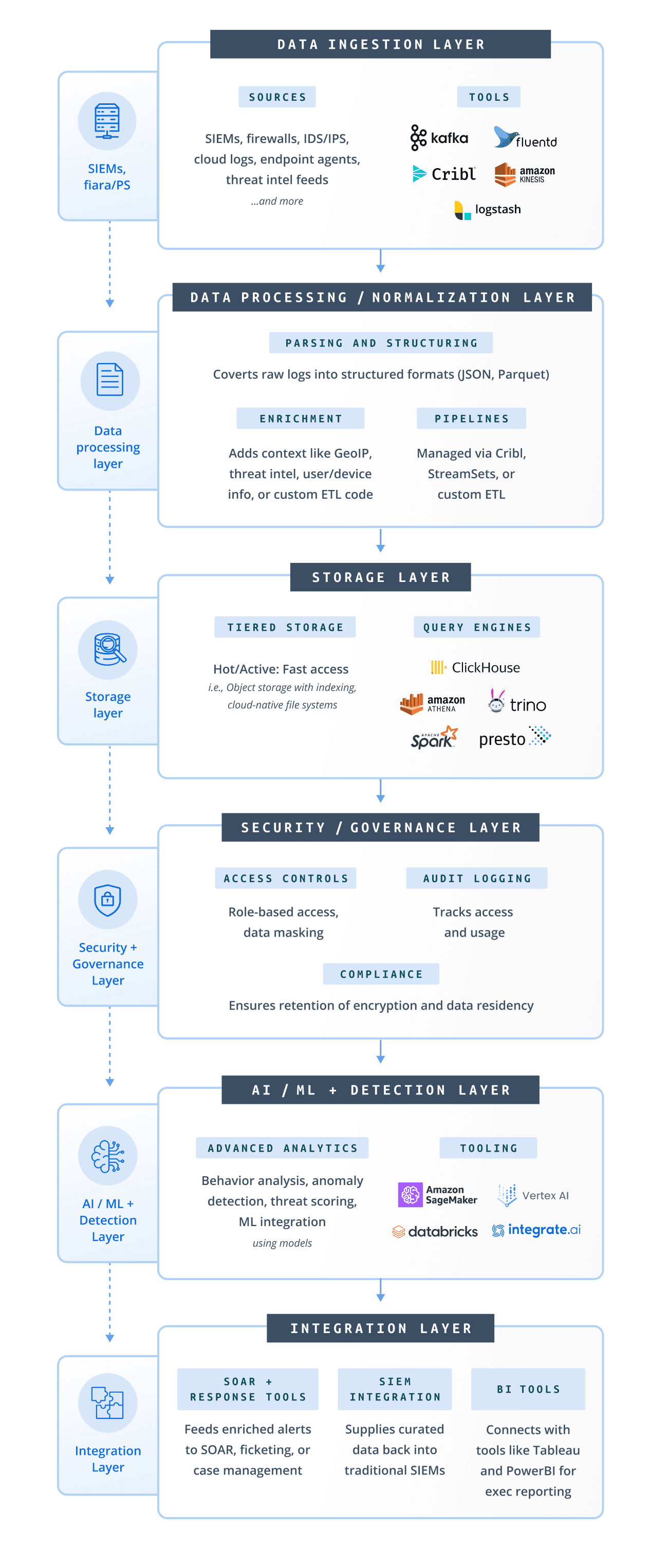
Security data lakes commonly hold cloud infrastructure logs, identity and access events, endpoint telemetry, SaaS audit logs, DNS and network flow data, application and container logs, threat intelligence feeds, and security alerts and case data. These datasets are often the information investigators wish they had months later.
The architectural shift matters because telemetry growth is outpacing the economics of legacy systems. Many organizations shorten retention or drop high-volume datasets entirely to keep SIEM licensing in check.
That creates blind spots.
A secure data lake makes long-term retention economically practical while preserving flexibility for investigations, compliance, AI, and analytics workloads.
Why are organizations moving toward security data lakes?
The biggest driver is scale.
Cloud-native infrastructure, Kubernetes, remote work, SaaS adoption, and AI applications generate much more machine data than traditional environments. You need broader visibility, but centralized indexing systems get expensive and operationally painful as volume climbs.
Security data lakes address several of those problems:
Data lakes also fit how security teams work now. Most run several tools side by side: a SIEM, detection platforms, threat hunting systems, AI analytics, and lakehouse engines. A centralized lake lets all of them operate against the same underlying dataset instead of their own partial copy.
Open standards make this possible. Frameworks like the Open Cybersecurity Schema Framework (OCSF) and Elastic Common Schema (ECS) improve interoperability between tools, simplify normalization, and reduce long-term migration risk.
Data lake vs. lakehouse: what should security teams know?
You will hear both terms, and while they are related, they are not identical.
A traditional data lake focuses on scalable storage for raw and semi-structured data using schema-on-read principles. A lakehouse builds on that foundation with ACID transactions, metadata management, performance optimization, structured analytics support, and stronger governance. Technologies like Delta Lake, Apache Iceberg, and Apache Hudi bring lakehouse functionality to plain object storage.
Most organizations adopt a hybrid. Raw telemetry lands in the lake, and curated subsets get optimized into lakehouse tables for analytics and AI workloads. For a deeper comparison, see data lake vs. data warehouse in the era of AI.
How do you build a security data lake?
The six steps below move from requirements to runtime controls. Follow them in order and you end up with a security data lake that scales, passes audits, and stays searchable.
Step 1: Define compliance and governance requirements early
The biggest mistake teams make is treating governance as a later-stage project.
Compliance requirements shape architecture decisions from day one: storage structure, retention policies, encryption strategy, identity model, and data processing pipelines. Before you build anything, identify which regulations apply, which data types count as sensitive, retention requirements by dataset, geographic residency rules, audit evidence expectations, access control requirements, and data deletion obligations.
Different frameworks impose different controls:
Retention strategy deserves special attention. Not every dataset needs the same lifecycle. Security alerts might need short hot retention and long cold retention, while compliance records may need immutable multi-year storage.
Define data ownership early too. Every major dataset should have a documented owner responsible for quality, governance, and access approvals. Nobody wants to discover the owner of a regulated dataset during an audit.
Step 2: Build a defense-in-depth data lake architecture
A secure data lake is not secured by one tool or one control.
It requires layered protection across storage, identity, networking, pipelines, compute, and monitoring. A strong architecture typically includes:
Encryption at rest and in transit
Federated identity and MFA
Role-based access control (RBAC)
Network segmentation
Immutable audit trails
Continuous monitoring
Automated policy enforcement
Data classification and lineage tracking
Encryption and key management
Encryption is foundational. Encrypt data at rest in object storage, in transit between systems, and during processing where applicable.
Cloud-native key management systems such as AWS KMS, Azure Key Vault, and Google Cloud KMS make this straightforward. Tenant-specific keys and automated rotation policies further reduce exposure in multi-team or multi-tenant environments.
Identity and access controls
Identity matters more in a data lake than almost anywhere else because many tools and users touch shared datasets. Strong controls include SSO integration, MFA enforcement, least-privilege RBAC, short-lived credentials, conditional access policies, and automated deprovisioning.
Granular authorization is also important. Governance systems such as AWS Lake Formation and Apache Ranger support row-level policies, column-level restrictions, attribute-based access controls, and dynamic masking. Once your datasets contain PII or PHI, these controls are required.
Step 3: Secure the ingestion pipeline first
The ingestion layer is one of the most important parts of a secure data lake architecture. It is also where you can cut both compliance risk and storage cost before data ever lands in long-term storage.
Good ingestion hygiene means filtering unnecessary telemetry, masking or tokenizing sensitive data, normalizing schemas, enriching metadata, compressing high-volume logs, and routing each dataset to the right storage tier.
Transform sensitive information before long-term retention. Replace usernames with unique IDs, hash IP addresses where appropriate, strip PII fields you do not need, and redact secrets and tokens. Doing this at ingestion time is far easier than remediating sensitive data later across petabytes of storage.
This is where a vendor-neutral pipeline is useful. Cribl Stream lets you filter, route, enrich, redact, and normalize telemetry before it reaches downstream systems. Cribl Guard adds policy-driven detection of sensitive data in the pipeline, so masking does not depend on hand-writing a regex for every PII variant. Instead of tightly coupling ingestion to one analytics platform, you control data flow independently of storage and compute decisions.
That flexibility is important in hybrid and multi-cloud environments.
Which ingestion patterns do security data lakes use?
Most security data lakes combine several collection methods:
Step 4: Implement strong data lake governance
Without governance, data lakes quickly turn into unusable data swamps.
Governance keeps datasets searchable, trustworthy, compliant, and understandable over time. Four capabilities do most of the work.
Data cataloging
A catalog provides centralized metadata about datasets, schemas, ownership, and lineage. Common options include Apache Atlas, AWS Glue Data Catalog, Amundsen, and DataHub. Cataloging improves discoverability and audit readiness.
Automated classification
Classification systems identify PII, PHI, financial records, regulated content, and secrets or credentials. Automation matters because manual classification does not scale past the first few terabytes.
Lineage tracking
Lineage tracks how data moves from ingestion through transformation and analytics. It lets security and compliance teams answer where data originated, who modified it, which systems accessed it, and which downstream tools consumed it.
Policy enforcement
Governance policies should automatically block prohibited data flows: PII entering non-compliant regions, sensitive datasets reaching unapproved teams, unencrypted exports, or public object storage exposure. Strong enforcement reduces operational risk and builds trust in the platform.
Step 5: Secure compute and analytics workloads
Data is vulnerable during processing, not just at rest.
Security teams often focus heavily on protecting storage buckets while overlooking compute-layer exposure. Isolate workloads by function, use temporary compute where possible, log all query activity, restrict outbound network access, enforce workload-level IAM, and monitor for abnormal query behavior.
Different workloads call for different environments:
Lakehouse technologies improve reliability here as well. ACID transaction support in Delta Lake or Apache Iceberg prevents corruption, inconsistent reads, and partial writes during concurrent processing. That matters for investigations and for the integrity of compliance evidence.
Step 6: Build centralized audit trails and continuous monitoring
Auditability is one of the most important characteristics of a compliant security data lake.
You should be able to answer who accessed which data, when, what changed, which policies changed, and which datasets moved locations. Comprehensive audit trails capture query logs, IAM changes, policy modifications, bucket access events, data movement, encryption key activity, and administrative actions.
Those audit logs need their own protection. Keep them immutable, centrally stored, access restricted, and retained separately from operational datasets.
Configuration drift detection
Misconfigured storage buckets remain one of the most common cloud security failures. Automated tools such as AWS Config, Azure Policy, and GCP Config Connector can alert on public exposure, disabled encryption, IAM policy drift, and key rotation failures before they become incidents.
Automated compliance evidence
Manual audit preparation consumes a large amount of time. Automated evidence pipelines continuously collect access reviews, encryption status, IAM assignments, policy snapshots, audit logs, and retention configurations. That turns audit season from a scramble into a report.
Which security data lake platform is best?
There is no universal best platform because requirements vary widely. Selection depends on your cloud strategy, compliance requirements, existing tooling, analytics needs, operational maturity, cost constraints, and multi-cloud footprint.
Most architectures combine several categories of technology:
Vendor-neutral architectures usually deliver the most long-term flexibility because storage, ingestion, and analytics layers can evolve independently. That is one reason more teams adopt decoupled telemetry pipelines instead of routing everything into a single analytics platform.
Cribl Search is one example of this approach. Instead of requiring full rehydration or centralized indexing, it queries data directly across cloud object storage and existing environments, so you can investigate distributed datasets without moving all your telemetry into one system first.
Best practices for building a security data lake
Here is the short version of everything above:
Define compliance and retention requirements before architecture design.
Use defense-in-depth security controls across all layers.
Encrypt all data at rest and in transit.
Implement least-privilege RBAC and MFA everywhere.
Mask or tokenize sensitive data during ingestion.
Standardize schemas using open frameworks like OCSF.
Automate governance, classification, and lineage tracking.
Separate storage and compute for scalability and flexibility.
Log every query, access event, and administrative action.
Continuously monitor for configuration drift and policy violations.
Use immutable audit logging for compliance evidence.
Prefer vendor-neutral architectures that reduce lock-in.
A secure data lake is not simply a storage destination. It is a long-term security data platform that must balance scalability, governance, flexibility, and operational simplicity.
Organizations that treat governance and pipeline design as foundational architectural components, rather than later optimizations, are more successful at scaling securely.
Your security data lake should answer to you, not your vendor
Every step in this guide points to the same principle, keep control of your telemetry. Cribl is built around that idea. Its vendor-agnostic platform gives IT and security teams the choice, control, and flexibility to collect, transform, route, store, and search telemetry across sources, tools, clouds, and SIEMs, with no lock-in and no data loss.
In practice, that means Cribl Stream sits in front of your lake as the ingestion control point, applying filtering and normalization to OCSF or other schemas, masking, and tiered routing before data lands. Cribl Edge extends processing to endpoints, servers, and Kubernetes clusters so hybrid and on-prem sources flow through the same governed pipelines. When you want a lake without the cloud plumbing, Cribl Lake provides tiered storage in open formats with unified retention, security, and access control policies, in Cribl-managed storage or your own buckets. Cribl Search gives analysts and AI agents one federated query surface across Cribl Lake, Amazon S3, Azure Blob, Google Cloud Storage, and your existing tools, so investigations run in place instead of waiting on rehydration.
Together, these products form a data engine for IT and security, a hub that reduces data volume issues and complexity, cuts costs, speeds SIEM migrations, and supports compliance without adding agents or disrupting existing systems. If your current lake project is delayed or you are building one from scratch, start with the pipeline and the governance model. The storage is the easy part.
Cribl.Cloud offers a free account. Lake and Search have sandboxes, and a custom demo is available.
Building a Security Data Lake FAQs
What is a secure data lake?
A secure data lake is a centralized repository for storing and analyzing large volumes of telemetry while enforcing encryption, access controls, governance, audit logging, and compliance policies.
How do compliance controls work in a data lake?
Compliance controls typically include encryption, RBAC, MFA, audit trails, retention policies, data classification, lineage tracking, and automated governance enforcement.
What are the benefits of a security data lake?
Security data lakes improve retention economics, reduce vendor lock-in, support multiple analytics tools, enable long-term investigations, and centralize governance across large telemetry environments.
What is the difference between RBAC and attribute-based access controls?
RBAC assigns permissions based on roles, while attribute-based access control uses dynamic policies tied to user, dataset, or environmental attributes.
Why are open schemas important in security data lakes?
Open schemas such as OCSF improve interoperability between tools, simplify normalization, and reduce long-term migration complexity.
Should organizations use cloud, on-premises, or hybrid data lakes?
Cloud deployments provide scalability and operational simplicity. On-premises deployments may support stricter sovereignty requirements. Hybrid architectures are common for organizations balancing both flexibility and regulatory obligations.