
Healthcare organizations are under constant pressure to do more with their data. Clinical teams need fast access to relevant information. IT teams need to connect aging systems with modern platforms. Security and compliance teams need to reduce risk without slowing everything down. At the same time, executives want better analytics, stronger operational visibility, and a clearer path to AI.
That combination is exactly why smarter data pipelines matter, and why Cribl products are such a strong fit for modern healthcare environments.
A modern data pipeline is not just a transport layer that moves information from one system to another. It should help organizations decide what data to collect, where it should go, how quickly it needs to get there, and what should happen to it along the way. In other words, the pipeline itself needs to become more intelligent.
Cribl helps make that possible by giving healthcare teams more control over telemetry before it becomes expensive, noisy, or operationally difficult to manage. With Cribl Stream, Cribl Guard, Cribl Edge, Cribl Lake, and Cribl Search, organizations can collect data closer to the source, shape it in motion, route it to the right destinations, store it more cost effectively, and access it when they need it.
What makes a healthcare data pipeline smart
A smarter pipeline is context-aware, policy-driven, and adaptable. It does more than move data. It helps improve the quality, usefulness, and control of that data in motion.
In practice, that often means the pipeline can:
Filter out unnecessary or duplicate data before it reaches expensive downstream systems
Route different types of data to different destinations based on need, priority, or sensitivity
Mask or transform sensitive fields to support privacy requirements
Normalize data formats so downstream teams can work efficiently
Monitor its own behavior and surface issues early
Scale across cloud, on-prem, and hybrid environments without requiring separate architectures for each
That is the exact type of flexibility Cribl Stream is built to provide. Stream can ingest data from many different healthcare-adjacent systems, transform and enrich it in flight, reduce excess volume, and send it to multiple destinations at the same time. For healthcare IT and security teams, that means fewer proprietary pipelines, less duplicated effort, and more control over what reaches SIEMs, observability platforms, data lakes, and long-term storage.
Cribl Edge extends that value even closer to where data is created. In distributed healthcare environments with remote clinics, regional facilities, medical devices, or endpoint-heavy operations, Edge can help collect and process data at or near the source before forwarding it upstream. That reduces unnecessary traffic, improves local control, and helps teams standardize collection across complex environments.
Better interoperability starts with better data movement
Healthcare has no shortage of systems. EHRs, imaging platforms, lab systems, identity services, patient engagement tools, billing platforms, and connected devices all generate valuable data. The challenge is not simply collecting it. The challenge is making it usable across the broader environment.
Smarter pipelines improve interoperability by reducing the friction between systems. They can ingest data from different sources, reshape it when needed, and route it to the teams and tools that depend on it. That helps healthcare organizations avoid the common trap of creating more silos while trying to break down old ones.
Cribl is particularly strong here because it does not require teams to standardize on a single downstream platform just to gain control. Healthcare organizations can use Cribl to receive data in one format, normalize or transform it, and then deliver it in the format and destination each team needs. That flexibility matters when security, infrastructure, operations, and analytics teams all rely on the same raw telemetry for different reasons.
Supporting clinical and operational teams without overwhelming them
One of the biggest problems in healthcare operations is noise. Teams often receive too many alerts, too much telemetry, and too little clarity on what actually matters. A smarter data pipeline can help address that before the noise ever reaches downstream platforms.
For example, organizations can reduce unnecessary event volume, enrich key records with useful context, and route only actionable data to incident response or operations teams. That leads to faster triage, lower alert fatigue, and better use of staff time.
This is one of the most practical benefits of Cribl Stream in healthcare. Rather than paying to ingest everything at full fidelity into expensive platforms, teams can remove blank fields, strip low-value events, apply routing logic, and preserve the data that truly matters. That creates better downstream performance and helps healthcare organizations control costs without sacrificing visibility.
Cribl Search also plays an important role here. Teams do not always need every dataset fully loaded into an expensive platform at all times. Search gives them a way to access and investigate telemetry when needed, which is especially useful in environments where data volumes are high but immediate access still matters. That supports faster investigations without forcing a keep-everything-hot model.
Building for compliance and security from the start
Healthcare data strategy cannot be separated from security and compliance. Sensitive information moves through every layer of the environment, and every handoff introduces potential risk.
That is why smarter pipelines should enforce governance as data moves, not just after it lands somewhere else.
Organizations benefit when pipelines can:
Apply field-level masking or redaction
Limit where regulated data is forwarded
Preserve auditability across routes and transformations
Standardize policy enforcement across teams and environments
This is another area where Cribl products fit naturally. Cribl Stream can mask sensitive fields before data is forwarded downstream, helping teams reduce exposure and support privacy requirements earlier in the pipeline. That is especially relevant in healthcare settings where protected information may appear in logs, application events, or platform telemetry.
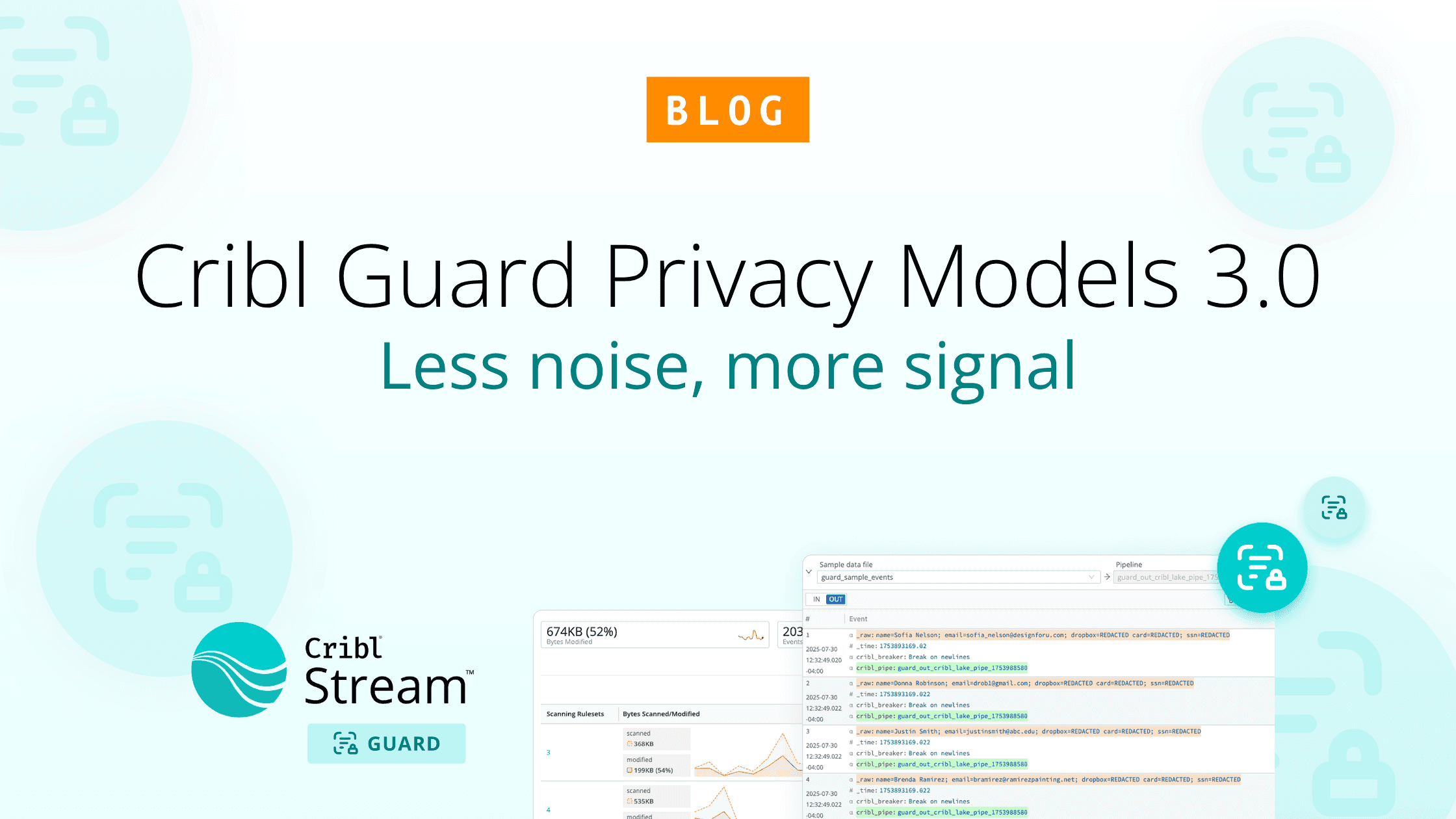
Cribl Guard strengthens that story even further. Due to Guard operating directly within Cribl Stream, it can scan telemetry in real time, detect sensitive data, and help teams mask, redact, block, or reroute it before it reaches downstream systems. For healthcare organizations, that is especially meaningful for HIPAA-aligned workflows, where protecting PHI and reducing unnecessary exposure are critical. Instead of discovering sensitive data after it has already landed in multiple tools, teams can identify and remediate it while it is still in motion.
That gives healthcare teams a more proactive way to support HIPAA requirements around safeguarding sensitive data, limiting where PHI flows, and maintaining better auditability around how it is handled. Instead of duplicating sensitive data everywhere and trying to govern it later, healthcare teams can use Cribl to apply controls upstream. That reduces risk while still preserving the operational value of the underlying data.
Preparing healthcare data for analytics and AI
Healthcare leaders are investing heavily in analytics and AI, but those initiatives are only as strong as the data behind them. If source data is incomplete, delayed, duplicated, or inconsistent, downstream models and dashboards will mirror those weaknesses.
A smarter pipeline helps create a stronger foundation by improving data quality before it reaches analytics platforms, data lakes, or AI workflows. It can reduce clutter, standardize structure, and ensure the most relevant data arrives in a usable form.
Cribl Lake supports that strategy by giving organizations a more cost-effective place to retain large volumes of telemetry without locking themselves into a single expensive workflow. Paired with Stream, teams can decide what should go to premium analytics tools immediately, what should be archived in lower-cost storage, and what should remain accessible for later investigations or reporting.
That does not just improve technical outcomes. It improves trust. And trust is essential when data is being used to inform operational decisions, patient experience initiatives, security investigations, or future AI-assisted workflows.
In conclusion
Modern healthcare does not need more raw data. It needs better control over how data is collected, shaped, protected, and delivered.
That is the real value of smarter data pipelines, and it is where Cribl products can have an outsized impact.
Cribl Stream helps healthcare teams route, reduce, enrich, and transform telemetry in motion. Cribl Guard uses advanced AI to protect sensitive data. Cribl Edge helps extend that control closer to endpoints and distributed environments. Cribl Lake helps retain data more cost effectively. Cribl Search helps teams navigate that data when they need answers fast.
Together, those capabilities help healthcare organizations reduce noise, improve interoperability, support compliance, and prepare for analytics and AI without adding unnecessary complexity. More importantly, they help technical teams spend less time managing data chaos and more time enabling outcomes the business actually cares about.
In healthcare, better data flow is not just an infrastructure improvement. With the right control plane in place, it becomes a foundation for faster decisions, more resilient operations, and increased efficiency across the organization.