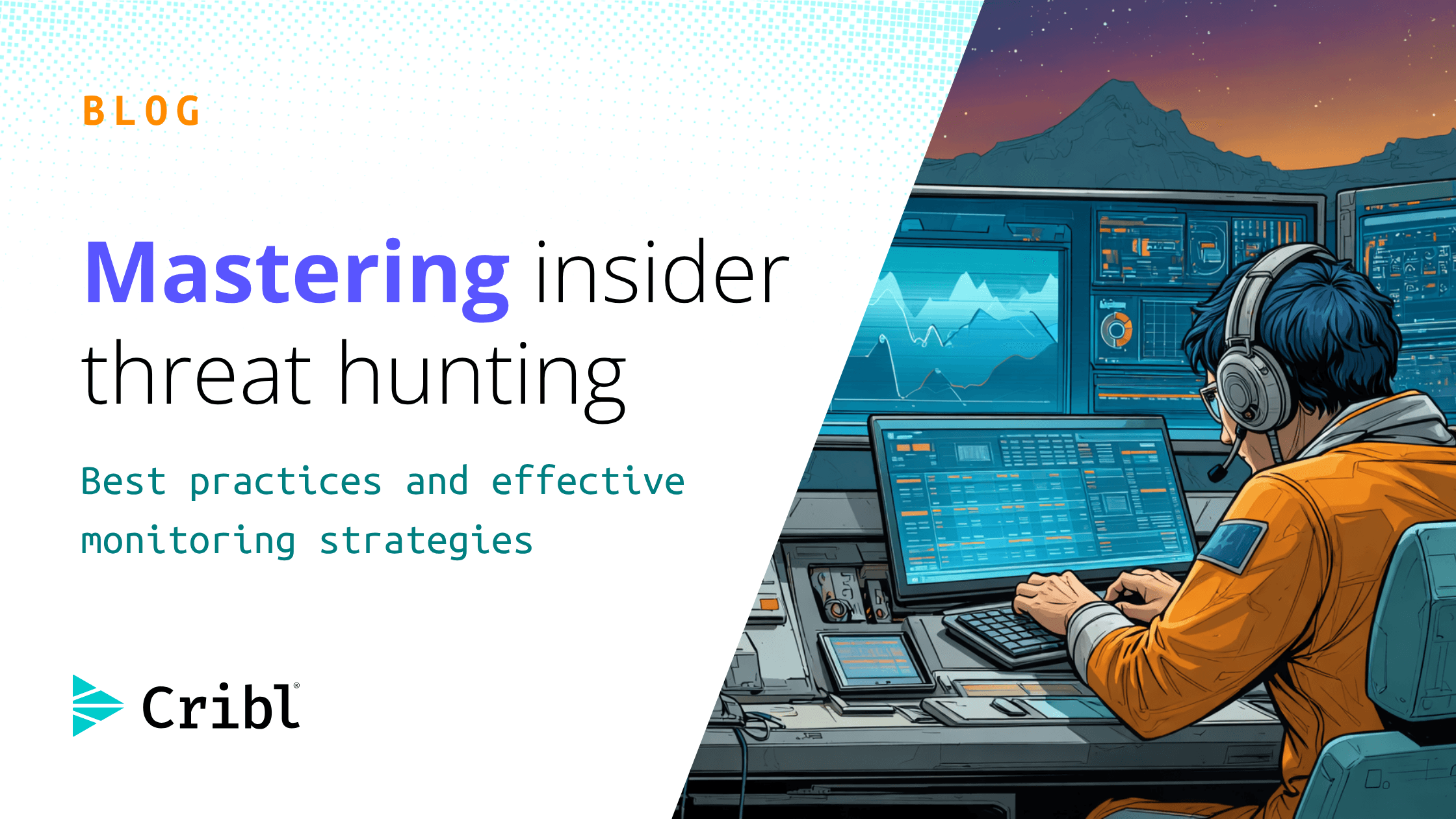

What is insider threat hunting?
Insider threat hunting is the proactive process of identifying suspicious or malicious activity originating from within your organization, whether intentional (data exfiltration) or unintentional (accidental data exposure).
Unlike reactive alerting, insider threat hunting explores patterns across user behavior, investigates anomalies before they trigger alerts, and correlates activity across systems for full context. You are not waiting for a problem, you assume one might exist and set out to prove or disprove it.
Why is insider threat detection so challenging?
Insider threat detection is uniquely difficult for four reasons: legitimate access masks malicious intent, data is fragmented across SaaS, cloud, and on-prem systems, high data volume creates noise that slows investigations, and siloed tools limit visibility.
To be effective, you need a unified way to collect, shape, and analyze telemetry across every environment without letting costs explode.
How do you conduct insider threat hunting effectively?
Follow these seven steps to build a repeatable, scalable insider threat hunting practice.
1. Define high-risk use cases
Start by identifying the behaviors that matter most to your organization. Focus on specific, testable hypotheses, such as: "Are employees accessing sensitive data outside business hours and transferring it externally?"
The highest-priority use cases typically include:
Data exfiltration, such as large downloads or transfers to unusual destinations
Privilege abuse or escalation
Access to sensitive systems outside normal patterns
Suspicious login behavior, including geo anomalies and off-hours access
2. Centralize and normalize your data
Insider threat detection relies on stitching together signals from multiple sources: identity providers like Okta and Azure AD, endpoint telemetry, SaaS applications like Google Workspace and Salesforce, network and proxy logs, and cloud infrastructure logs.
The challenge is not just collecting this data, it is making it usable. Normalize and route telemetry into a unified data layer where it can be queried consistently. That reduces friction during investigations and eliminates tool-hopping.
3. Reduce noise before you hunt
Data overload is one of the biggest barriers to effective monitoring. Instead of ingesting everything at full fidelity into expensive systems, filter irrelevant logs early, route high-value data to analytics platforms, and archive low-priority data in affordable storage.
A data pipeline approach helps: shape data before it lands and you cut storage and SIEM costs, improve query performance, and focus only on meaningful signals.
4. Apply behavioral analytics
Static rules alone will not catch insider threats. You need context. Behavioral analytics identifies deviations from baseline user activity, unusual access patterns, and changes in data movement.
Consider these real-world examples:
A developer accessing HR systems outside their normal scope
A finance employee downloading unusually large datasets
A user logging in from multiple geographies within hours
The goal is to move from event-based detection to behavior-based detection. Know what normal looks like, and the abnormal starts to stand out.
5. Run federated investigations across data sources
When you spot a potential threat, speed matters. Instead of pivoting between tools, your analysts should query multiple datasets from a single interface, correlate identity, endpoint, and application data in one workflow, and reconstruct the full story of what happened.
Federated search lets your team investigate without moving all data into one system, access historical and real-time data, and shrink investigation time from hours to minutes.
6. Collaborate and document findings
Insider threat investigations are rarely solo efforts. Your team should share queries and findings, build reusable investigation workflows, and document conclusions for compliance and reporting. Collaborative notebooks or shared workspaces standardize investigations and improve team efficiency over time.
7. Continuously refine detection strategies
Insider threat hunting is an iterative practice, not a one-time project. Refine hypotheses based on findings, tune detection logic to reduce false positives, and incorporate new data sources as your environment evolves.
What capabilities do insider threat monitoring tools need?
Evaluate tools against the capabilities that actually move the needle.
How Cribl can help with insider threat hunting
Cribl, the AI Platform for Telemetry, gives your team the choice, control, and flexibility to modernize insider threat detection without lock-in, data loss, or compromises. Cribl is a vendor-agnostic hub between your sources and your tools, so identity, endpoint, SaaS, and cloud telemetry all flow through one place where you decide what to keep, how to shape it, and where to send it.
With Cribl Stream, you filter, enrich, and route only high-value data to downstream systems, cutting SIEM and storage costs while preserving full-fidelity copies for hunts and compliance. Cribl Lake retains months or years of telemetry in cost-effective, open-format storage, so retrospective insider threat hunts are never limited by a license cap.
When it is time to investigate, Cribl Search gives analysts one federated interface to query data wherever it lives, correlating identity, endpoint, and application activity without re-ingesting or rehydrating data first. Notebooks capture queries, findings, and analyst notes in shareable, repeatable workflows, so teams standardize investigations rather than rely on one person's ad hoc work.
This reduces data friction and lowers operational overhead, letting teams hunt more effectively. To evaluate, schedule a demo or try a hands-on sandbox.