
Threat detection and response (TDR) is a cybersecurity process that identifies, analyzes, and responds to potential security threats in real time. It combines technology, processes, and people so that a suspicious signal becomes a confirmed finding, and a confirmed finding becomes a contained incident, as quickly as possible.
What is threat detection?
Threat detection is the process of identifying potential security threats by monitoring and analyzing security data collected from across your organization. That means spotting patterns and anomalies that could indicate an attack or breach. Threats can come from external attackers or internal actors, and they range from accidental misconfigurations to targeted campaigns.
What is threat response?
Threat response is the set of actions you take to mitigate, contain, and remediate a confirmed threat. Typical moves include isolating affected systems, revoking credentials, applying patches, running forensic analysis, and restoring normal operations. Good response also documents what happened so it is less likely to happen again.
What are the common types of threat detection?
Most TDR programs blend three detection approaches:
Signature-based detection matches activity against known indicators of malicious behavior, such as file hashes, IP addresses, or attack patterns. It is fast and precise for known threats, but blind to anything new.
Behavior-based detection builds baselines of normal user and system behavior, then flags deviations. It catches novel attacks and compromised accounts that signatures miss.
Threat hunting is the proactive, hypothesis-driven search for attackers who have already slipped past automated controls. Hunters look for traces of present and past intrusions across historical data.
How does threat detection and response work?
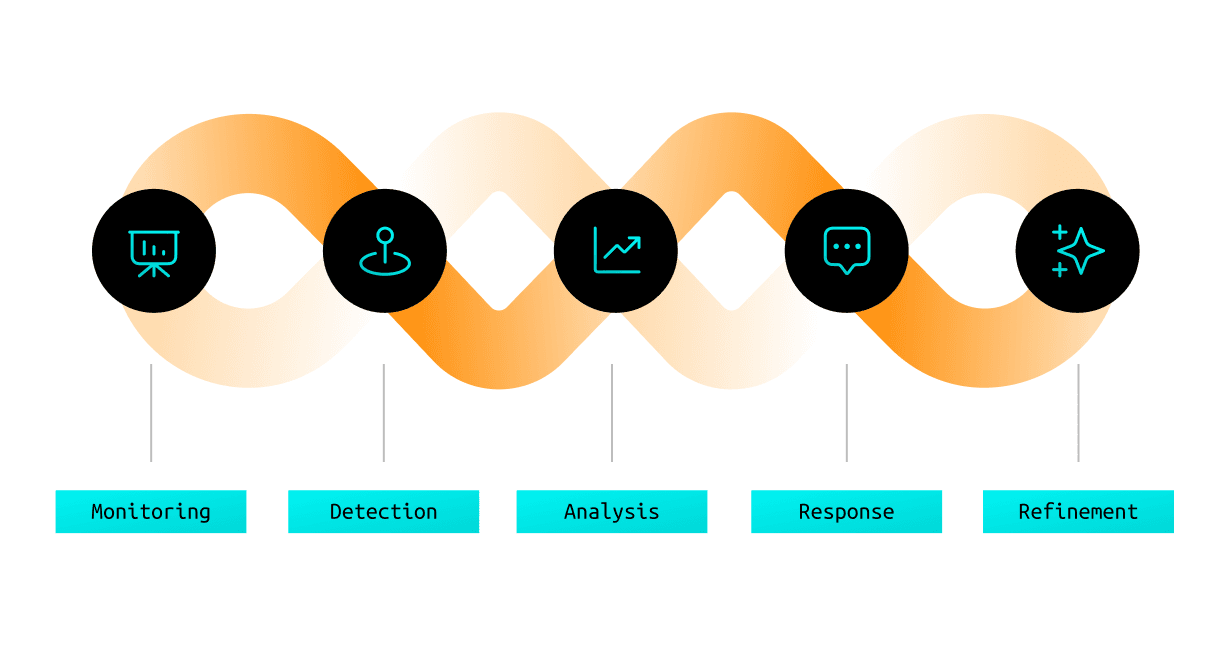
TDR works by continuously monitoring network traffic, system behavior, and user activity, then applying rules, machine learning, and AI to detect anomalies and known attack patterns. When something trips a detection, automated and manual responses act to contain the threat. Forensic analysis follows, and the findings improve future defenses.
The cycle runs in five phases:
Monitoring. Systems collect and analyze telemetry from network traffic, endpoints, cloud services, identity providers, and applications around the clock.
Detection. Rules, signatures, and behavioral models surface potential threats, from known malware to suspicious login patterns.
Analysis. Analysts or automated systems investigate each detection to determine severity, scope, and potential impact. This is where good context separates real threats from noise.
Response. The team blocks malicious activity, isolates affected systems, revokes access, and kicks off incident response procedures.
Refinement. Lessons from each incident tighten detection rules, update playbooks, and close telemetry gaps so the next one is caught faster.
What are the key components of threat detection and response?
TDR is not a single product. It is a set of interconnected capabilities that share data and coordinate action. Here are the pieces most security teams rely on.
Security information and event management (SIEM)
SIEM platforms collect and correlate log and event data from across your environment to detect security incidents. They provide real-time alerting, historical analysis, and compliance reporting. They are also where most security budgets go, which matters later in this article.
Endpoint detection and response (EDR)
EDR tools continuously monitor endpoints such as laptops, servers, and workstations for malicious activity. They give you deep visibility into process execution, file changes, and network connections, and they enable rapid isolation of compromised hosts.
Extended detection and response (XDR)
XDR extends EDR by centralizing and correlating telemetry across endpoints, network, cloud, email, and identity. The goal is unified visibility and automated analysis that improves detection accuracy and reduces friction in response.
Identity threat detection and response (ITDR)
ITDR focuses on protecting user and service identities. It detects behaviors that signal compromised credentials, privilege abuse, or lateral movement through identity systems, then responds to block unauthorized access.
Threat intelligence
Threat intelligence feeds supply current information about attacker infrastructure, tactics, and emerging campaigns. Enriching your telemetry with threat intel at ingest time turns a raw IP address into a known command-and-control server, which is the kind of context analysts need.
Vulnerability management
Vulnerability management is the ongoing practice of finding, prioritizing, and fixing weaknesses in systems and applications. Regular scanning and patching shrink the attack surface and remove the easy entry points attackers look for first.
Security orchestration, automation, and response (SOAR)
SOAR platforms connect your security tools and automate repetitive response tasks. Playbooks can enrich alerts, isolate endpoints, open tickets, and pull additional data without waiting for a human, which shortens response time and reduces analyst fatigue.
Managed detection and response (MDR)
MDR services provide outsourced monitoring, detection, and response, often supplementing an internal security team that cannot staff 24/7 coverage on its own.
What are the benefits of threat detection and response?
Early detection of sophisticated threats. A mature TDR program identifies advanced persistent threats (APTs) and multi-stage attacks that evade traditional perimeter defenses, catching them before they reach their objective.
Reduced damage and faster recovery. Proactive threat management limits the blast radius of an attack. Containing a compromised account in minutes instead of days is the difference between a routine ticket and a breach disclosure.
Unified visibility across your environment. Centralized monitoring across endpoints, cloud, identity, and network gives analysts a single picture of what is happening, which speeds decision-making and resource allocation.
A proactive posture. Threat hunting and continuous refinement let your team look for indicators of compromise before an alert fires. Over time, that shifts your SOC from reacting to incidents toward preventing them.
What does threat detection and response look like in practice?
Effective TDR often depends on how fast you can get to the evidence. One large Cribl customer detected an indicator of compromise (IOC) and needed to trace it back through archived data. Their existing system required pulling two weeks of logs, roughly 26 TB, with a 24-hour retrieval window in the vendor SLA. That meant a full day while an attacker could move through the environment.
The team used Cribl Search instead. Using federated search, they queried archived data across multiple regions without rehydrating any of it, narrowed the relevant window from two weeks to three days, and retrieved just 1.2 million targeted events. Total time: under 90 minutes, on a Friday night. The investigation resumed the same evening, and the team acted before the threat escalated.
Response time is capped by data access time, and most SOCs have never measured that cap.
Your response time is a data problem before it is a tooling problem
Detection logic rarely fails because the rules are wrong. It fails because the data behind the rules is incomplete, delayed, or too expensive to keep long enough to matter. A SOC that rations telemetry to control SIEM spend is betting that the gaps it creates will never be the gaps an attacker walks through. That bet does not always pay off.
Cribl's products treat telemetry as something to shape, route, and store on your terms rather than a vendor's. Cribl Stream, Cribl Edge, Cribl Lake, and Cribl Search give security teams the choice, control, and flexibility to keep full-fidelity data without paying full-fidelity SIEM prices for all of it. This is the difference between an investigation that takes 90 minutes and one that takes 24 hours while an attacker keeps moving.
If your team has ever rationed what gets collected, shortened a retention window to hit a budget number, or waited on a rehydration ticket during an active incident, that is the signal worth paying attention to. The fix is not another detection rule. It is a telemetry architecture that treats data access speed as a security metric in its own right, which is the problem Cribl was built to solve.
What challenges hold threat detection and response back, and how does Cribl solve them?
Identifying, investigating, and responding to threats is the core job of security operations. Yet most teams face the same structural problems: too much data, too many formats, too little budget, and too slow a path to historical telemetry. According to the SANS 2025 SOC Survey, 42% of SOCs send all incoming data to a SIEM without a retrieval or management plan, which drives up both noise and cost. Here are common failure points and how Cribl's data engine addresses them.
Data overload and alert fatigue
Security teams drown in a daily flood of events and false positives. Siloed sources and raw event volumes make it hard to prioritize genuine threats, and critical alerts get missed or delayed.
Cribl Stream filters, routes, and enriches telemetry before it reaches your SIEM or analytics tools. You can drop health checks, dedupe duplicates, and send only high-fidelity events downstream. Analysts see fewer, better alerts, and your SIEM bill stops growing faster than your business.
Lack of data normalization and enrichment
Inconsistent log formats and incomplete events slow investigations and break automated detections. When every source uses a different schema, correlation across tools becomes manual work.
Stream normalizes and enriches telemetry in flight, converting formats, adding GeoIP and threat intel context, and mapping events to common schemas like OCSF, CIM, or UDM. Downstream tools receive analytics-ready data, and detections stop failing when a vendor changes a field name.
High costs and inflexibility of security analytics tools
Traditional SIEMs charge by ingest and push you to keep everything in a proprietary format. Teams respond by rationing data, which creates blind spots where attackers operate. Vendor lock-in makes it painful to change course.
Cribl's vendor-agnostic architecture lets you route different data to different destinations based on value. Real-time detection data goes to the SIEM. Full-fidelity copies land in Cribl Lake or your own object storage in open formats. You keep more data for longer, pay less for it, and retain the freedom to add or swap analytics platforms without re-collecting a single event.
Delays in incident response due to slow access to historical data
Investigating advanced threats often requires months or years of telemetry. With legacy tools, retrieving cold storage data means a ticket, a wait, and a rehydration bill.
Cribl Search queries data directly where it lives, whether that's Cribl Lake, Amazon S3, Azure Blob, Google Cloud Storage, or your SIEM, with no rehydration or duplication. This federated search turns archived telemetry into a live investigation resource. When you need to bring a subset back into a tool, Stream's Replay pulls exactly the slice you want from object storage and nothing more.
Gaps in visibility from distributed and dynamic environments
Hybrid and cloud-native infrastructure generates telemetry from thousands of sources in different formats and locations. Getting a unified, compliant view is hard.
Cribl Edge collects and processes telemetry at the source on endpoints, servers, and Kubernetes nodes, while Cribl Stream centralizes routing and policy. Together they give end-to-end visibility across cloud, on-premises, and edge environments, with masking and redaction applied in the pipeline before sensitive data reaches a downstream tool.
Threat Detection & Response FAQs
What is Threat Detection & Response?
TDR stands for Threat Detection and Response. It’s a cybersecurity approach that continuously monitors your systems for suspicious activity. In real-time, TDR can identify, analyze, and respond to security threats, minimizing potential damage and mitigating risks.
What are the stages or processes of the threat detection and response process?
The threat detection and response process typically includes several stages, often defined as a cycle to ensure continuous improvement and robust security posture.
Preparation. Develop policies, procedures, and tools. Train staff on cyber threat detection & incident response. Set a baseline for anomaly detection.
Detection. Utilize diverse methods like signature-based, anomaly-based, heuristic, and behavioral analysis for threat detection. Continuously monitor network traffic, logs, and user activity with tools such as IDS, SIEM, and security solutions.
Analysis. Prioritize threats based on severity and impact. Conduct detailed analysis to confirm and understand threats.
Containment. Implement short-term measures to contain the threat and follow up with long-term strategies for full control.
Eradication. Identify and eliminate the root cause of the threat. Remove malicious files, patch vulnerabilities, and update systems as needed.
Recovery. Restore systems to normal, monitor for threats, and validate remediation effectiveness.
Post-Incident Activities. Conduct post-mortem analysis to review the incident response process, document actions taken, and update policies/tools for improvement.
What’s the difference between threat detection and incident response?
The primary difference lies in their respective purposes and processes. Threat detection identifies potential security threats or vulnerabilities in a system or network by monitoring network traffic, logs, and user behavior to detect anomalies or signs of malicious activity. While on the other hand incident response addresses and manages the aftermath of a detected security breach or cyber attack to limit damage, reduce recovery time, and minimize costs. This includes containing the threat, eradicating the cause, recovering from the effects, and implementing measures to prevent future incidents.