
The foundation problem
Here is a scenario that plays out in SOCs every single day: An incident wraps. The timeline gets reconstructed. And someone in the room asks the question nobody wants to answer:
Why did it take us eight months to find this?
The signals were there. The attacker moved through the environment and left breadcrumbs across three different systems that nobody was correlating in real time. The SIEM had some of it. The EDR had more. A cloud logging bucket had the rest, untouched, because nobody had built a query against it. By the time anyone assembled the full picture, the dwell time was already a liability.
That is not an analyst failure. That is not a tool failure. That is an architectural failure.
And it has a direct consequence beyond that single incident: every AI investment in that SOC is already broken before it starts. Agentic triage, automated investigation, ML-based detection none of it works on fragmented, stale, unnormalized data. AI does not fail in the SOC because the models are not good enough. It fails because it cannot see. And visibility is an architecture problem, not a model problem.
The SOC performance problem and the AI readiness problem are one and the same. Fragmented telemetry, inconsistent schemas, short retention windows, brittle pipelines built to survive the budget cycle rather than support investigation at scale. You can optimize every tool in your stack and never close the gap if the foundation underneath is broken.
This guide is about fixing that foundation, and building a SOC that is not just faster and more cost-effective today, but genuinely ready for the AI-driven operations era ahead.

An architecture failure isn't one bad incident: it's every AI investment in your SOC broken before it starts.
Why high-performance SOCs are rare
Talk to enough security leaders and a pattern emerges fast. The symptoms vary by organization, but the underlying complaint is strikingly consistent: we have more security tools than ever, more data than ever, more detections than ever, and we still cannot answer basic questions about our environment fast enough when something actually happens.
That tension caused by more investment resulting in slower outcomes is not a vendor problem. It is an architecture problem. And it is one the industry has been slow to name directly. Three numbers tell the story more precisely than any anecdote:
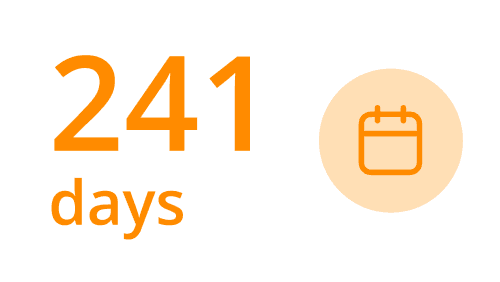
Average time to identify and contain a data breach. Nearly eight months in an era of ML-based detection, AI-assisted triage, and behavioral analytics deployed across most enterprise security stacks.
Source: IBM Cost of a Data Breach Report, 2025
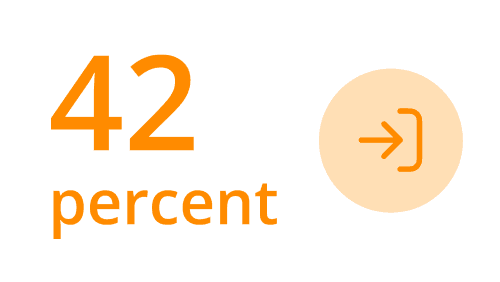
of SOCs dump all incoming data into a SIEM without a coherent retrieval or management plan. Paying full ingestion cost. Getting incomplete coverage. And generating the noise that makes AI models unreliable.
Source: SANS SOC Survey, 2025
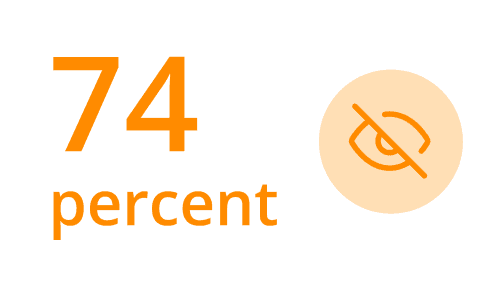
of threat hunters say investigations are hampered by lack of access to historical data. 3 in 4 hunters work with incomplete history, not because the logs don't exist, but because the architecture makes them unreachable at investigation time.
Source: IBM Cost of a Data Breach Report, 2025
Read those three numbers together and the picture is unmistakable: the SOC performance problem is a data architecture problem. Not a detection logic problem. Not a staffing problem. Not a vendor selection problem. The data is not in the right place, in the right shape, at the right time and every downstream capability, from detection to hunting to AI-assisted investigation, suffers for it.
The inertia problem
Legacy SIEM architectures were engineered for a different era. When the major platforms were designed, the threat landscape was simpler, data volumes were manageable, the cloud was not a primary attack surface, and AI was a research topic. The economics made sense: ingest what matters into a centralized store, run correlation rules against it, generate alerts. That model worked at the scale and pace of security operations ten years ago. It does not work at the scale and pace of today.
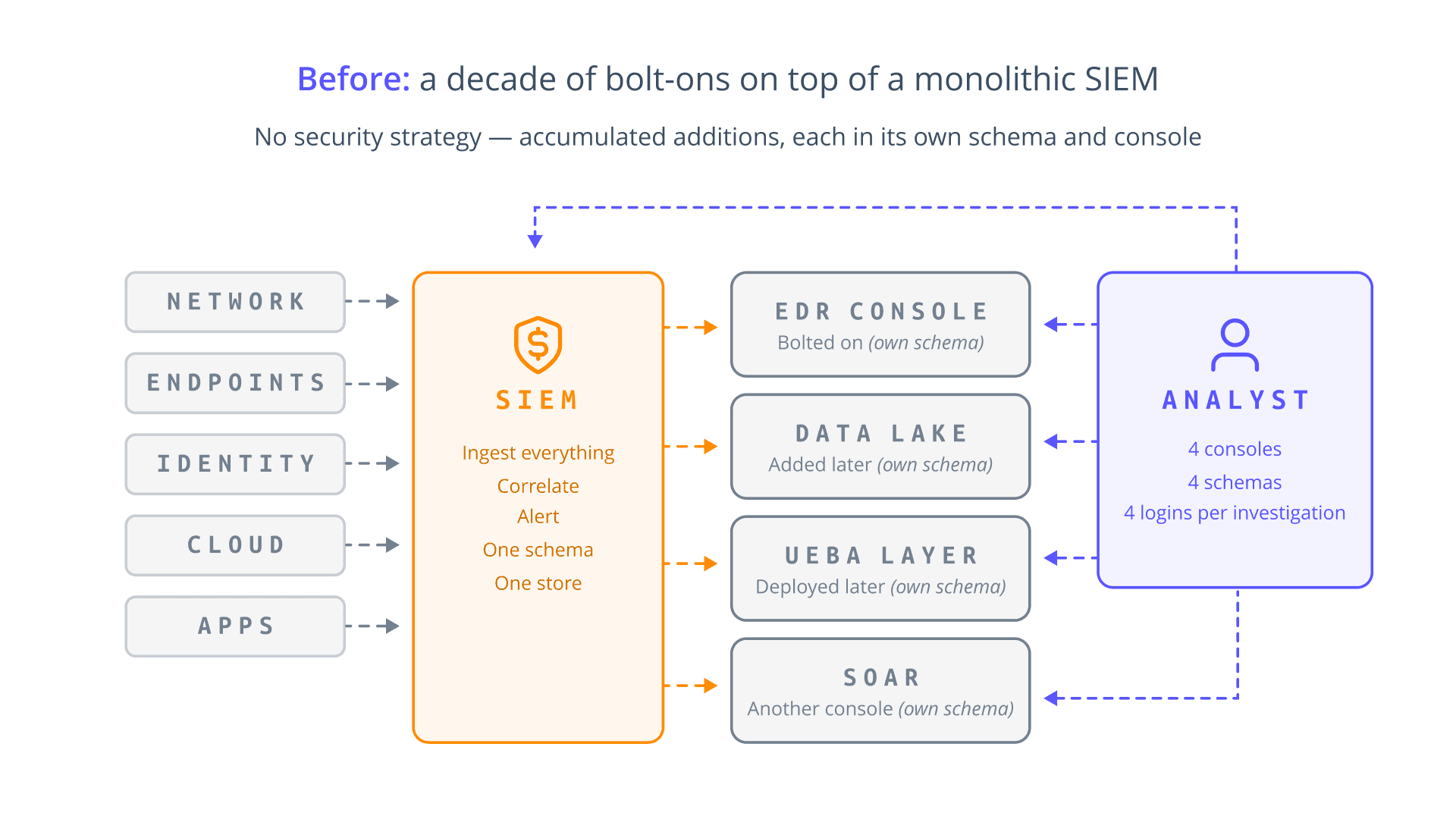
Every patch applied to that architecture since then, such as adding a data lake here, bolting on an EDR console there, deploying a UEBA layer somewhere else, increased the surface area of the fragmentation without fixing the underlying incoherence. Most enterprise SOCs today do not have a security data strategy. They have a collection of independent logging decisions that accumulated over a decade, governed by different teams, in different schemas, with different retention policies, searched through different interfaces.
When an incident happens, analysts do not investigate. They excavate.
The AI trap
This is the part that stings most right now, because every major vendor is selling an AI story and many security leaders have bought in. The promise is real: AI-driven triage, autonomous investigation, intelligent detection at machine speed. But the promise breaks down quickly within the reality of most enterprise telemetry environments.
An AI that cannot see stale data, cannot correlate across fragmented sources, cannot normalize across schema chaos that AI does not underperform quietly. It confidently produces wrong answers. It flags the wrong things. It misses the right ones. And in multi-agent pipelines, where one agent's output becomes the next agent's input, those errors cascade faster than any human team can catch them.
Fixing the AI problem and fixing the SOC performance problem require the same architectural move: a vendor-neutral telemetry control plane that gives every downstream system, human or AI, a consistent, complete, governed view of what is happening across the environment.
Why this has not been fixed
High-performance SOCs are rare because fixing this requires confronting an uncomfortable truth: the investment needed is not in the next tool on the evaluation list. It is in the layer underneath all the tools, the telemetry plane that determines what every downstream capability can actually see, query, and act upon. Organizations that have made this architectural shift have not just reduced costs. They have accelerated detection, extended retention, enabled AI that actually delivers, and given their analysts back the time spent on pipeline plumbing, parsing, and routing. The sections that follow explain how to fix it, layer by layer.

The SOC performance gap is not a tool gap or a talent gap. It is a data architecture gap. Every AI initiative, every detection program, every hunting workflow sits on top of the telemetry layer and if that layer is fragmented, incomplete, or ungoverned, everything built on top of it underperforms.
Five layers to AI-ready SOC
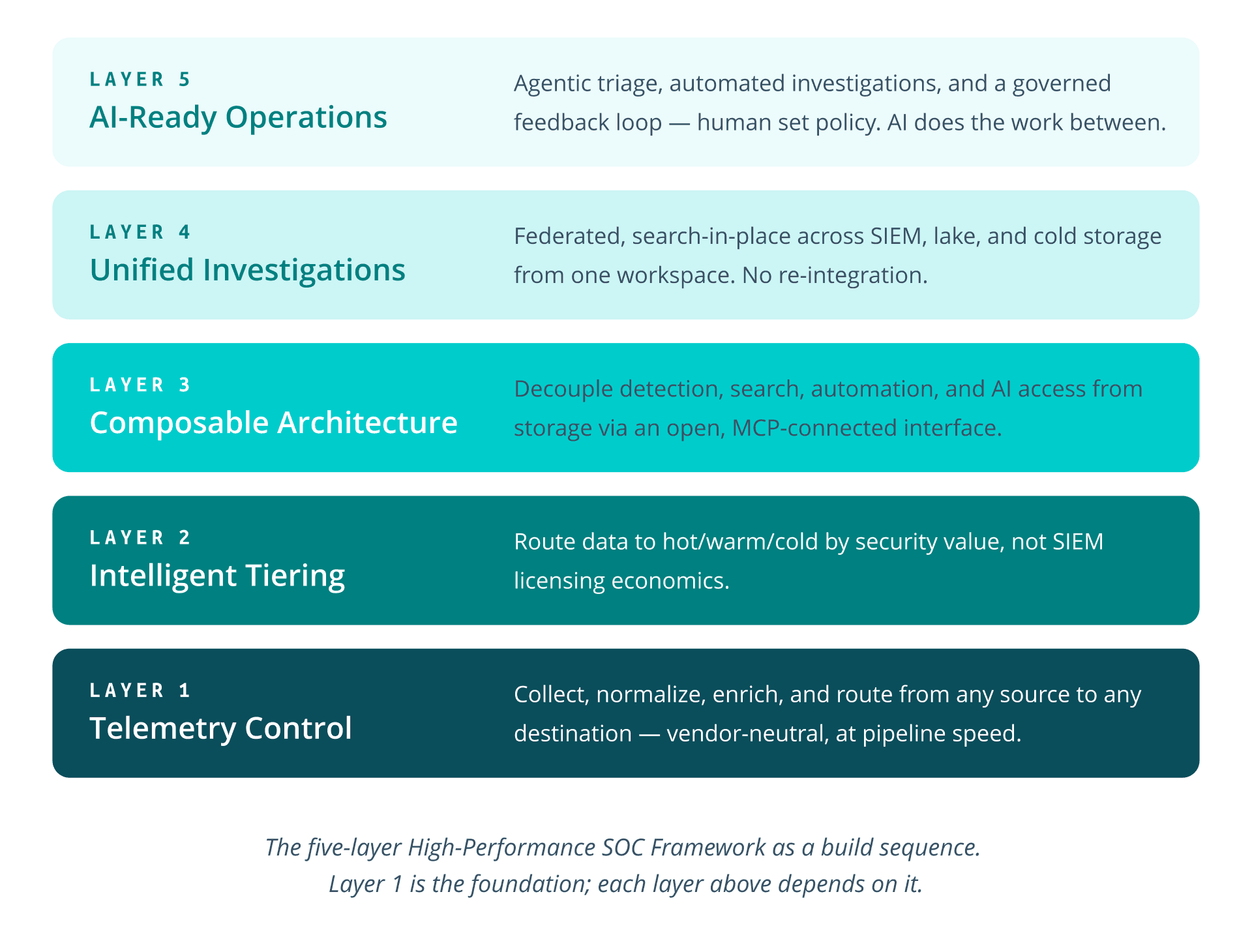
The High-Performance SOC Framework is not a product architecture. It is an operational model. A sequence of five capabilities that, when built in order, transform how telemetry flows through your environment and how every team that depends on it performs.
Each layer builds on the one before it. You cannot run intelligent tiering without first controlling your telemetry flows. You cannot build a composable architecture without knowing what you are tiering and where it lives. You cannot unify investigation without a governed, accessible data foundation. And you cannot build AI-ready operations on top of any of it without clean, normalized, enriched telemetry underneath. This is the architecture that high-performing SOCs are building toward. It does not require replacing everything at once. It requires starting at the right layer and methodically building a resilient, composable, detection and response ecosystem.
Telemetry Control

Collect, normalize, enrich, and route from any source to any destination. Vendor-neutral, at pipeline speed.
The problem this layer solves
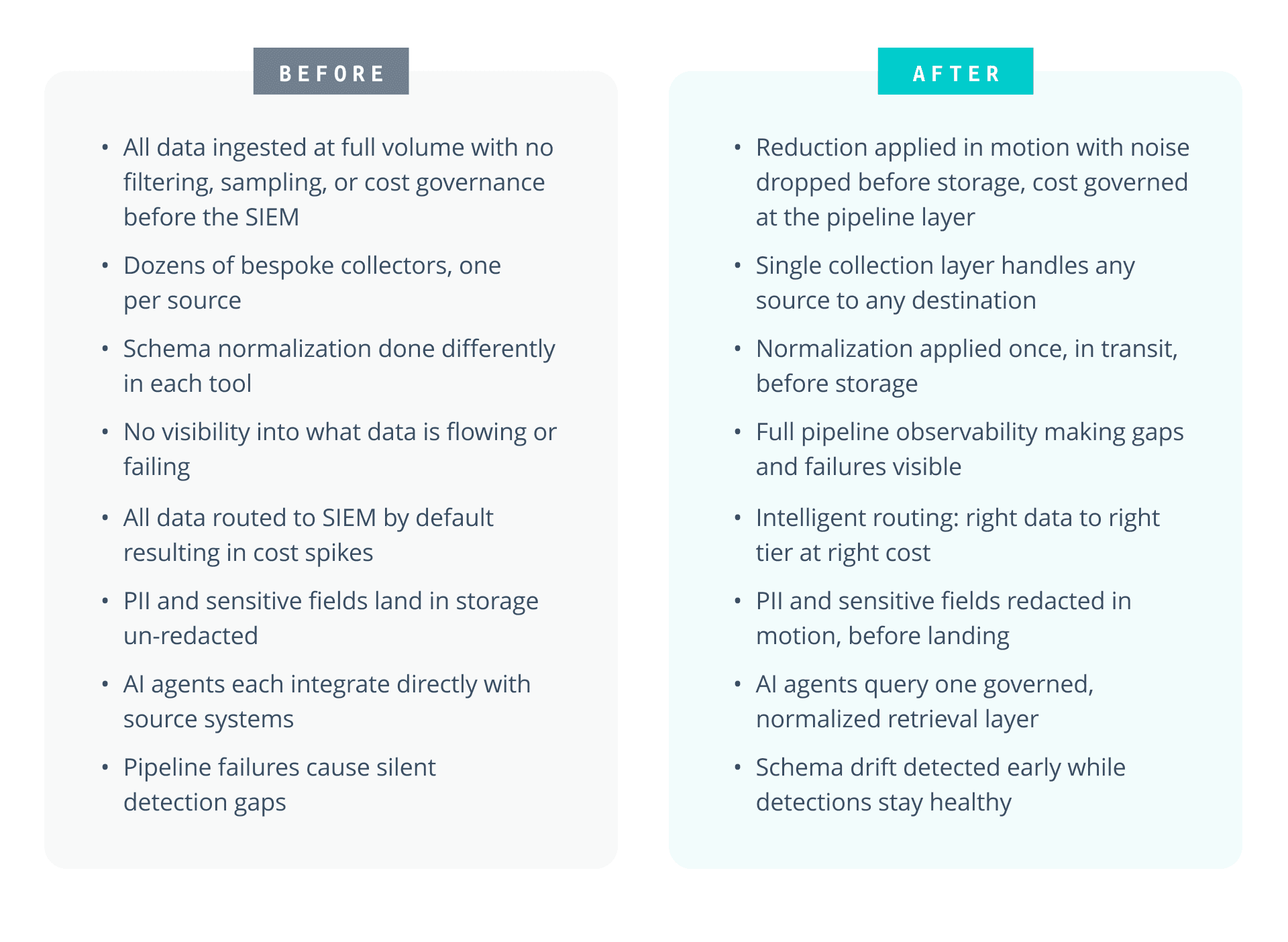
Most enterprise telemetry environments did not get designed. They accumulated. Every time a new security tool was deployed, someone wrote a new collector. Every time a new cloud environment came online, someone built a new parser. The result is what security architects live with today: dozens of brittle, bespoke pipelines, each with its own schema quirks, each one a potential point of failure.
When those pipelines break (and they break constantly, because schemas change, APIs update, and log formats drift), detections silently fail. Dashboards still show green. Coverage metrics still look healthy. But the data is not flowing, the enrichment is not applying, and the AI that depends on that feed is now reasoning on a gap it does not know exists.
The telemetry layer is also where the cost problem lives. Without a control point between sources and destinations, data flows wherever it was configured to flow, often into the most expensive storage available. Engineering teams have no practical way to filter noise before ingestion, route data to cost-appropriate tiers, or enforce consistent governance policies across the stack. The SIEM fills up. Costs spike. The response is to trim retention which creates exactly the historical data gaps that break threat hunting and compliance.
What Telemetry Control looks like
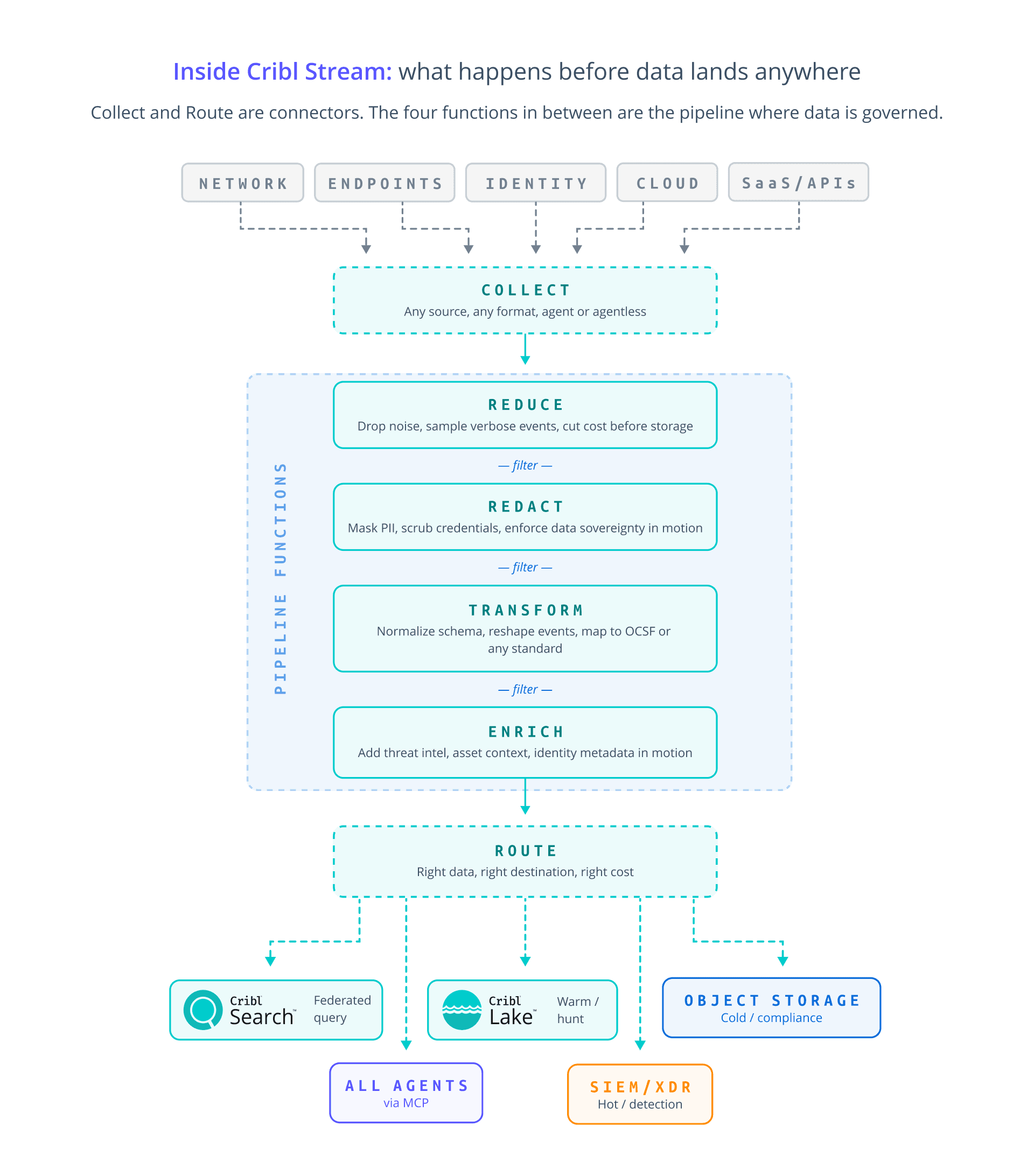
A telemetry control plane sits between every source and every destination in your security stack. It is the first place that data lands, and the last place where you have full control over what happens to it before it reaches any tool, storage tier, or AI system.
In practice, telemetry control means six capabilities working together.
Collection covers any source, such as endpoints, servers, cloud services, Kubernetes, identity providers, SaaS APIs, network infrastructure and OT environments — without requiring bespoke parsers or brittle per-source agents.
Reduce verbose event streams before they reach any destination, dropping redundant logs, capping noisy sources, and applying volume-based sampling without losing investigative fidelity.
Redact stripping or masking sensitive fields such as PII, credentials and session tokens while data is still in motion, before it lands in any storage tier or reaches any tool. Compliance posture becomes an architectural property rather than a remediation project.
Transform by applying consistent schema mappings such as Windows event logs, AWS CloudTrail entries, EDR alerts arriving at every destination in a predictable, queryable shape. OCSF and other standards applied once, in transit for every destination.
Enrichment connects raw events to context while data is still in motion: threat intelligence lookups, asset metadata, identity correlation, and business criticality tags applied in transit before anything lands in storage.
Routing determines where each stream goes: which events belong in the SIEM, which belong in low-cost object storage, which belong in both, and which can be safely dropped without losing investigative value.

The result is a single, governed, observable layer that every downstream system such as a SIEM, data lake, XDR, detection engine, or AI agent draws from. Not a different version of reality in each tool. One version, consistently shaped, consistently enriched, consistently available.
The architecture shift
Why this matters for AI
Every AI system operating in your SOC is only as good as what it can see. A pipeline that drops events because they are noisy by one team's definition may be dropping exactly the lateral movement signal that an AI agent needs. A pipeline without enrichment means every AI query must reconstruct context at query time slowly, expensively, inconsistently.
Telemetry control is not a prerequisite for AI because it is nice to have clean data. It is a prerequisite because AI operating on incomplete, unnormalized data does not fail gracefully it fails confidently.
Conclusion
A pipeline without redaction means AI agents operate on data that was never meant to be seen at query time such as PII, credentials, and sensitive fields surfaced at retrieval speed, at scale, without the audit trail that a human analyst would leave behind. And in a security context, a confident wrong answer is more dangerous than no answer at all.

Telemetry control is not an infrastructure project. It is a security strategy. When you own how data moves how it is collected, reduced, redacted, transformed, enriched, and routed you shape how your detections behave, how your hunts scale, how your compliance posture holds, and how your AI performs. Everything else in the framework depends on getting this layer right first.
"With Cribl, we have full control of what data we send, drop, and enhance and where we send it to take action."
Sheldon Carmichael | Information Security Architect | Sally Beauty
41% reduction
Sally Beauty reduced daily EDR volume by 41% (from 9.25 TB to a little over 5 TB) and extended investigation retention from 7 days to 45.
Intelligent Tiering

Route data to hot, warm, and cold storage by security value not SIEM licensing economics.
The problem this layer solves
Most enterprise telemetry environments did not get designed. They accumulated. Every time a new security tool was deployed, someone wrote a new collector. Every time a new cloud environment came online, someone built a new parser. The result is what security architects live with today: dozens of brittle, bespoke pipelines, each with its own schema quirks, each one a potential point of failure.
When those pipelines break (and they break constantly, because schemas change, APIs update, and log formats drift), detections silently fail. Dashboards still show green. Coverage metrics still look healthy. But the data is not flowing, the enrichment is not applying, and the AI that depends on that feed is now reasoning on a gap it does not know exists.
The telemetry layer is also where the cost problem lives. Without a control point between sources and destinations, data flows wherever it was configured to flow, often into the most expensive storage available. Engineering teams have no practical way to filter noise before ingestion, route data to cost-appropriate tiers, or enforce consistent governance policies across the stack. The SIEM fills up. Costs spike. The response is to trim retention which creates exactly the historical data gaps that break threat hunting and compliance.
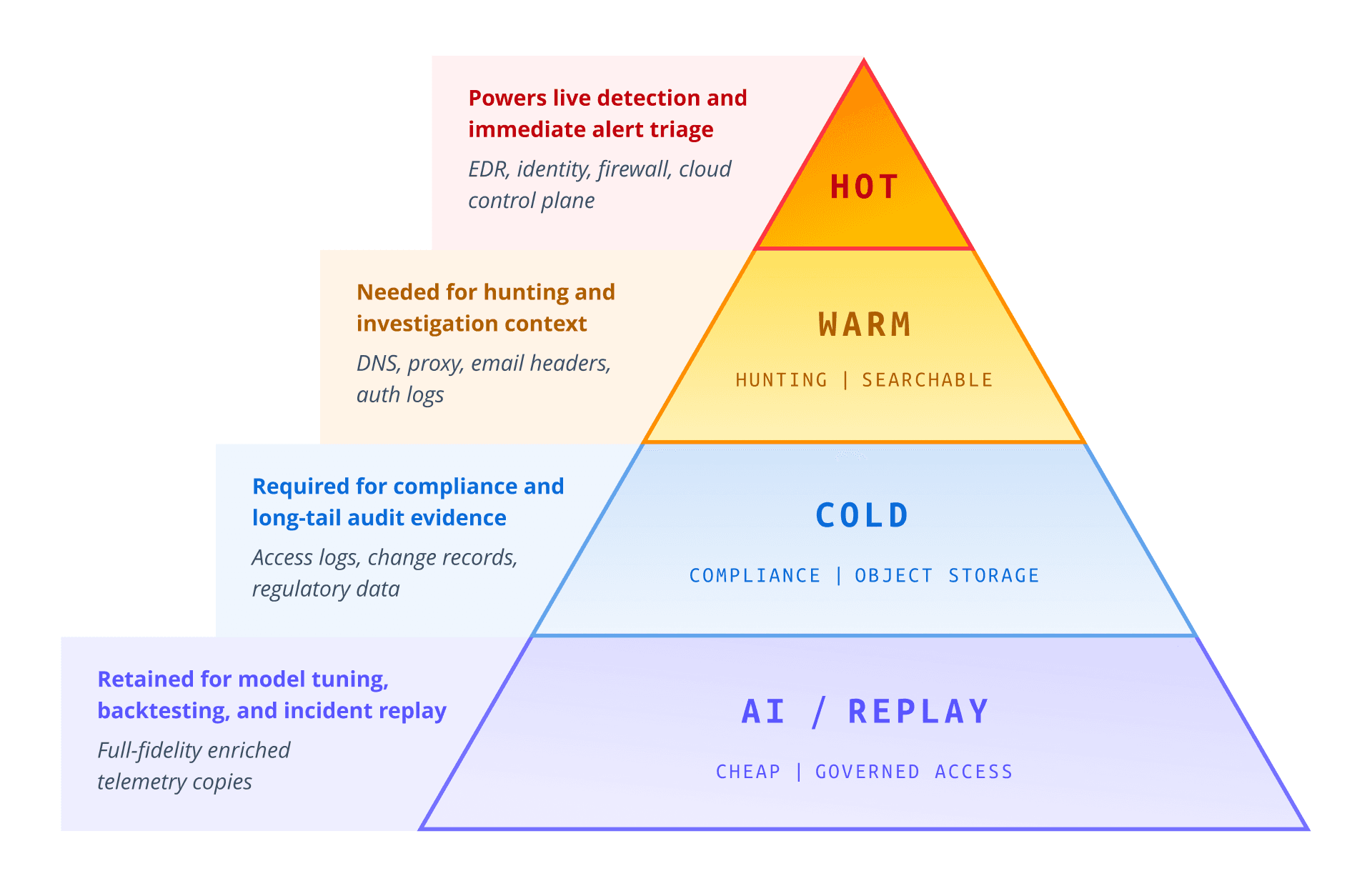
Tiering by security value
A practical tiering model starts with classifying data by how it will actually be used.
Real-time detection data such as EDR telemetry, identity events, firewall logs, cloud control plane activity likely needs to be hot: indexed, fast, immediately queryable by both analysts and AI. These feeds power live detections, alert triage, and the initial pivots of any investigation.
Hunt-critical data such as DNS, web proxy, email headers, authentication logs with full context benefits from warm storage: slightly cheaper, still searchable, retained longer. Hunters need to go back weeks or months, but they do not need sub-second response times.
Compliance and audit data, such as long-tail access logs, change records, regulatory evidence, belong in cold storage: open formats, object storage at minimal cost, searchable via federated query when needed rather than pre-indexed at all times.
AI training and replay data, such as full-fidelity copies of enriched telemetry retained for model tuning, detection backtesting, and incident replay, lives wherever it is cheapest, as long as it can be replayed or accessed in a governed way when a specific dataset is needed.
The key discipline is decoupling retention from SIEM licensing. Regulations increasingly assume year-plus log retention: PCI DSS requires at least one year, HIPAA often expects six, SOX mandates seven for relevant records. If all of that has to live in SIEM hot storage, the cost becomes unmanageable. If it lives in open-format object storage, federated and queryable on demand, compliance becomes an architectural property rather than a budget emergency.
What changes operationally
For detection engineers, intelligent tiering means detections can query across tiers without re-ingesting data. A Sigma rule written once fires against hot telemetry in real time (or even in the pipeline) and can be back-tested against months of warm storage to evaluate coverage before deployment. For threat hunters, it means the historical data they need actually exists and is reachable, not trimmed to control SIEM costs. For compliance teams, it means audit questions can be answered by federated search directly on cold storage, without a stressful thaw-and-re-ingest project under deadline. For AI systems, it means training data is available, enriched, and governed not locked in a proprietary format behind a license wall.

Intelligent tiering is how you escape the cost-coverage trap. When data is routed by security value rather than default pipeline, you keep everything that matters, discard what genuinely does not, and make the rest accessible at the cost that matches how often you actually need it. The SIEM stays fast and focused. (Everything else stays reachable.
"The goal is to optimize the data. Our priority is to make the data more valuable... it's not just about cost-cutting, it's about getting more context to make better decisions."
Sudha Kanupuru | DevOps Engineering Manager | Autodesk

93% reduction
With Cribl, Autodesk reduced duplicate ingestion by 93% "by just doing the easy stuff."
Composable Architecture

Decouple what makes sense detection logic, search, automation, and AI access from the backend storage layer, so any SOAR, agent, or AI system can reach your data through a single federated interface without being locked into any one vendor's platform.
The problem this layer solves
The monolithic SIEM was built on a premise that made sense at the time: one platform to collect, correlate, detect, investigate, and report. That premise has not survived contact with the modern threat landscape. Environments are too large, too distributed, and too dynamic for any single platform to be authoritative across all of them. The result is a familiar pattern: teams bend their operations to fit the SIEM's schema, accept the SIEM's retention constraints, build detections inside the SIEM's proprietary query language, and find themselves locked to a vendor roadmap they have no ability to influence.
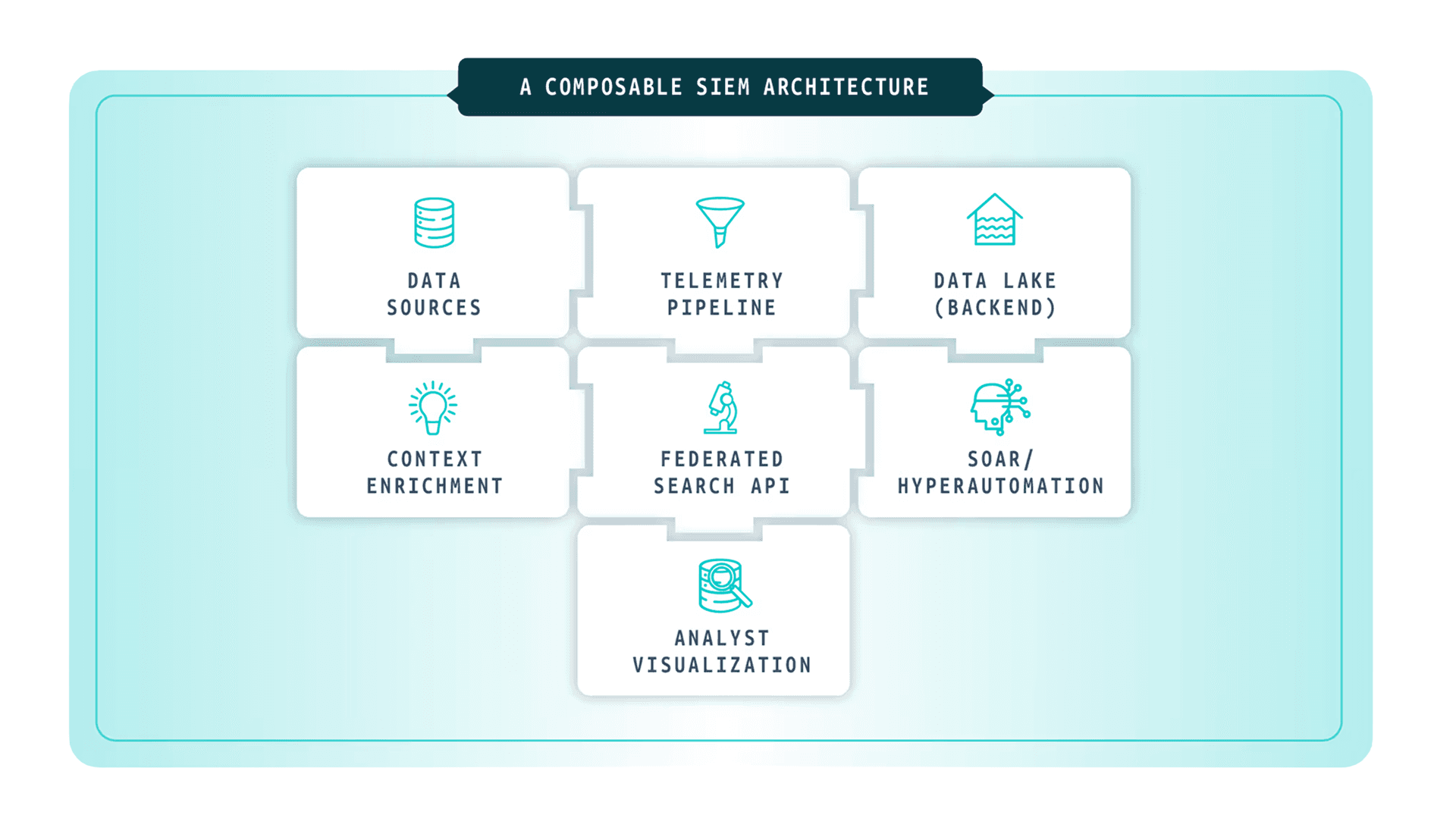
The answer is not to throw out the SIEM. The SIEM remains a critical component particularly for real-time correlation, alert management, and the detection workflows teams have spent years building. The answer is to stop treating it as the only component. Composable architecture means selectively decoupling the functions that benefit from being separated, such as detection logic, search, automation, and AI access, from the backend storage and correlation engine. As a result, each can evolve independently and the entire stack can be reached by any authorized system through a consistent, vendor-neutral interface for investigation and retrieval.
Decoupling detection and investigation
Detection logic is the first candidate for decoupling. When detections are written, versioned, and tested as code independent of any specific platform's proprietary language they become portable, auditable, and improvable. A detection written in Sigma can fire against telemetry in the pipeline, backtest against warm storage, and be deployed to a new SIEM without a full rewrite. Detection engineering becomes a software discipline: pull requests, peer review, automated testing, and rollback. Coverage becomes measurable and governable rather than opaque.
Investigation is the second candidate. When investigation and hunting workflows run against a federated search layer that can query the SIEM, object storage, data lakes, and SaaS APIs from a single interface, analysts stop being constrained by what any one tool can see. They can pivot across hot and cold data in a single query, follow an attacker's path across storage tiers without switching consoles, and share investigation notebooks that are reproducible across shifts and teams.
Freedom from vendor lock-in
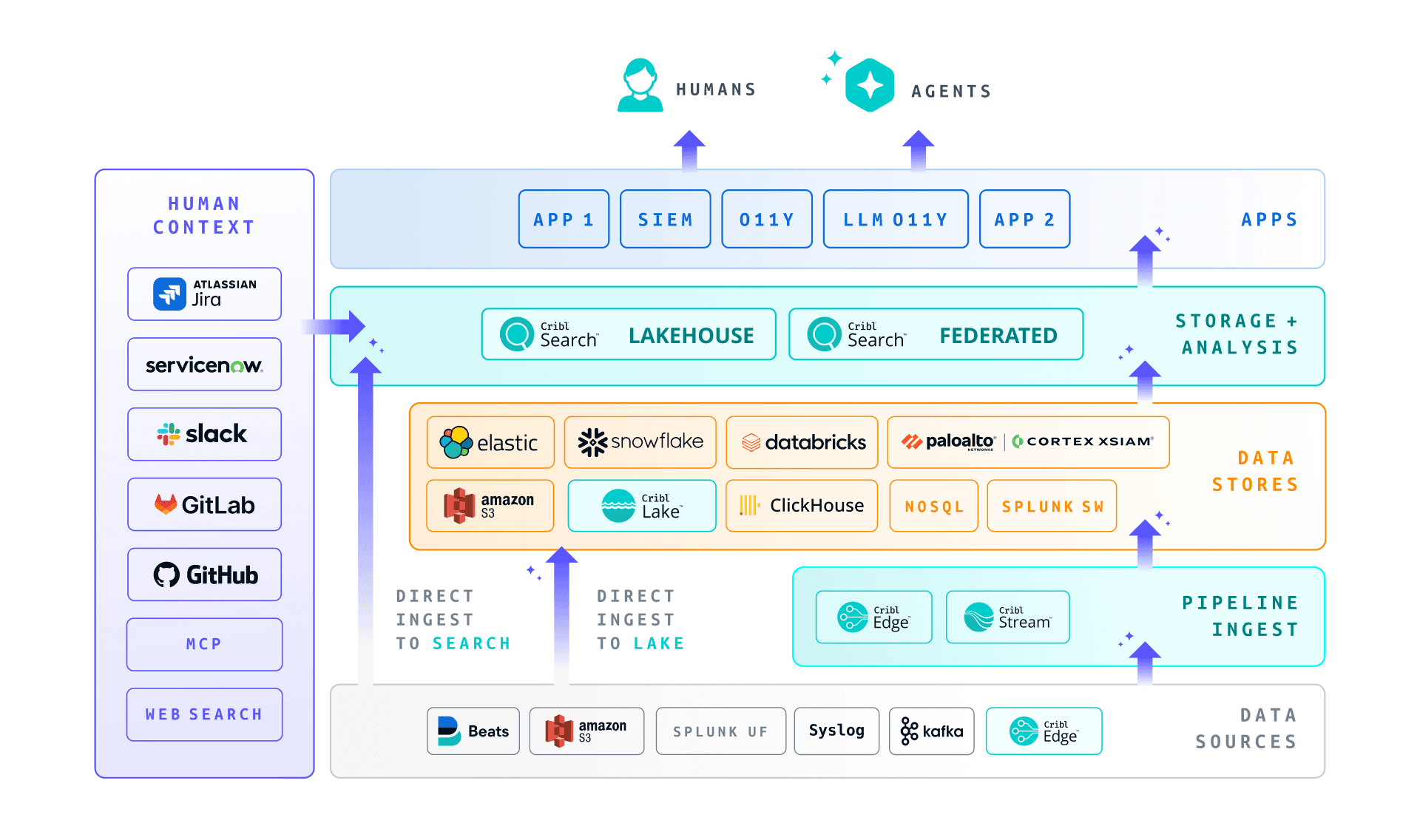
The most significant architectural shift in composable security operations is the emergence of a standardized access layer for AI and automation. A federated API search capability, potentially leveraged via the Model Context Protocol (MCP), provides exactly this: a structured, auditable bridge that allows any AI agent, SOAR platform, or automation workflow to reach your data and your pipeline through a single governed interface, regardless of where that data lives or which vendor built the tools it lives in.
This matters enormously for vendor independence. Today, many AI-powered security products effectively require you to bring your data to their platform, their model, their storage, their schema, their terms. A federated, API-based, and MCP-connected architecture inverts that model. Your AI works with your data, wherever it lives, in whatever tools you have already chosen.
A new AI vendor, a new SOAR platform, a new detection tool, any of them can plug into the same access layer without requiring a new pipeline, a new data copy, or a new integration project. The composable architecture is what makes that possible, and the API coupled with the MCP layer is what makes it operationally real.
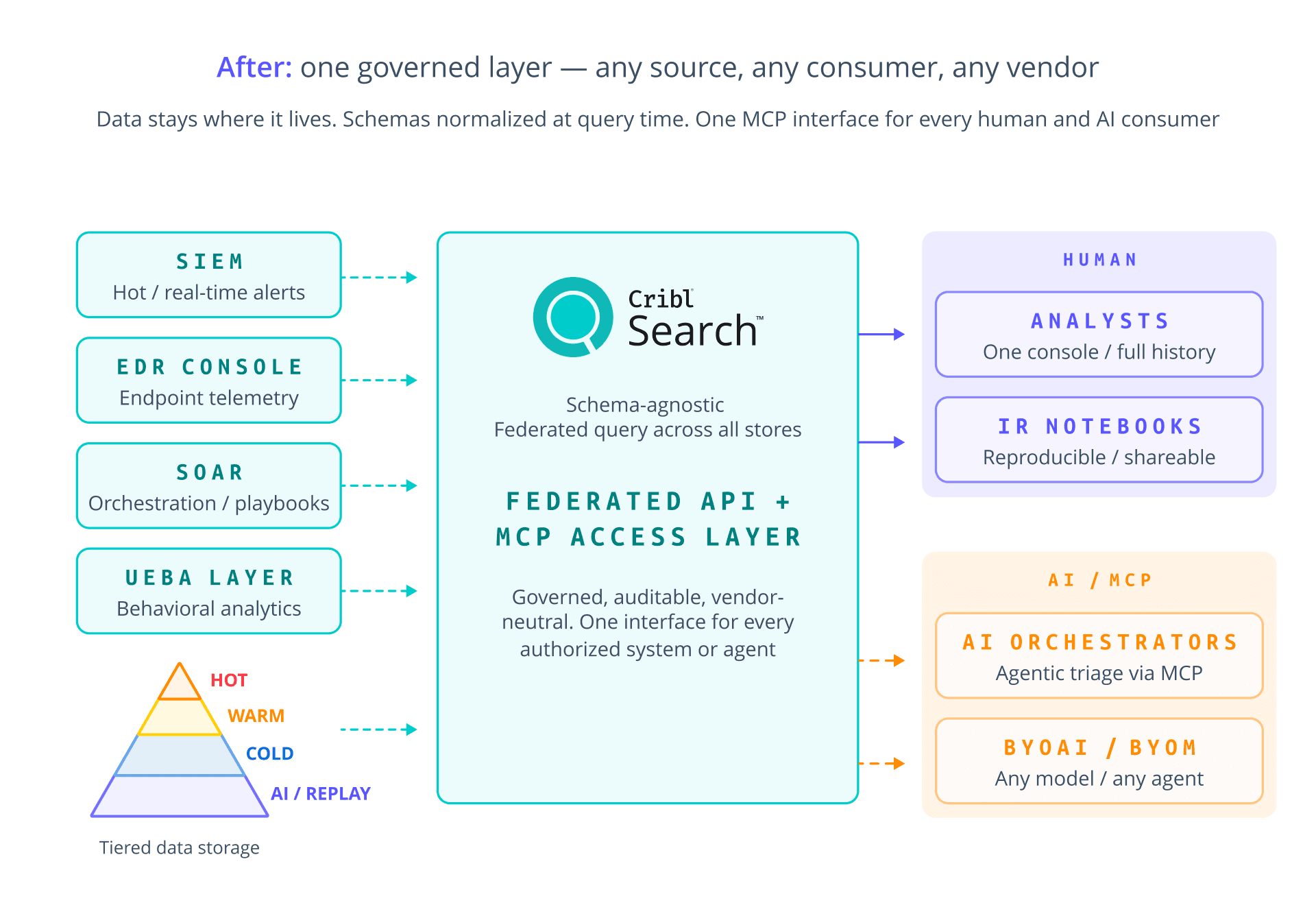

Composable architecture is not about decomposing your SIEM, it is about ensuring that no single vendor controls access to your data, your detections, or your AI workflows. When detection logic, search, and automation are decoupled from backend storage and exposed through an open, MCP-connected interface, you gain the freedom to evolve any component without unwinding the whole system.
"Cribl Search has optimized our operations teamsˇ time and efficiency. Theyˇre able to troubleshoot and find issues for our customers in a minimal amount of time."
Samer Abdallah | Engineering Fellow | Pegasystems

Search-in-place lets Pegasystems query data where it lives, avoiding the cost and complexity of moving and processing logs.
Unified Investigation

Federated search across SIEM, data lake, and cold storage from one workspace — search in place, no re-ingestion required.
The problem this layer solves
Investigation in most enterprise SOCs is not a workflow. It is a series of context switches. An alert fires. The analyst opens the SIEM. Pivots to the EDR console. Checks the identity provider. Pulls logs from the cloud platform. Exports to a spreadsheet. Tries to reconstruct a timeline from fragments that were never designed to be correlated with each other, using query languages that differ between every tool, against data that may or may not still be within the retention window.
This is what 241-day average breach identification actually looks like at the operational level. Not a single dramatic failure, a grinding accumulation of friction. Every pivot that requires a new login. Every query that returns incomplete results because the relevant logs were trimmed to control SIEM costs. Every investigation that stalls because the historical data needed to establish a baseline simply does not exist in an accessible form. The investigation surface is fragmented, and fragmented investigations are slow investigations.
One surface, all the data
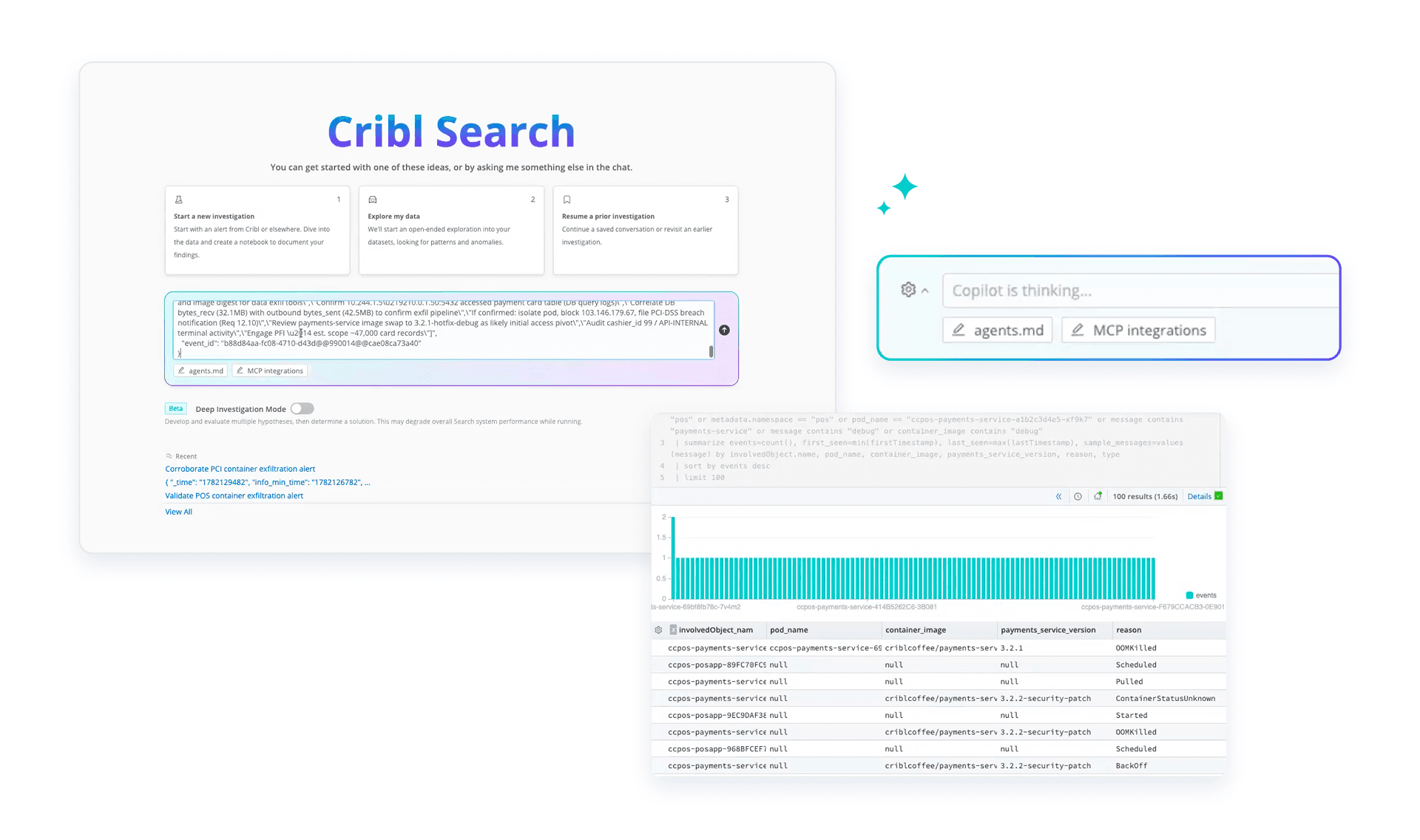
Unified investigation means analysts can ask a single question and get an answer that spans every storage tier where relevant evidence lives. Without moving data, without re-indexing, and without switching consoles. Hot data in the SIEM lakehouse engine returns in seconds. Warm data in the data lake returns in a query. Cold data in object storage is reachable via federated search without a re-ingest workflow. SaaS APIs, such as identity providers, cloud platforms, and collaboration tools, are queryable alongside on-premises telemetry in the same investigation context.
The critical design principle is search-in-place. Evidence does not need to come to the analyst's tool. The analyst's tool needs to go to the evidence. This changes the economics of investigation fundamentally. Data can be retained in the cheapest appropriate storage tier and still be fully available at investigation time, because the investigation surface is not a single repository, it is a query layer that federates all of them.
Investigation as a repeatable discipline
Unified investigation also changes how investigations are documented and transferred. When an analyst works from a notebook that captures queries, intermediate results, AI-generated summaries, and analyst commentary in a single artifact, the investigation becomes reproducible. A second analyst picking up the case at shift change does not start from zero. A peer reviewing the investigation for quality or escalation can follow the reasoning chain. A post-incident review can replay the investigation to understand what was known and when.
AI-assisted investigation fits naturally into this model. When the AI has access to the same unified evidence surface as the human analyst hot data, cold data, enrichment context, all in one governed layer it can propose pivots, summarize timelines, and highlight anomalies without being constrained to what fits in a single tool's scope. The analyst remains the decision-maker. The AI accelerates the evidence gathering that previously consumed most of the investigation time.

Investigation speed is not a training problem or a hiring problem. It is an access problem. When analysts can query all of their evidence from one surface, regardless of where it lives or how old it is, investigations that previously took days compress to hours. The data was always there. Unified investigation makes it reachable.

Security Risk Advisor's SCALR XDR uses Cribl Search's federated "search-in-place˛ so analysts query data wherever it lives (SIEM, lake, object store) from one surface, reinforcing "one place to ask the question."
AI-Ready Operations

Clean, normalized, governed telemetry is the prerequisite for every AI investment: agentic triage, automated investigation, and continuous pipeline improvement via feedback loops.
Why this layer is last
Every layer in this framework has been building toward this one. Not because AI is the goal it is not. The goal is a SOC that detects faster, investigates more thoroughly, hunts more effectively, and operates more efficiently. AI is a means to that end. But it is a means that only works well when the foundation beneath it is sound.
The organizations that have deployed AI in the SOC and found it underdelivering are almost always dealing with a foundation problem, not an AI problem. The model is reasoning on incomplete telemetry. The enrichment is inconsistent so context varies by source. The retention is too short so the AI cannot see enough history to identify slow-moving threats. The data is in three proprietary formats that each require different normalization before the AI can use them. Layer 5 does not introduce AI to the SOC. It makes the SOC ready for AI to actually work.
What AI-Ready Operations looks like
At Layer 5, the telemetry control plane is in place, data is tiered intelligently, detection and search are decoupled from backend storage, and investigation runs against a unified federated surface. At that point, every AI system operating in the SOC whether for triage, investigation, hunting, anomaly detection, or automation is drawing from the same complete, normalized, governed view of the environment.
Agentic triage means AI can receive an alert, pull relevant context from across the unified investigation surface, correlate it with enrichment data from the pipeline as well as existing playbooks, and produce a decision-grade work item with a hypothesis, bounded evidence, and recommended next steps all before a human analyst ever opens the case. The analyst's job shifts from context assembly to decision review. That is not replacing the analyst. That is giving the analyst back the hours that were spent reconstructing what the AI can now surface in seconds.
Automated detection improvement closes the loop that most detection programs have never been able to close at scale. Agentic tooling can monitor the pipeline for schema drift, identify detection rules that have gone quiet because a field disappeared or a source dropped, propose enrichment updates based on new threat intelligence, and surface those candidate changes for human review. The goal is for all that to happen without requiring a dedicated engineering cycle for each iteration. The pipeline stops being a static configuration and becomes a living system that responds to what the data is telling you.
The feedback loop
The most forward-looking capability in Layer 5 is the agentic pipeline feedback loop. When an AI agent observing landed data identifies a pattern such as a new sensitive field appearing in a log source, a detection rule producing excessive false positives, or a new threat behavior not covered by existing logic it can draft a proposed pipeline configuration change, route that change for human review and approval, and then deploy it back into the stream. The entire cycle is auditable, reversible, and governed. Humans set policy and approve changes. AI does the pattern recognition and implementation work in between.
This is the operating model the Autonomous SOC is actually moving toward not a world where AI operates without human oversight, but a world where AI handles the continuous monitoring, pattern matching, and implementation work that no human team can sustain at scale, and humans retain clear authority over what gets deployed and why. The Autonomous SOC is a journey, not a destination. You do not get there by buying an AI product. You get there by building the architecture that makes AI trustworthy, layer by layer, starting with the data.

AI-ready operations is not a product you deploy on top of your existing architecture. It is the state your architecture reaches when every layer beneath it is working correctly. Clean telemetry. Intelligent tiering. Composable, decoupled workflows. Unified investigation. When those are in place, AI does not just add features it fundamentally changes what your SOC can do and how fast it can do it.

10x faster
data extraction, normalization, and CIM/ECS data-model compliance in Cribl Stream before data reaches the SIEM.
Cribl helps Finality accelerate detection content delivery by 250%, improve correlation speed, and reduce SIEM compute load.
Building an AI-Ready SOC
Why is SOC performance a data architecture problem and not a tooling problem?
Because every downstream capability — detection, hunting, AI-assisted investigation sits — on top of the telemetry layer. If that layer is fragmented, unnormalized, or under-retained, adding more tools just multiplies the fragmentation. The fix is upstream, in how data is collected, shaped, governed, and routed..Do we have to rip out our SIEM to modernize?
No. The SIEM stays valuable for real-time correlation, alert management, and the detection workflows teams have already built. Modernization decouples functions that benefit from being separated (like detection logic, search, automation, and AI access) so the SIEM is one component rather than the only one.Why does AI in the SOC underdeliver so often?
Usually it is a foundation problem, not an AI problem. The model reasons on incomplete or stale telemetry, enrichment is inconsistent, retention is too short to see slow-moving threats, and data arrives in conflicting formats. AI operating on incomplete, unnormalized data does not fail quietly it fails — confidently, which in security is more dangerous than no answer at all.Where should we start if we can only fund one move this year?
Layer 1. Take a single high-cost, high-volume dataset and route it through a telemetry control plane. Measure the impact on cost, coverage, and retention, then expand. The architecture compounds — each layer makes the next cheaper and easier.What is the role of MCP in a composable architecture?
A federated, API-based interface — potentially via the Model Context Protocol — gives any AI agent, SOAR platform, or automation workflow a single governed way to reach your data and pipeline, regardless of where the data lives or who built the tools. It inverts the usual model: your AI works with your data, in the tools you already chose, instead of forcing your data into a vendor's platform.How does intelligent tiering help with compliance retention?
Regulations increasingly assume year-plus retention. If all of it lives in SIEM hot storage the cost is unmanageable; if it lives in open-format object storage that is federated and queryable on demand, compliance becomes an architectural property rather than a budget emergency.
Where to go from here
The High-Performance SOC Framework is a sequence, not an overnight transformation. Most organizations can start at Layer 1 with a single high-cost, high-volume dataset and route it through a telemetry control plane, measuring the impact before expanding. The architecture compounds. Each layer makes the next one more valuable and easier to implement.
The goal is not perfection on paper. It is a SOC that performs when it matters. One where analysts have the data they need, AI has the foundation it requires, and the organization has the architectural freedom to evolve without being locked to any single vendor's roadmap.