
For years, security teams have been sold the same bargain: send in more data, buy more tools, tune more rules, and you'll be better protected. In practice, a lot of teams have ended up with the opposite. They're carrying more cost and more complexity, and they still don't have much confidence that their detections are actually working the way they should.
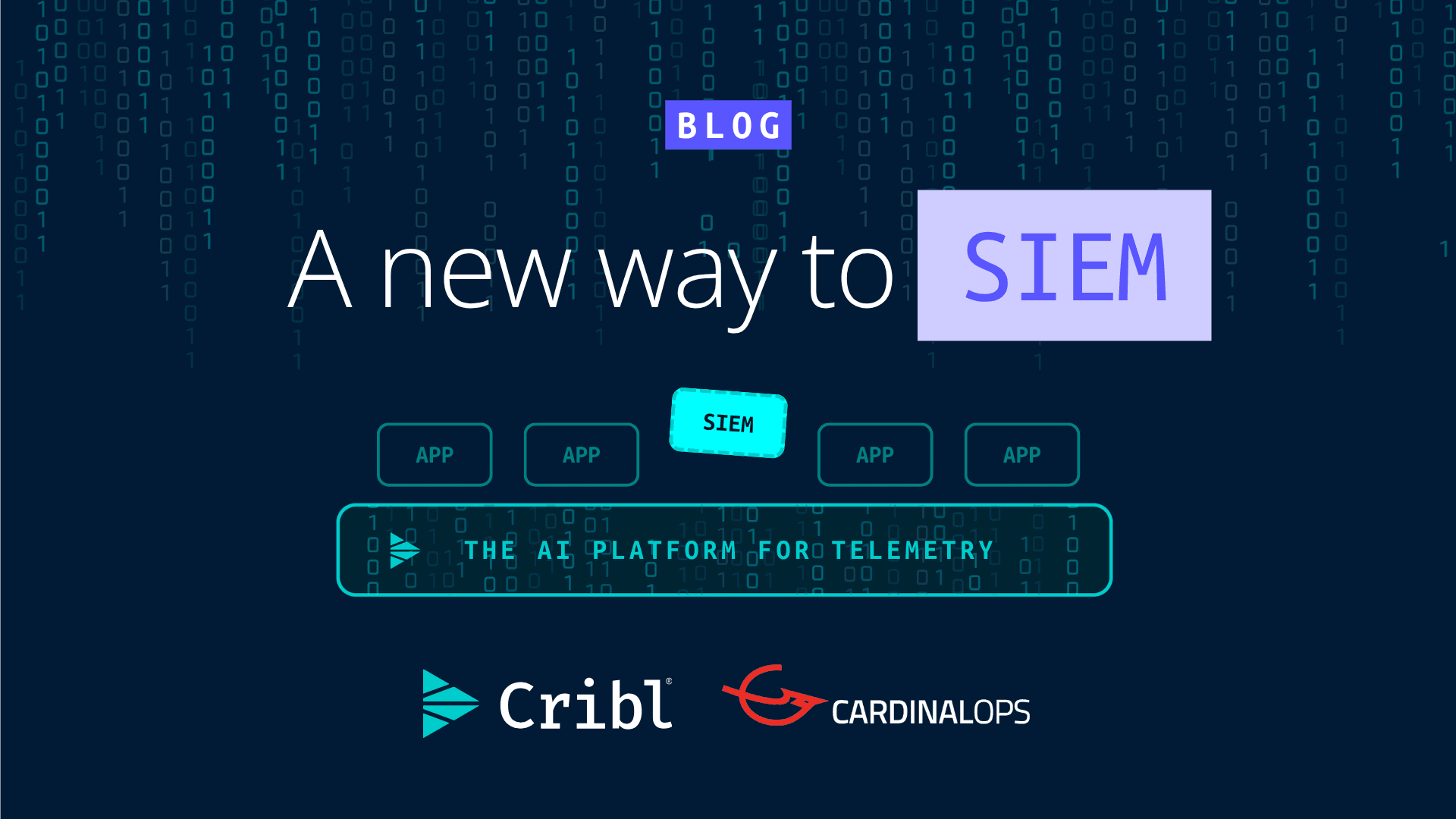
That's the backdrop for why Cribl is acquiring CardinalOps. CardinalOps brings agentic detection engineering to Cribl’s AI Platform for Telemetry and gives security teams a more open alternative to the SIEM they run today, without forcing them back into the same tradeoffs.
Since day one, we’ve believed customers buy solutions, not platforms (and they're right to). Nobody wakes up wanting a platform; they want a problem solved. But the value of Cribl is that those solutions aren’t a loose collection of separate products. They’re built on one shared foundation, so customers get more reuse, more flexibility, and better economics as their needs grow. That matters across the platform, but it becomes especially clear in SIEM.
It's fair to ask whether this is just another SIEM telling you to send in everything and hope the bill works out. It isn't. The traditional model assumes you'll keep centralizing telemetry, keep paying to ingest and index it, keep tuning detections by hand, and keep absorbing a lot of operational drag as the cost of doing business. Most security teams are already telling us that model is straining under its own weight. Data keeps growing, environments keep getting more distributed, and threats keep moving faster, while budgets aren't keeping pace.
And even after all that spend, a lot of teams still can't answer some pretty basic questions with confidence. Where are we covered? Where are we blind? Which rules are broken? Which detections are noisy? Are we getting better over time, or just generating more alerts?
That's the gap CardinalOps closes, and it's why we’re bringing them onto the Cribl platform. CardinalOps does something practical: it continuously assesses detection coverage, maps detections to real adversary behavior, finds the gaps, and fixes broken or noisy rules. Paired with our AI Platform for Telemetry, we now have a full end-to-end security solution.
That's the beginning of a new way to SIEM. It's not another closed box, it's not "send us everything and hope your bill works out," and it's not a pile of products dressed up to look like a platform. The idea is simpler: shape data before it becomes cost, search across environments without moving everything first, improve detections continuously, and adopt the pieces you need without getting locked into someone else's all-or-nothing stack.
I want to be clear about what CardinalOps is and isn't. It isn't "the SIEM." It's one of the key capabilities you need to build something better than the old model. Detection engineering is a big part of effective security operations. Cribl already provides the telemetry foundation underneath it.
The CardinalOps team has been consistent on this for years. They've worked to bring more automation and rigor to detection engineering, and to help customers improve their protection instead of just managing more noise. That's a worldview we share: customers should get better outcomes from the tools and data they already have, not just a new logo on the same operational burden.
There's a lot of work ahead. Building the future of security operations takes more than one acquisition. But this is a meaningful step. It gives customers something useful now and moves us toward an open alternative to legacy SIEM, built for the way modern environments actually work.