
When a service crashes, a deployment fails, or a database goes down, most teams know how to run a postmortem. You establish a timeline, identify the root cause, measure impact, and define corrective actions. That approach works well for traditional systems because the central question is usually:
What failed?
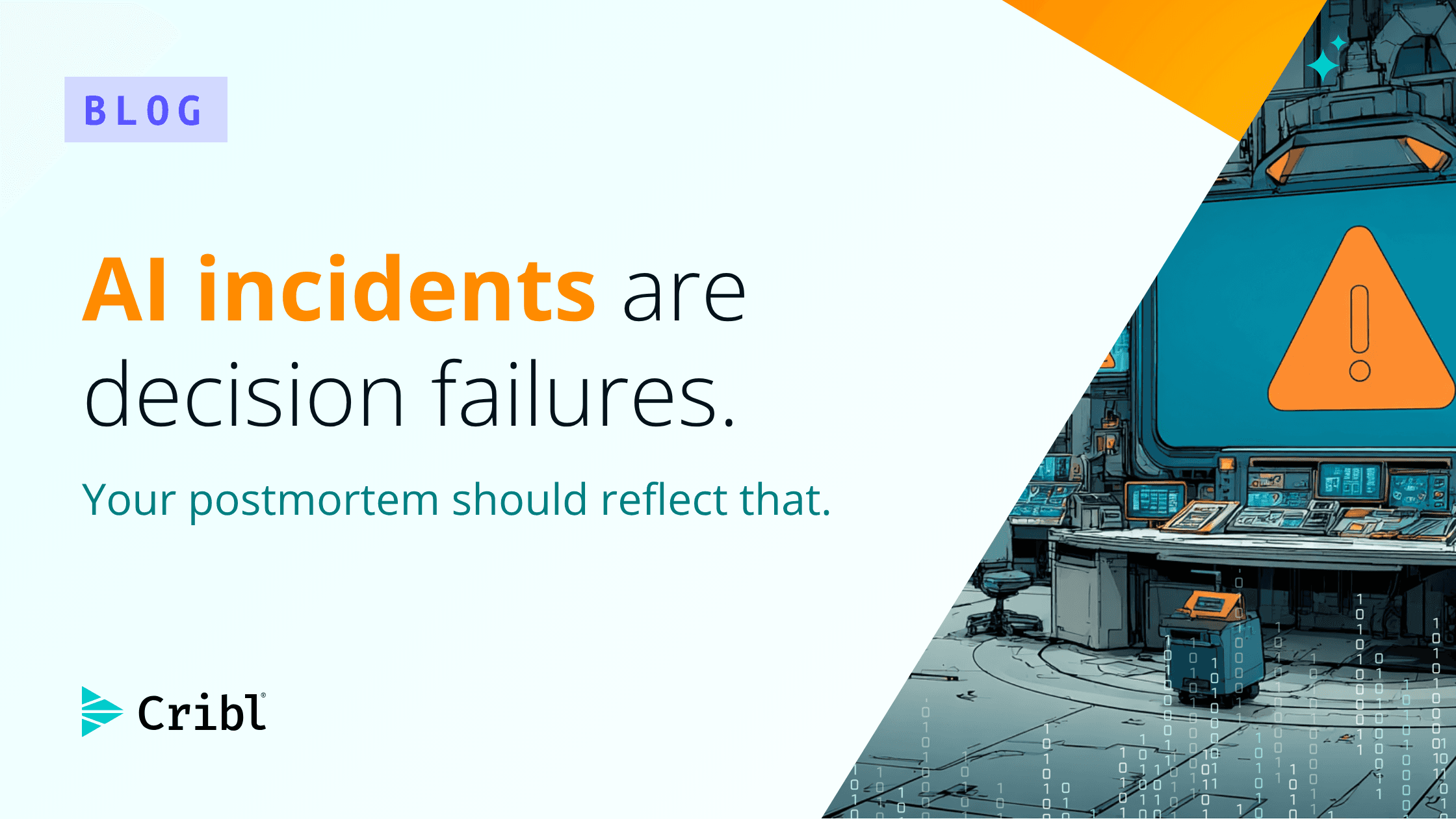
AI incidents are different. In many cases, nothing actually breaks. The infrastructure is healthy. The workflow executes as designed. The model returns an answer.
The outcome is still wrong.
An AI assistant summarizes the wrong document. A security copilot downplays a real threat. An agent recommends a change that appears reasonable but introduces risk downstream. The problem is not always a system failure.
Often, it is a decision failure.
Traditional postmortems explain system failure
Most incident reviews are built around deterministic systems. They focus on questions like:
What changed?
Which component failed?
Why wasn't the issue detected sooner?
How do we prevent it from happening again?
Those questions still matter. But AI-driven workflows introduce another set of questions:
What information did the AI have?
What information was missing?
How did it arrive at its conclusion?
Who approved or acted on the output?
What controls should have caught the mistake?
Without those answers, teams often document the symptom while missing the actual failure mode.
AI incidents require reconstructing the decision environment
The most useful way to think about AI postmortems is this:
Traditional postmortems reconstruct system failure. AI postmortems reconstruct the decision environment.
To understand why an AI-driven outcome occurred, you need to understand:
The context available to the model
The data and evidence it could access
The recommendations it generated
The humans who reviewed or approved those recommendations
The guardrails that were supposed to limit risk
Those factors often matter more than the model itself.
A security copilot that misclassifies an incident may not have had access to critical telemetry. An AI assistant that makes a poor recommendation may have retrieved incomplete evidence. A human reviewer may have accepted a confident answer without seeing the supporting context.
In each case, the failure extends beyond model behavior.
In practice, teams often spend hours debating whether the model was wrong before asking whether the model had the information it needed to be right.
That's exactly why AI postmortems need to reconstruct the decision environment.
What an AI postmortem should capture
Organizations do not need an entirely new postmortem process. They need to extend the existing one. A useful AI incident review should answer five questions:
1. What happened?
Document the incident, timeline, impact, and the role AI played in the workflow.
2. What did the AI know?
Capture the prompts, instructions, retrieved information, tool outputs, telemetry, and other context available at decision time. Just as important: identify what was missing.
3. How was the decision made?
Review the recommendation, classification, summary, or action produced by the system and trace how it influenced downstream decisions.
4. Who was accountable?
Identify where human review occurred, what information reviewers could see, and whether approval checkpoints were meaningful.
5. What controls failed?
Review guardrails, escalation paths, rollback mechanisms, governance policies, and validation requirements that should have reduced risk.
A simple example
Imagine an AI assistant helping investigate a surge in failed logins. The assistant concludes that the activity is likely a benign configuration issue and recommends lowering the incident priority. A traditional postmortem might conclude that the assistant made the wrong assessment.
A better review might reveal that:
The assistant only had access to authentication logs
It did not retrieve a related change ticket
It lacked identity context for affected accounts
The analyst saw a concise recommendation but not the underlying evidence
No validation step required checking external context before downgrading severity
The lesson changes completely. The problem is no longer that the AI was wrong. The problem is that the system lacked the context, visibility, and controls needed to support a reliable decision.
The bottom line
In many public AI failures, the model wasn't the only problem. Missing context, weak oversight, and inadequate controls played just as large a role.
AI incidents fail across context, retrieval, oversight, and governance. Not just infrastructure.
Traditional postmortems help teams understand why a system failed. AI postmortems should help teams understand why a decision failed.