
If you’ve been in security operations for more than a few years, you’ve probably lived through at least one difficult, if not failed, SIEM migration. Maybe it was sold to you as a fresh start to achieve better performance, lower costs, or to introduce a modern architecture. Maybe your vendor pushed you into it with aggressive up-front pricing. Either way, there’s a decent chance it didn’t go the way anyone planned. At best, it was a painful distraction. At worst, you now have two (or more) SIEMs, less engineering time, confusion, and even higher costs.
This is the first post in a series on SIEM migrations: why they go sideways, and more importantly, what you can actually do about it. I am not going to pretend there’s a simple fix, because there isn’t. There is no magic button. But there are ways to change how your security program operates so that the next migration or the one after that doesn’t put you back in a mess. This issue has to be approached from the point of view of the program and the culture of the organization to achieve long term success. Never start with tools. Build on a foundation of people, and then layer technical capabilities to help your people achieve the best possible outcomes.
Before we get into solutions, we need to be honest about the underlying problems.
The dirty secret nobody talks about before you sign
SIEM migrations fail regularly, and they fail for reasons that are almost entirely predictable. The technology is rarely the core issue. The real problems are structural, organizational, and contractual. They were baked in long before a migration was even considered.
Here’s what those problems actually are.
Structural - Your data collection and retention is owned by your SIEM vendor
Most organizations don’t think about log collection as a vendor relationship. It’s plumbing, right? You set it up, it runs, you move on. Not so fast.
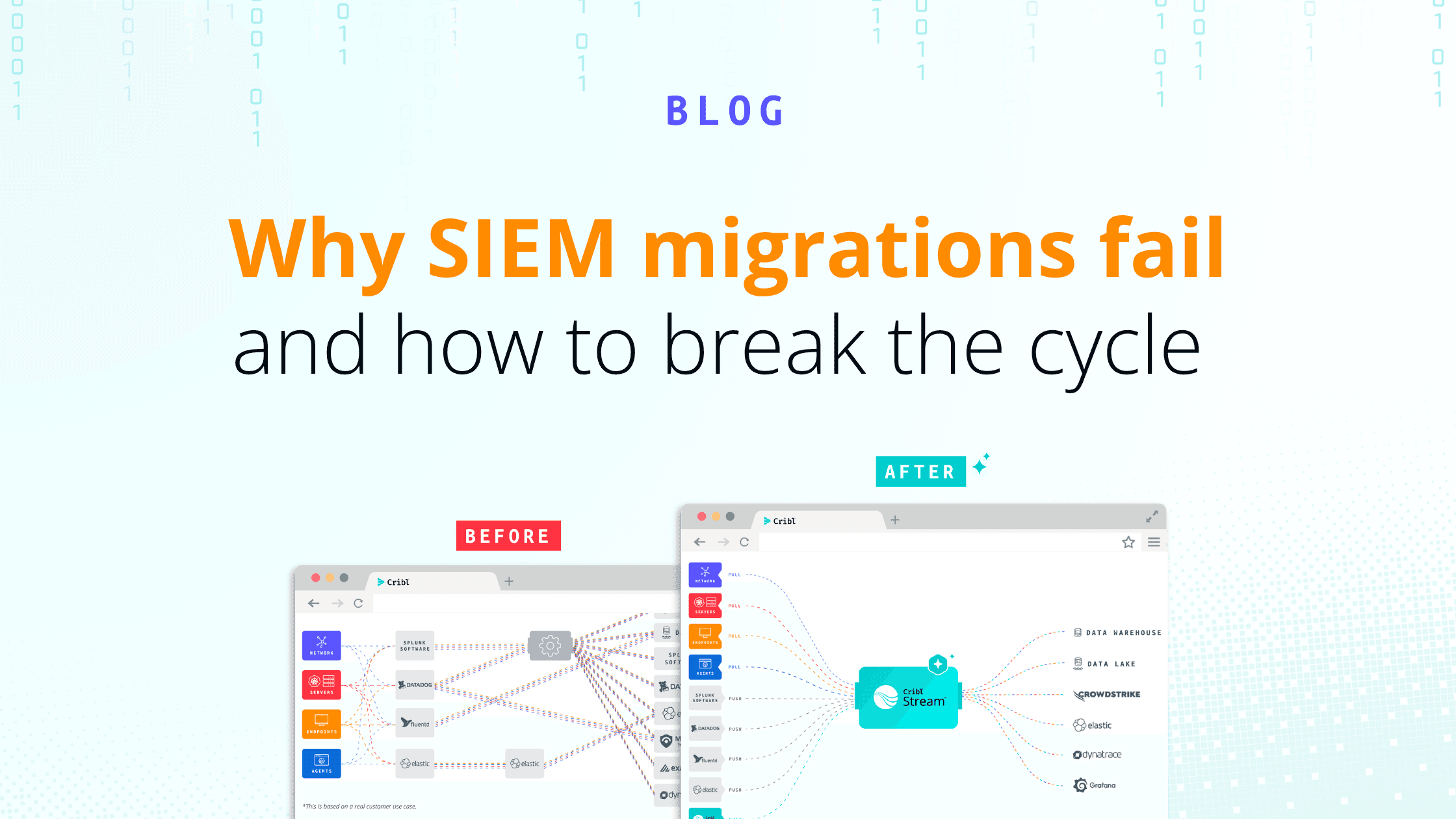
The problem is that log collectors, forwarders, and parsing pipelines are often deeply tied to the SIEM vendor. Proprietary agents, custom connectors, and vendor specific formats are not accidents. They’re how vendors protect their revenue.
Most SIEM vendors offer a proprietary agent that speaks a proprietary protocol, sending data to a proprietary database that requires a proprietary query language.
When you decide to leave, you find out fast that your data collection infrastructure doesn’t come with you. You’re not migrating a SIEM. You’re rebuilding an entire data pipeline while simultaneously trying to maintain detection coverage and your security posture in general. Those are multiple full-time jobs, and most teams are already stretched trying to do one.
Retention is another big lock-in pattern that teams don't think about until it's time to migrate. Your data is probably in a proprietary format in a data store accessible only to your proprietary platform. For many companies, data retention requirements have a serious regulatory focus. If you do migrate to another platform, the data is still needed, but getting the data out of the old platform and into the new platform can be very difficult. So many companies end up keeping the old platform around just because it's the only way to access this data. It sounds crazy, but it happens all the time.
This pattern is on purpose. The vendor math is simple. Make the migration just expensive and painful enough to keep the company on the platform, even if the platform does not meet requirements and is just annoying.
Organizational - Nobody on your team has done this before
SIEM platforms are complex enough that the people who really know one tend to know only that one. Query languages, data models, correlation logic, and tuning methods vary significantly across vendors. When you migrate, you’re not just moving detections. You’re asking your analysts to become proficient in a new system while keeping the old one running, often with no reduction in their regular workload. A 6 course online training program does not make an expert. Your team needs time to own their new SIEM, while of course they keep the company secure, handle the day to day and battle through incidents. Of course, where is that spare time?
This is compounded by the fact that SIEM expertise, in general, is hard to hire for. If your migration depends on skills you don’t currently have in-house, you’re either paying a lot for professional services or you’re accepting that the migration will take much longer than the vendor’s implementation timeline suggests.
Contractual - The contract you’re in and the contract you’re signing
Vendor contracts for SIEMs are built to retain customers, not to help them leave. Long initial terms, auto-renewal clauses, and data egress fees are standard. It’s common to find yourself mid-migration still paying for the old platform because the exit terms didn’t align with your go-live timeline.
My favorite was the company that asked for the renewal quote a year out so they had time to plan, but the vendor made excuse after excuse and finally delivered the quote only 6 weeks before the deadline. Of course, the quote was 25% for basically a flat renewal. The vendor did not think the company could or would leave because its SIEM software was so deeply enmeshed in its processes and so deeply tied to risk that the cost of migration was higher than the benefit of leaving.
The vendor felt like it could name its price, and the company had no choice but to pay up. The fancy word for this is sticky vendor relationship or better yet, partnership. The real word for this is shakedown.
The contract you’re signing for the new platform carries its own risks. Pricing tied to data ingestion volume sounds reasonable until your log sources grow, a new compliance requirement kicks in, or your detection strategy matures and requires more data. What looked like a manageable cost in year one can look very different in year three.
Culture moves slower than technology (people and process come first)
Even when the technical migration goes reasonably well, organizations often find that the security program itself hasn’t changed. Workflows, escalation paths, playbooks, and reporting structures were all designed around the old platform. Migrating to a new SIEM but keeping everything else the same means you’ve traded one set of limitations for another.
The SIEM as a security process has evolved into a single vendor solution that handles most, if not all, security functions because the data is already in the SIEM platform. It is very hard for people to change these processes. The cost of change is substantial and must be factored into the decision to switch SIEMs. Whether you know it or not, every security organization has hundreds, if not thousands, of processes and procedures tied to its SIEM. The processes have to be updated to reflect that the underlying tech has changed. A tip from years of working through these issues. Consider changing your processes to adapt to your new SIEM platform. It is much harder to change the workflows built into the platform to adapt to your processes. I once watched a company spend a year bending the platform to its processes and then another 6 months on migration. They wasted half of the initial contact and received little to no value.
There’s also the human side. Analysts who spent years becoming proficient in the old system aren’t always enthusiastic about starting over. That resistance is understandable, and ignoring it doesn’t make it go away. It’s likely to make people dig in and resist change. Spend real time on adoption, both in the beginning and post migration. Maximize value at every step in the process to justify the initial investment.
Time: The resource nobody budgets honestly
Migrations almost always take longer than estimated. The reasons are usually mundane, such as competing priorities, staff turnover, integration issues that weren’t scoped, and content that needs to be rebuilt rather than translated. (Content is never migrated; it is rebuilt.) But the timeline pressure doesn’t go away just because the work is harder than expected.
Contracts expire. Leadership wants the old platform decommissioned. The team ends up rushing the final stages of a migration, which is exactly when cutting corners causes the most damage. Too many teams get into a situation where time has run out and they face the decision to throw caution to the wind and YOLO their way to a new SIEM or they take the cautious approach by taking the SIEM Migration L and buy another year of time to get it right.
Time is the biggest planning gap and has to be factored into the plan more than anything else.
Where this goes next
Each of the issues above has a thread that runs through it: security programs are too dependent on the SIEM vendor as the center of gravity. Detection logic, data access, operational workflows, and institutional knowledge all get organized around a specific platform. When the platform changes, everything built on top of it has to change too.
The rest of this series is going to focus on what it looks like to build a security program differently, one where the value is in your data and your processes, not in your vendor relationship. We’ll cover practical steps for breaking the data collection dependency, how to structure content and detection logic so it’s portable, how to decouple the IR and Threat Hunt Process from your SIEM and how to build the internal skills that make you less reliant on any single platform.
Some of these changes are things you can start on now. Others require a longer view. But both matter, and we’ll get into both in this series.