
A telemetry pipeline is the system that collects, processes, and routes telemetry data, your logs, metrics, and traces, from any source to any destination. Whether you're feeding an observability platform, an APM tool, or a security information and event management (SIEM) system, a telemetry pipeline makes sure the right data reaches the right tool in the right shape at the right cost.
Your IT ecosystem spans cloud-native, hybrid, and distributed systems, and each one generates more data than the last. Building reliable data pipelines matters as much as picking the right tooling. Your telemetry pipeline is where you regain control.
Key components of a telemetry pipeline include data collectors and agents, processors for filtering, enrichment, and transformation, routing mechanisms for directing data to the appropriate destinations, storage systems for hot and cold data, and analytics tools for turning it all into insight.
Why are telemetry pipelines essential in modern IT?
Telemetry pipelines are essential because data growth has outpaced both budgets and legacy architectures. Telemetry data is growing at a 29% compound annual growth rate, enough to double your data volumes roughly every 18 months, according to IDC (2025). Budgets are not doubling every 18 months.
The traditional approach, ingest everything into one centralized platform, drives up storage and licensing fees fast. Yet plenty of that data is redundant or irrelevant. Without a way to filter, enrich, and shape telemetry, you're paying premium prices to store noise.
Then there's variety. Unlike tidy business data, telemetry arrives raw, in uncontrolled formats you don't get to dictate. Logs, metrics, and traces each require different handling to stay consistent and usable, and that complexity compounds as your environment grows.
A reliable telemetry pipeline addresses these problems. It simplifies collection, transforms raw data into actionable signals, and ensures the right information reaches the right systems. The best pipelines let you reduce ingestion, route efficiently, and enrich with context while avoiding vendor lock-in.
How does a telemetry pipeline work?
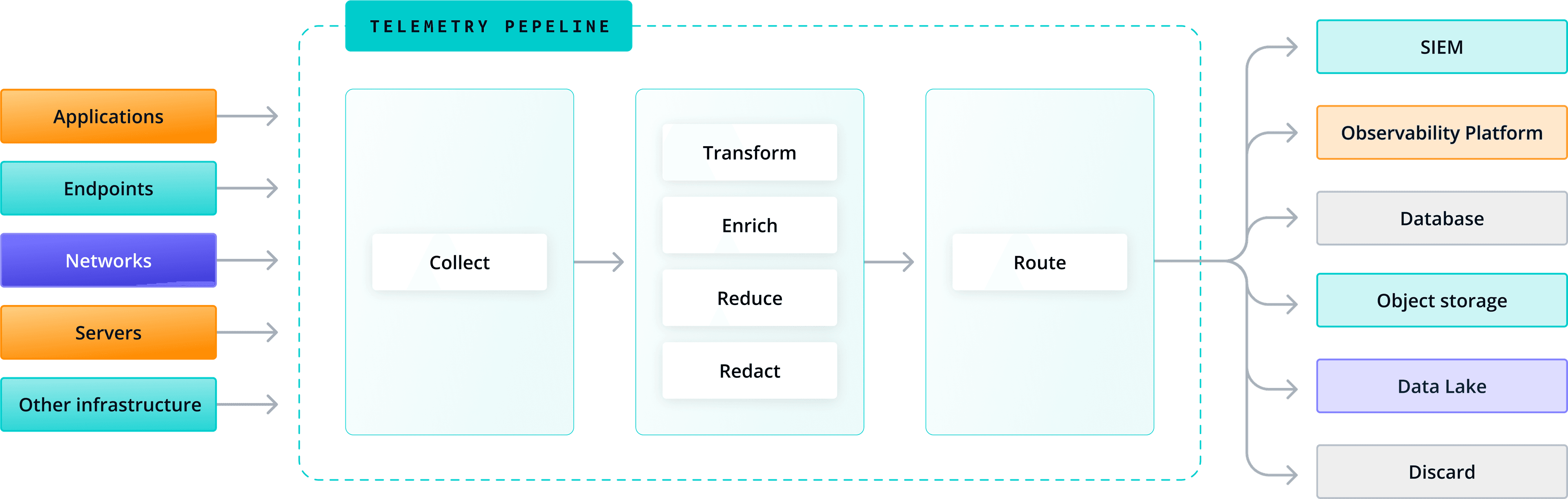
A telemetry pipeline works through three fundamental stages: data collection, data processing, and data routing. Together, they transform raw telemetry from scattered sources into actionable insights delivered to the right destinations, while keeping costs and performance in check.
Data collection
Collection is where telemetry gets gathered from across your infrastructure: applications, servers, containers, databases, cloud services, and more. Modern environments demand that this happen across many sources simultaneously, covering every data type.
Consider a global e-commerce platform monitoring uptime, user activity, and payments. Agents and collectors gather logs from web servers, metrics from monitoring tools, and traces from distributed tracing systems, then hand it all off to the pipeline.
You should collect consistently without dragging down system performance. A practical approach is to collect only the data you need, minimizing unnecessary ingestion and preserving bandwidth.
Data processing
Processing is where raw data gets ready for analysis. The pipeline transforms events, removes duplicates and noise, and enriches records with context that makes them actionable. This stage is your main lever for managing volume and delivering insight instead of clutter.
Picture a financial institution hunting fraud. Its pipeline filters out irrelevant logs and enriches critical events with geolocation data, so downstream fraud detection focuses only on genuinely suspicious activity instead of drowning in everything else.
Processing is also where compliance happens. Redact sensitive fields, normalize logs into consistent formats, and aggregate metrics to shrink downstream volume, all without sacrificing data quality.
Data routing
Routing directs processed data to its destinations: observability platforms, storage systems, or security tools. In a DevOps environment, APM data might flow to a real-time observability platform while archival logs head to cold storage for compliance, and security logs get forwarded to a SIEM for immediate threat detection.
Flexible routing sends the same dataset to multiple destinations, enriches data for one tool while trimming it for another, or replays historical data into a new platform. That gives control with no lock-in.
What are the types of telemetry pipelines?
Telemetry pipelines are not one-size-fits-all. Your architecture choice depends on data volume, performance requirements, and operational goals.
Stream-based telemetry pipelines
Stream-based pipelines process data as it's generated, delivering results in real time or near real time. They're essential when you need immediate visibility into system health, fast incident response, or continuous security monitoring. Tools like Apache Kafka and Cribl Stream power this architecture for use cases like live dashboards, real-time alerting, and security monitoring.
Batch telemetry pipelines
Batch pipelines collect and process data in large chunks at scheduled intervals. They work well for workloads that don't need instant answers: historical aggregation, periodic compliance audits, and large-scale analytics. Processing in bulk during off-peak hours optimizes resources and cuts costs.
Hybrid pipelines
Hybrid pipelines combine both approaches. Stream real-time data to your observability or security platforms while sending older, less critical data to batch processing for long-term storage and analysis. You get real-time responsiveness for critical events and cost-efficient handling of everything else.
Vendor-specific architectures
Many pipelines come tightly coupled to a specific platform. Proprietary options are easy to set up but limit flexibility and invite lock-in. Open source options offer control but demand significant engineering effort to deploy and maintain. A vendor-neutral pipeline that supports both streaming and batch processing allows you to route from any source to any destination and choose the best tools for the job.
What are common telemetry pipeline use cases?
Telemetry pipelines drive critical operations across nearly every industry. Here's how that plays out in practice:
Technology and software: A SaaS company routes server health, response times, and user behavior data to monitoring tools, catching issues before customers notice.
Financial services: A global bank enriches millions of daily transactions with location and device context to detect anomalies, while routing audit logs to compliant long-term storage.
Healthcare: A hospital system monitors medical device performance with real-time alerts and securely routes patient data to analytics tools in line with HIPAA requirements.
Retail and e-commerce: An online retailer processes website and payment gateway logs during flash sales, spotting latency and failed transactions in real time.
The same pattern holds for telecommunications providers collecting metrics from cell towers for proactive maintenance, manufacturers feeding sensor data into predictive maintenance dashboards, and government agencies routing endpoint logs to SIEM platforms for threat detection. Different industries, the same core need: get the right data to the right place without breaking the budget.
Why does flexibility matter in a telemetry pipeline?
Flexibility matters because your telemetry is growing faster than any single tool can economically absorb, and your toolset will change. With data volumes climbing at a 29% compound annual growth rate, according to IDC (2025), rigid pipelines that lock you into specific platforms force your workflows to conform to the pipeline's restrictions. That stifles innovation, complicates compliance, and raises costs.
As your IT ecosystem diversifies, you need the freedom to integrate telemetry from any source into the tools best suited to your needs. Without vendor-neutral options, your team is limited in adopting advances in observability, security, or analytics.
A vendor-agnostic telemetry pipeline keeps your data portable and interoperable. You choose the tools, control the flows, and adapt as your business requires.
How Cribl can help with telemetry pipelines
Cribl is a platform for telemetry, built on the Data Engine for IT and Security. It is based on the idea that your data should serve your teams, not the other way around. Cribl's platform helps you manage and analyze telemetry for both humans and agents with no lock-in, no data loss, and no compromises. Half of the Fortune 100 uses Cribl.[citation needed]
At the center of the platform is Cribl Stream, which lets you collect, transform, route, and store telemetry across sources, tools, clouds, and SIEMs. Route the same dataset to multiple destinations. Enrich data for one tool while reducing it for another. Replay historical data into new platforms when needed. Redact, encrypt, or selectively route sensitive data to meet compliance requirements without adding agents or disrupting existing systems. Every decision about what gets collected, processed, and routed stays under your control, not a vendor's predefined workflow.
The practical results include reduced ingestion costs, faster observability and security outcomes, accelerated SIEM migrations, and an architecture that adapts to new sources, destinations, and standards without disruption. Cribl acts as a central hub that reduces data volume and complexity, so your telemetry pipeline becomes a strategic advantage instead of a bottleneck.
Cribl offers a free trial and lets you process up to 1TB per day, no license required.
Telemetry Pipeline FAQs
What is a telemetry pipeline?
A telemetry pipeline is a system that collects, processes, and routes telemetry data, such as logs, metrics, and traces, from any source to any destination. It sits between your data sources and your analytics, security, and storage tools, and formats or filters data so downstream systems receive the fields they need.
What are the three stages of a telemetry pipeline?
Every telemetry pipeline runs through three stages: data collection, which is the process of collecting telemetry from applications, servers, containers, and cloud services; data processing, which filters, enriches, normalizes, and redacts data; and data routing, which sends the right data to observability platforms, SIEMs, and storage.
How is a telemetry pipeline different from a traditional ETL pipeline?
ETL pipelines move structured business data in scheduled batches. Telemetry pipelines handle high-volume, high-variety machine data, often in real time, and route the same dataset to multiple destinations simultaneously. Telemetry also arrives in uncontrolled formats you cannot dictate, which requires more flexibility.
How does a telemetry pipeline reduce costs?
Not all telemetry is equally valuable. A pipeline lets you filter noise, sample high-volume streams, and aggregate events before data reaches expensive analytics tools. High-value data goes to premium platforms while lower-priority data goes to lower-cost long-term storage, reducing licensing and storage spend without losing visibility.
What types of telemetry pipelines exist?
The main architectures are stream-based pipelines, which process data in real time for alerting and security monitoring; batch pipelines, which run on schedules for compliance and historical analytics; hybrid pipelines, which combine both approaches; and vendor-specific pipelines, tightly coupled to a single platform and often causing lock-in.
Why does vendor neutrality matter in a telemetry pipeline?
Vendor-locked pipelines limit where your data can go and make migrations painful. A vendor-agnostic telemetry pipeline keeps your data portable and interoperable, allowing you to adopt new tools, migrate SIEMs, or route to multiple destinations without re-instrumenting systems.