
Ask a SOC leader how well their detections cover the threats that matter most, and you might get a confident answer. Ask how they know, and the answer gets much less certain.
Detection posture management closes that gap. It's a way to evaluate your threat detection readiness and continuously optimize effectiveness of your detection engineering program. Instead of thinking of detections as ad hoc responses to new threats, detection posture management treats detection engineering as a measurable program: what you cover, what you don't, what's broken, and what to fix next.
CardinalOps' 2025 State of SIEM Detection Risk report shows why this matters. It analyzed more than 13,000 detection rules and nearly 2.5 million log sources across a wide range of production SIEMs operating in enterprise SOC environments. On average, SIEMs had detections for only 22% of MITRE ATT&CK techniques, yet they were ingesting enough telemetry to potentially cover 90%. This reveals an operational gap: organizations are collecting much more telemetry than they’re detecting against.
The disparity between potential and actual coverage is where detection posture management earns its place. This guide walks through shortcomings that detection posture management addresses, how to manage detection posture in practice with core functional components, and the use cases it supports for detection engineers and SOC leaders.
Key takeaways
Most SOCs can't prove their detection readiness and don’t act on opportunities to expand coverage: CardinalOps' 2025 State of SIEM Detection Risk report found SIEMs detect only 22% of MITRE ATT&CK techniques, despite collecting telemetry that could support 90% coverage.
Without a system of record, detection blind spots go unaddressed. The same report found that about 13% of detections were broken, leading to false negatives that can allow threats to go unnoticed.
Detection posture management addresses these challenges with five connected capabilities: detection mapping, telemetry mapping, coverage scoring, rule health, and gap analysis and prioritization.
When applied across detection lifecycle management, engineering automation, threat preparedness, and threat intelligence operationalization, detection posture management helps answer the question "are we covered?" using measurable metrics that can be tracked and improved.
Cribl Detect streamlines detection posture management, giving you a clear picture of current readiness, with multiple ways to expand coverage and continuously improve your posture.
What the SOC looks like without detection posture management
Most SOCs have no shortage of skill or effort. What they lack is a system of record for their detections: one place that shows which detections are deployed, what they’re protecting against, and whether they’re working. Without it, a few familiar problems show up.
Lack of confidence in threat readiness
Without a holistic view of how your detections map to the threats you care about, you don't know where you stand. Rule counts and "enabled" dashboards tell you how much content is deployed, not what it protects against. When a new campaign hits the headlines and leadership asks "would we catch this?", the answer requires a manual audit. By the time it's done, the environment has already changed.
For detection engineers, that means blind spots you can't see until something gets through. For SOC leaders, it means reporting on activity–alerts triaged, tickets closed–instead of readiness. The State of SIEM Detection Risk Report data suggests most teams would be surprised by the real picture: on average, SIEMs have detection rules for only 4 of the 10 most frequently used ATT&CK techniques.
No strategic view of detection program effectiveness
Detections still get deployed, but in an ad hoc, reactive way. A rule gets added after an incident. Another goes in because a vendor shipped a new template, or because an analyst had a hunch. Each decision may be reasonable on its own, but they don’t align to a cohesive strategy.
What's missing is a deliberate effort to fill specific coverage gaps based on a cohesive plan: the adversary techniques most relevant to your industry, or the new infrastructure IT just stood up (a new cloud account, a SaaS application, an identity provider) that needs to be monitored. Without a program-level view, you can't tell whether last quarter's detection engineering work moved coverage forward or just reshuffled the backlog.
False negatives you can't see
Detections fail silently. A log source changes format after a vendor update. A field gets renamed. A parser breaks, or a collector goes offline. The rule is enabled, but alerts don’t fire when they should.
The State of SIEM Detection Risk Report found that about 13% of SIEM rules are broken.That’s about 1 in 8 detections that won't alert on a real threat, most often because of misconfigured data sources, missing fields, and parsing errors.
Broken rules are particularly troublesome because your team invested the time to develop and implement them, but they’re providing false confidence. And finding out they’re broken often happens only in a post-incident review, when a threat that should have triggered an alert didn't.
Coverage left on the table
This is the 22% versus 90% gap mentioned above, in day-to-day terms. You already collect the telemetry. Your SIEM has detection content that could use it. But nothing connects the dots. No one sees that a technique could be covered today with data you already have and a rule you already own. Quick wins go unclaimed.
Threat intelligence often follows a similar pattern. Your team receives a report on a new adversary behavior relevant to your threat model. It gets read, shared, maybe summarized for leadership. But turning it into deployed detections means mapping the techniques, checking existing coverage, then writing and testing new rules. That work competes with everything else in the queue and doesn’t get done.
The key functional components of detection posture management
Detection posture management addresses the challenges mentioned above using a handful of powerful capabilities. Each answers a different question, and together they form a continuous loop: evaluate your rules and telemetry, assess coverage, surface gaps, and remediate.
Detection mapping
Detection mapping ties every rule to the adversary behavior it's designed to catch, answering “what do my detections actually protect against?”
It works at two levels:
Framework mapping. Map detections to MITRE ATT&CK tactics, techniques, and sub-techniques. This gives the team a common language and a standard way to measure coverage. Sub-technique detail matters here: a rule for LSASS memory dumping covers one sub-technique of OS Credential Dumping (T1003), not the whole technique.
Adversary mapping. Map detections to the specific threat actors, APT groups, and campaigns in your threat model. This is where threat intelligence enrichment comes in. When intel ties a group to a set of techniques, adversary mapping tells you how well you'd detect that group specifically.
Mapping done by hand in a spreadsheet is out of date almost as soon as it's finished. To be useful, it has to be automated and continuous.
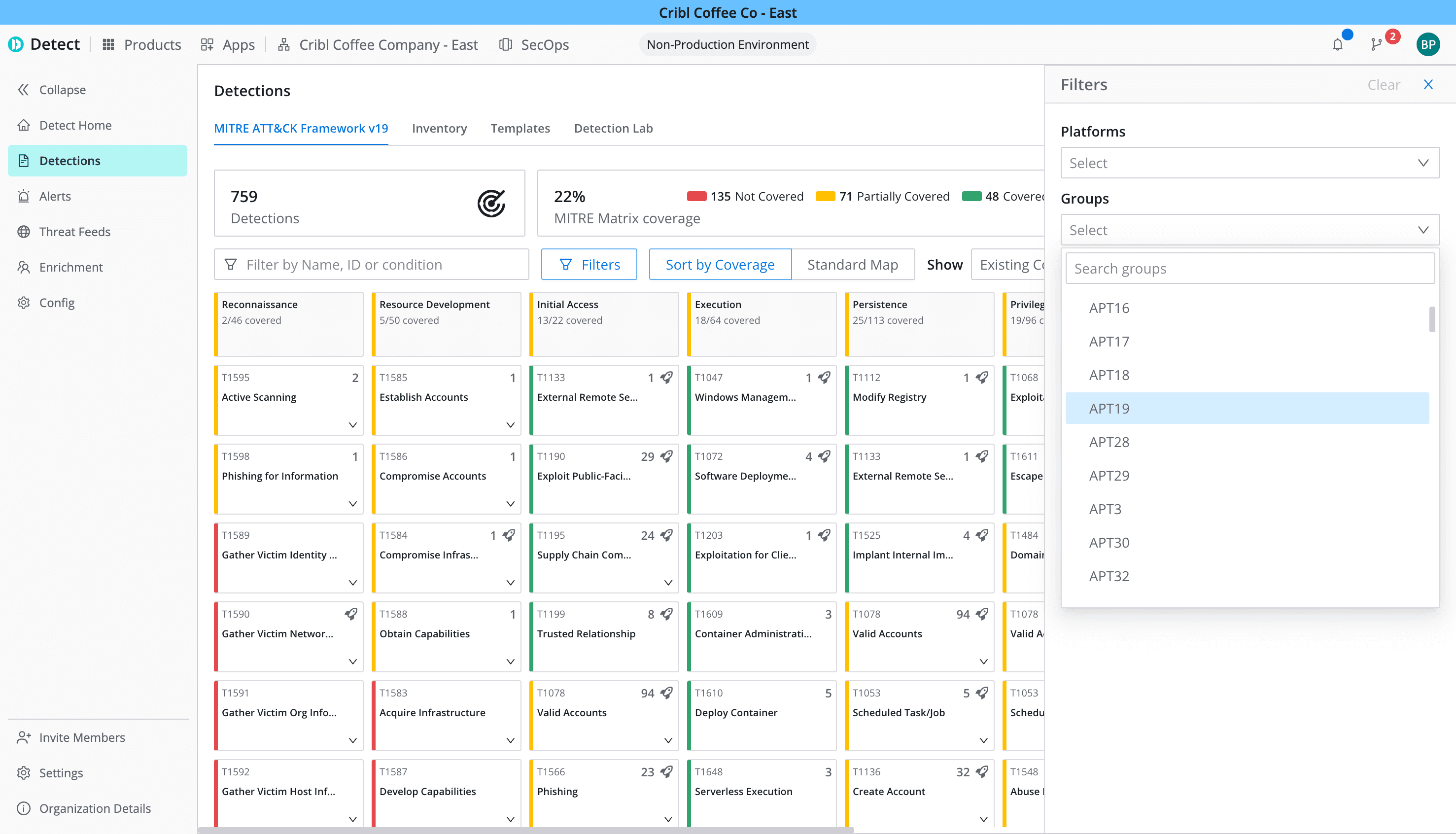
Cribl Detect’s out-of-the box rules are mapped to MITRE ATT&CK techniques and sub-techniques, and users can tag custom rules with the relevant techniques too. This helps coverage views stay current as rules are added, changed, or retired.
Telemetry mapping
A detection is only as good as the telemetry behind it. Telemetry mapping identifies which log sources each detection depends on, then answers two key questions:
Is the telemetry available? Is the source onboarded and flowing, or has it gone stale or offline?
If not, what's needed? Which source needs to be onboarded, which fields need to be extracted, and which mappings need to be fixed?
This is the other half of every coverage gap. Detection mapping shows where rules are missing. Telemetry mapping shows where the data is incomplete or malformed. You need both views to know whether a technique is covered.
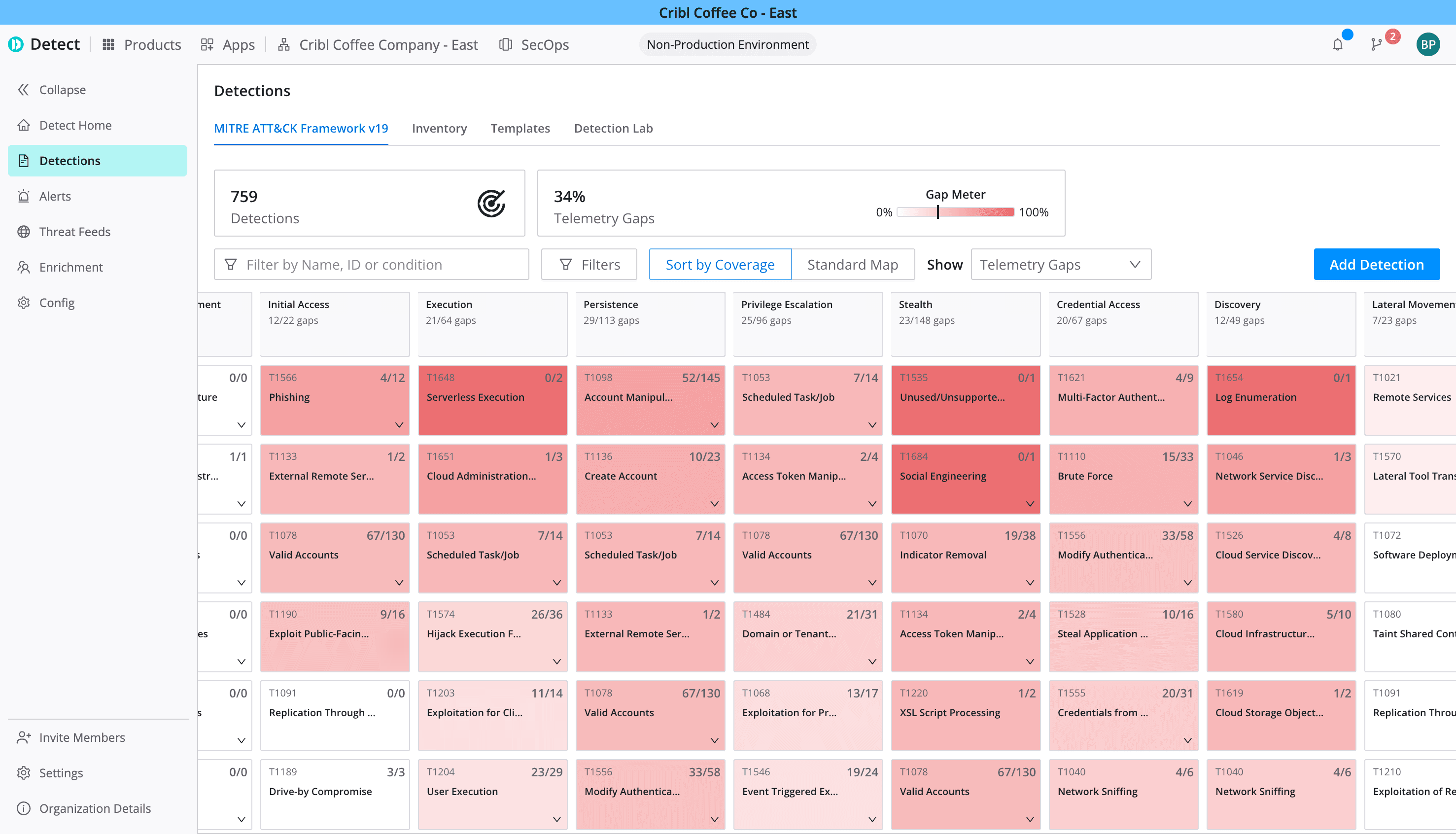
With Cribl Detect, you can see which techniques and sub-techniques are missing the telemetry needed to power detections.
Coverage scoring
Coverage scoring answers “how well are we covered, and is our coverage improving?” The coverage score metric is simply the percentage of adversary techniques covered by detections that are backed by working telemetry. A few principles keep the score honest:
Score at the technique and sub-technique levels. Technique-level scoring on its own can overstate coverage.
Count only what works. A technique with a rule but no supporting telemetry, or with a broken rule, is not covered.
Break it down. View scores by tactic, by threat actor, and by platform infrastructure (e.g. Windows, Linux, Mac) to see where coverage is thin.
Track it over time. The trend is what matters most to SOC leaders and CISOs. It turns "are we covered?" into a number, a direction, and a plan.
Full coverage shouldn't be the goal. Any SOC that feverishly chases 100% ATT&CK coverage is missing the point. The goal is to have coverage for techniques that matter to your organization, with steady, measurable progress over time.
Rule health
Rule health tells you whether deployed detections are working as intended. An enabled rule is not the same as a working rule. Rule health validates detection logic on an ongoing basis and identifies the root cause when something goes wrong.
Two failure modes are important to track:
False negatives. The rule doesn't fire when it should. Common causes include stale or missing sources, schema drift, renamed fields, parsing errors, and configuration changes after updates. Rule health flags rules that have gone unexpectedly quiet and checks them against the telemetry they expect.
False positives. The rule fires too often. Noisy rules bury real signals and burn analyst time, and they often end up disabled, which creates a new coverage gap. Tracking alert volume and true-positive rates per rule shows which detections need tuning.
Understanding the root cause is what makes rule health useful. "Rule X is broken" is just another finding without any real benefit. "Rule X stopped firing because the source renamed the user field in last Tuesday's update" enables a fix that actually improves your posture.
Gap analysis and prioritization
These findings will create al backlog of potential remediations, so eventually the question becomes “what should we fix first?” Once you have a more complete picture of your current coverage, gap analysis helps you begin to answer that question. Gaps fall under two general categories:
Missing coverage. There's no detection for a technique or sub-technique, or no telemetry to support one.
Broken or noisy coverage. A rule is deployed but isn't working as intended and needs to either be fixed or tuned.
Teams have limited capacity to address these gaps, so prioritization decides what gets filled now, next, and later. Some of the inputs that matter most for prioritization may include:
Threat relevance. Techniques used by threat actors targeting your industry or region, and APT groups your intel team has flagged, go to the front of the line.
Prevalence. Techniques seen most often in real, observed attacks deserve early attention.
Asset exposure. Gaps that affect critical systems or newly deployed infrastructure carry more risk.
Effort. Gaps you can close with telemetry you already collect and content you already have are the fastest way to recover coverage left on the table.
Detection posture management use cases
With those components in place, detection engineers and SOC leaders can run a set of repeatable workflows. Four key use cases stand out.
Detection lifecycle management
Every detection has a lifecycle. Detection posture management brings actionable insights to each stage:
Deploy. Use coverage scores and ATT&CK mapping insights to determine which new rules to develop and deploy first. Base these decisions on coverage gaps and priority, not just which templates happen to be available.
Maintain. Rule health findings help identify broken and noisy rules quickly, and tee them up for repair or tuning.
Retire. Remove rules that duplicate other rules or cover systems you've decommissioned. Fewer, better rules mean less maintenance and less noise.
Iterate. Re-score coverage after each change and repeat the cycle.
Leading teams seem to be favoring quality over quantity with their detections: the State of SIEM Detection Risk Report found the number of rules in production SIEMs has dropped by nearly a quarter since 2022, and in 2025 the share of broken rules fell to its lowest level in all five years of data. Detection lifecycle management is how to maintain this high standard of detection quality.
Detection engineering automation
A lot of detection engineering is repetitive, toilsome work: mapping rules to ATT&CK by hand, adapting templates to local field names and data sources, testing rule logic, validating everything still works after an upstream change, and staying on top of new threats.
Detection posture management automates those steps so engineers can spend their time on work that needs their judgment, like threat research, hunting, and writing detections for new behaviors. The biggest wins come from automating detection mapping, telemetry dependency checks, logic validation before a rule is deployed, and health monitoring after it's live.
Threat preparedness
When a new campaign makes the news or a board member asks whether you're exposed to a specific threat actor, preparedness means being able to answer quickly and specifically. The workflow looks like this:
Filter your coverage to a specific APT group or set of techniques.
See which techniques are covered, which have broken rules, and which lack telemetry.
Close the highest-priority gaps.
Track score improvements to confirm progress.
Answering "are we prepared to detect this threat if it hits our environment?" is no longer guesswork, but a confident response that flows from these detection posture management processes throughout this post. Now you can confidently tell the board something like: "We cover 14 of the 19 techniques this group uses. Three more will be covered this week, and the last two need a log source we're onboarding now."
Operationalizing threat intelligence
Threat intelligence only reduces risk when it changes what you can detect. Posture management turns that into a repeatable process:
Extract the tactics, techniques, and procedures from a new report or feed.
Map them to ATT&CK.
Check them against current coverage, including both detections and telemetry.
Build and deploy detections for the behaviors you don't cover.
Validate that the new rules work.
Without that process, intel reports sit in the detection engineering backlog, and engineers still have to do most of the research to turn them into detection logic. With it, each new report becomes deployed, validated coverage.
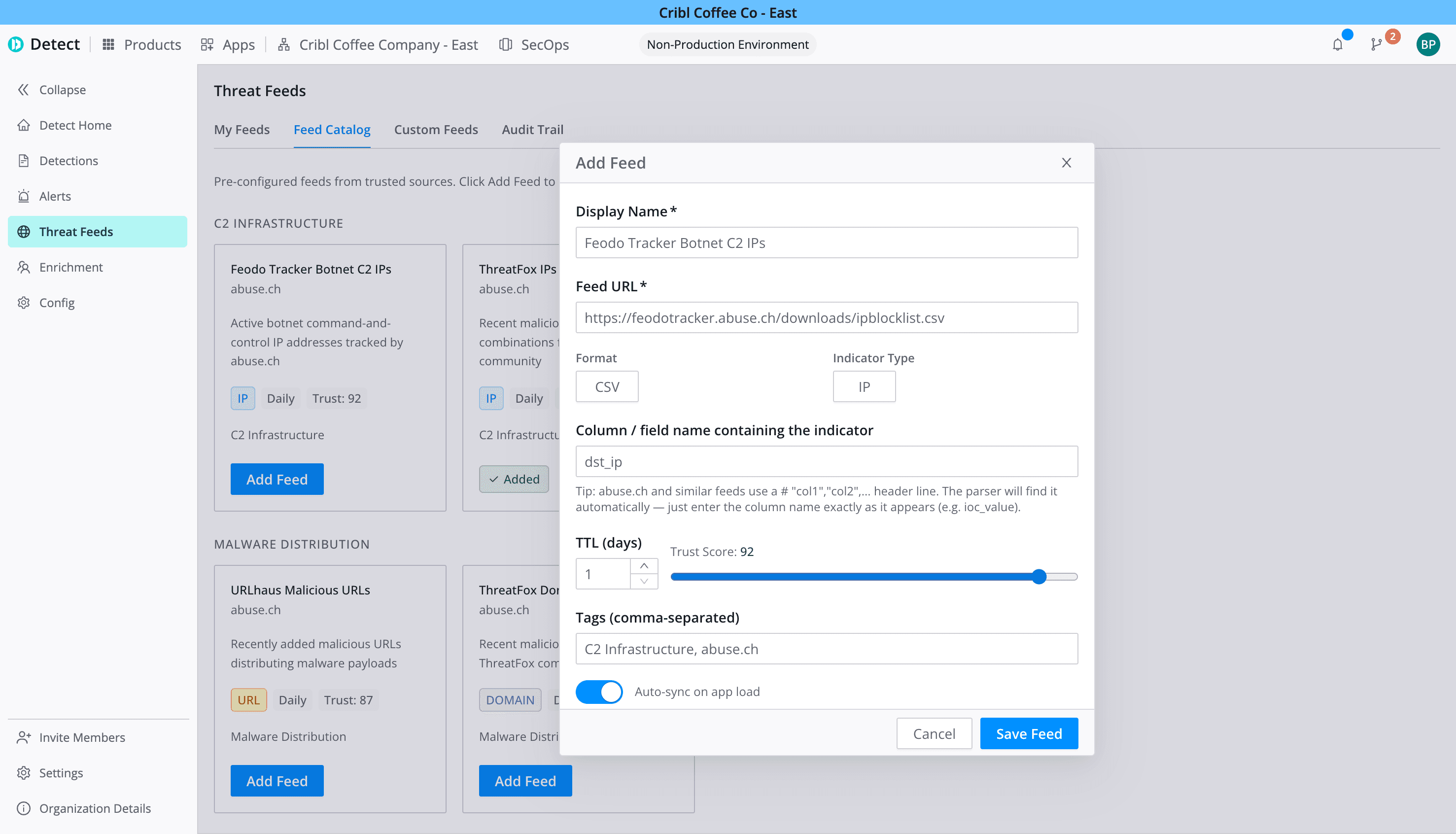
Threat feeds bring intelligence directly into the platform, helping map detections to specific APTs and enriching alerts with indicators that accelerate response workflows.
How Cribl Detect helps
Cribl Detect offers detection posture management as a core capability, starting with the MITRE ATT&CK Framework. Detect shows a heatmap view of how your current detections cover ATT&CK sub-techniques, with a high-level coverage score that tells you where you stand. Filtering on threat groups or technology platforms offers granular coverage views to answer more specific questions related to vulnerable infrastructure or your readiness to detect specific APT behaviors.
Detect also shows your potential coverage, comparing observed events already in the system against detection rule templates that haven’t been deployed yet to indicate what your coverage could be if you deployed those templates into production. You also get a view of telemetry gaps, pinpointing which ATT&CK techniques are missing the relevant telemetry for the rules to work.
Templates are Detect’s out-of-the-box detection content, developed by a team of expert security researchers with decades of collective detection engineering expertise. These production-ready rules have been tested and validated at enterprise scale, and new templates are continuously added as new threats emerge. For anything else, there’s Detection Lab, an AI Copilot for detection development with an intuitive, familiar chat interface to generate and refine new detections.
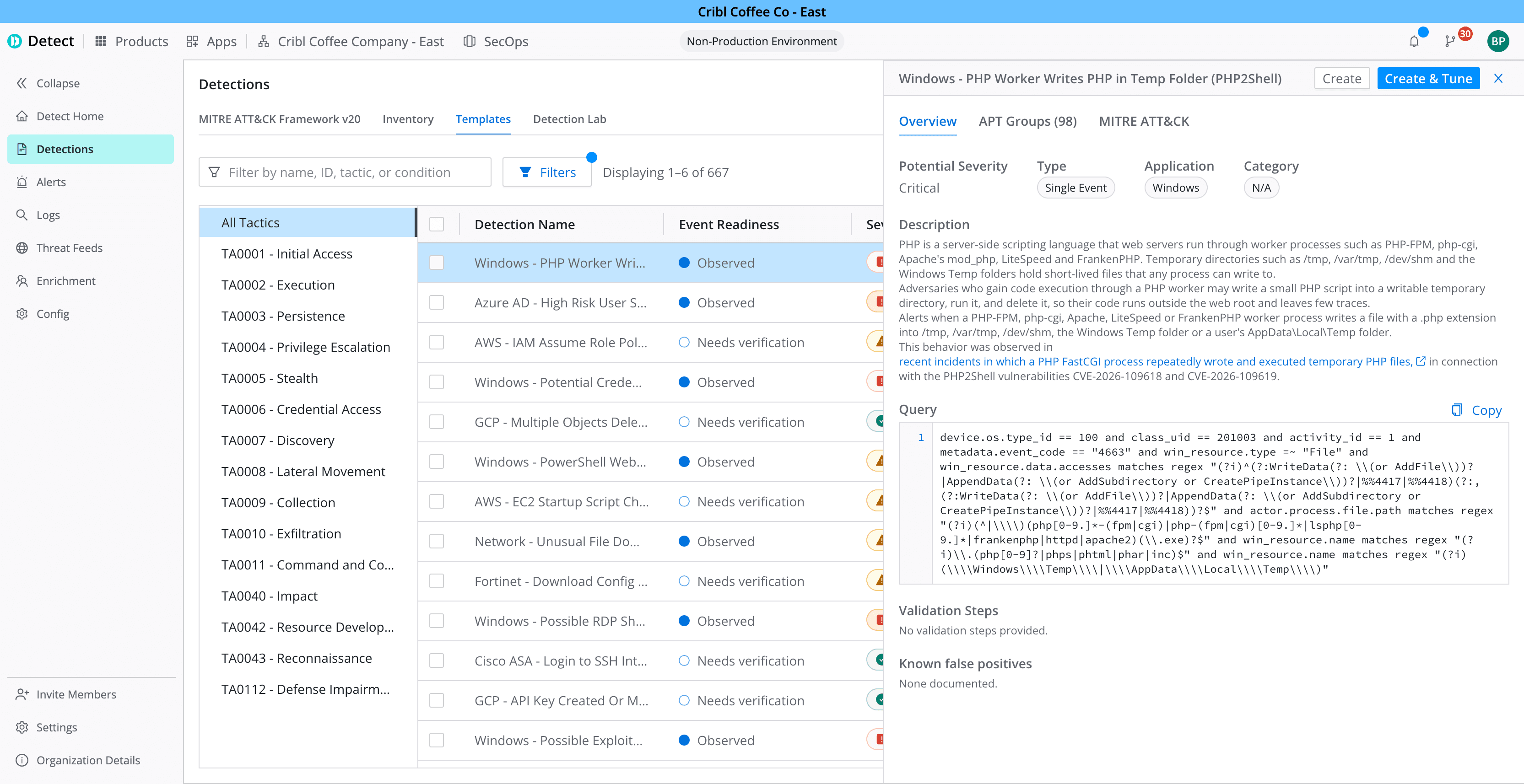
Detect provides thousands of production-ready rule templates for a wide range of threat detection use cases, already mapped to the relevant ATT&CK techniques and relevant APT groups.
Together, these Detect capabilities give you a clear understanding of your current threat readiness and provide multiple ways to expand coverage and continuously improve your detection posture.
Turn detection coverage into a measurable program
The distance between the 22% of ATT&CK techniques most SIEMs cover and the 90% they could cover with data already being collected comes down to visibility and process. Detection posture management provides both.
Detection and telemetry mapping show what each rule protects against and whether it has the data it needs. Coverage scoring turns readiness into a number you can track. Rule health catches silent failures and noisy rules before they become incidents or burnout. Gap analysis and prioritization point the team at the work that matters most. Put those components to work across the detection lifecycle, engineering automation, threat preparedness, and threat intelligence, and coverage becomes something you manage on purpose.
For detection engineers, that means less toil and more trust in the rules they've built. For SOC leaders, it means a clear answer to "are we covered?"
See it in action. Request a demo to see how to manage detection posture with Cribl Detect.