
There’s a new way to SIEM
Find and fix your detection and telemetry gaps, detect before storage, and investigate across your entire estate. Decouple analysis from storage, so cost decisions don't create blind spots. It's a SIEM, but not as you know it.

The Challenge
Your SIEM bill grows faster than your coverage
Legacy SIEMs are buckling under AI-era data growth. The cost of moving data into proprietary storage rises far faster than budgets do, so security teams filter and drop data to stay solvent. Detections break as schemas drift. Analysts pivot across tools to chase one alert. Data that could make the difference between quick detection versus a costly breach might never reach the SIEM. Heads spin, crucial questions go unanswered, and the renewal quotes go up and up and up.
The Solution
Security designed for outcomes, not your SIEM budget
Cribl breaks down the monolith. Ingestion, analytics, and storage are separate, so detection, hunting, investigation, and AI-driven operations can run on telemetry wherever it lives, not just what's been paid for, ingested, and indexed. A complete security analytics platform that isn’t going to Pac-Man its way through your entire security budget.

Security value starts before storage
Detection runs in the pipeline, before you've decided where that data will live, whether that’s Cribl Lake, Lakehouse Engine, or any other destination. No need to wait for data to be ingested, indexed, and stored before it can be used for detection and response - security value starts before data reaches its destination.

Continuously improve detection posture
Posture management maps coverage to ATT&CK and shows where you’re missing detections - or the telemetry to power them. Find detections that are silently failing, before a threat goes undetected. Prioritized recommendations tell you what to fix first.

Investigate the whole estate
AI-driven federated search spans Cribl, data lakes, object storage, and other SIEMs. Query a year-old S3 log and last night's endpoint alert together, with no rehydration and no ticket to move data first. Cribl Detect is open by design - your detections and data come with you, no re-indexing to get them back.

Detection for all your data, not all your budget
Legacy SIEMs make you choose which data you can afford to secure. Cribl Detect breaks the link between what you keep and what you pay to analyze, so you can detect and retain across more of your telemetry without your bill growing to match.

Guide
Why security teams are deciding it’s time for a change
Security teams don’t hate their SIEM. They hate what they have had to put up with to get value from it. Read on to uncover the full “it’s complicated” story from the point of view of the CISO, SOC Manager, and Detection Engineer - and learn what form a new way could take.
Key features
In-stream detection
Cribl Detect spots suspicious activity as data moves through the pipeline, creating signals that speed up response, then chains them into correlations that catch the slow-burn attacks a single rule misses. Detection starts before storage, even on data headed to your existing SIEM.
Posture management
See your coverage across MITRE ATT&CK, catch rules quietly failing to schema and config drift, and get told which detections and telemetry to add next. Stop counting rules. Start closing gaps.
AI-powered investigations
AI-driven investigation helps analysts go from alert to answer and containment fast, without building every query. Notebooks wrap queries, findings, and related alerts into shareable investigation workflows.
Smart tiered storage
Not all telemetry has the same security value, so it shouldn't cost the same to store it. Cribl routes data to tiered destinations based on its value: hot storage for high-value, frequently searched telemetry, and low-cost storage for full-fidelity historical data.
Webinar
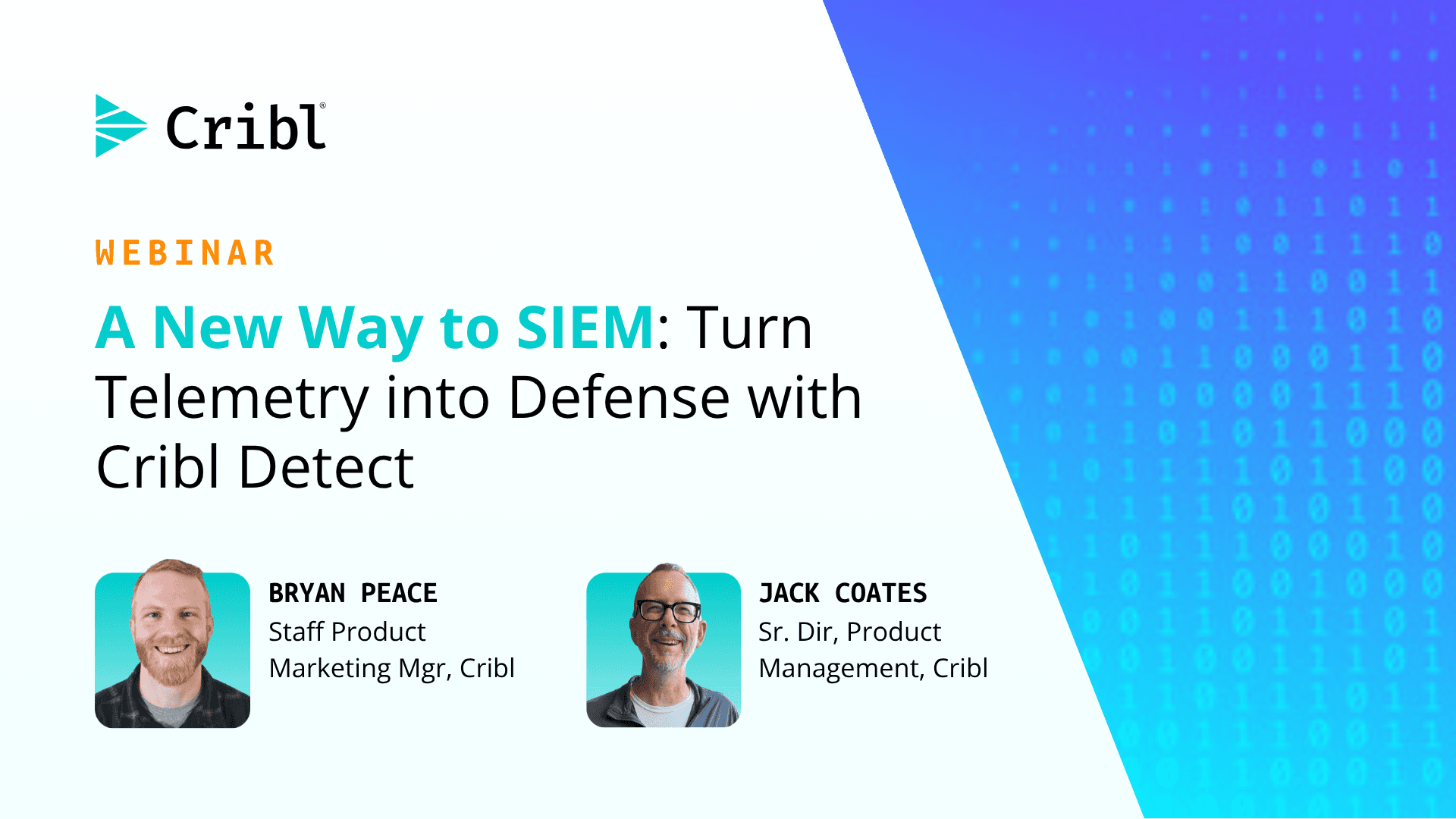
Turn Telemetry into Defense with Cribl Detect
Join us on Wednesday, October 28th to see what a new way to SIEM could actually mean for security teams. See a live demo, ask questions, and learn how it improves choice, flexibility, and control when compared to legacy solutions and ‘SIEM-less’ alternatives.

AI readiness
Give AI investigators a data foundation worth trusting
An AI investigator is only as good as the data it can reach. By separating security analytics from closed, vendor-controlled storage, Cribl lets analysts and AI agents work across your full estate, not just what one platform indexed.
RESOURCES
Explore more from Cribl


get started
Choose how to get started
See
Cribl
See demos by use case, by yourself or with one of our team.
Try
Cribl
Get hands-on with a Sandbox or guided Cloud Trial.
Free
Cribl
Process up to 1TB/day, no license required.