
INCIDENT | DynamoDB otel-demo-orders write capacity 10→1 · ~86% of order writes failing. One agent, one prompt, two telemetry paths.
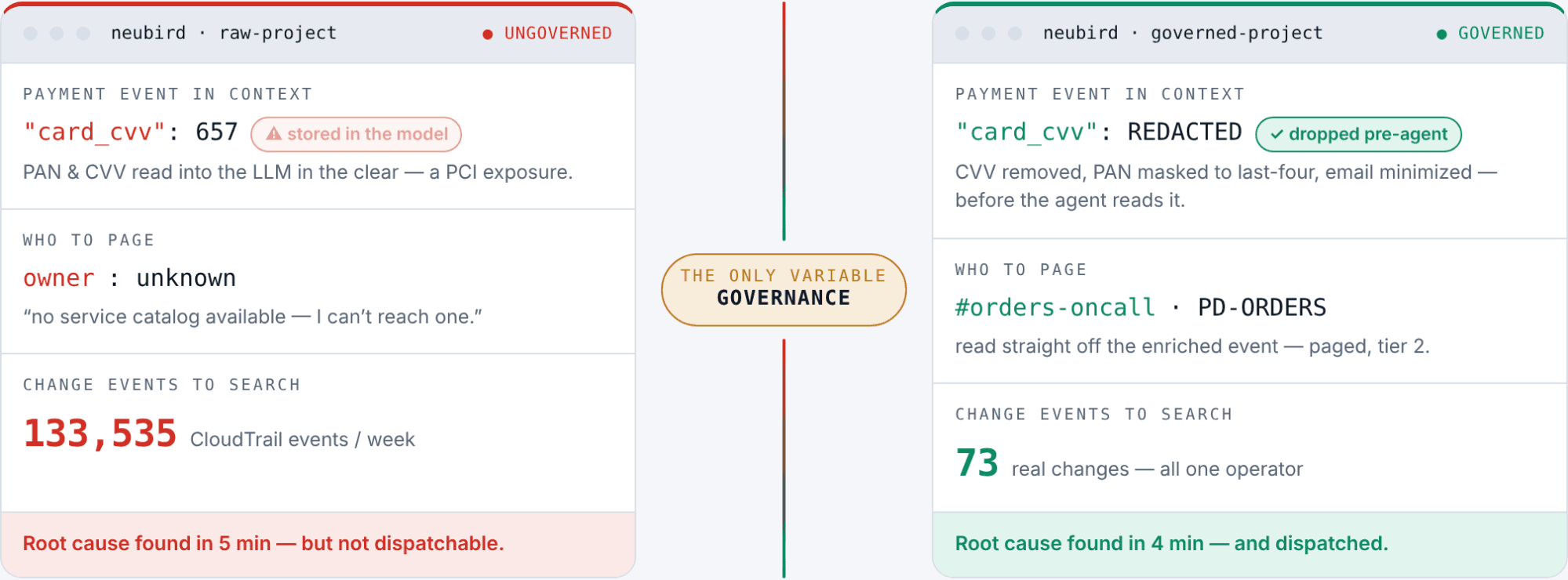
Same model. Same prompt. A strong agent on both sides. Governance decided what the AI was allowed to see and what it was able to conclude — from PCI exposure to who got paged.
The on-call loop is getting a new first responder, and it isn’t human.
AI agents are moving into operations — not writing runbooks, running them. You wire one to your telemetry, and when something breaks it reads the logs, metrics, traces, and change events itself, forms hypotheses, tests them with its own queries, and hands back a root cause and a fix while you’re still typing your password into the VPN.
The agent we used is the Production Ops Agent by NeuBird. Point it at an incident and it connects to your telemetry over MCP, decides what to query, correlates across signals, and returns a cited root-cause analysis — with a remediation plan and rollback steps — in minutes instead of the hour-plus it takes by hand. It’s genuinely good at this. Which is exactly why the next question matters so much.
Any agent inherits the trustworthiness of its data. Feed it a clean, governed stream and it reasons like your sharpest SRE; feed it the raw firehose and it can only work from whatever happened to be in the pile — including things that should never have been there. The variable isn’t the agent; it’s what the pipeline leaves for it to read.
So we tested it. Same agent, same outage, twice — changing only whether Cribl governed the telemetry on the way in. One run pulled a live card number and a CVV into the model’s context and still couldn’t tell us who owns the broken service. The other dropped the CVV before the agent ever saw it, named the owning team, and paged them, in four minutes. Here’s what happened.
The test: two orgs, two NeuBird projects, one prompt
The app under test is the OpenTelemetry Astronomy Shop — including a few AI services of its own — on EKS. The telemetry forks into two Cribl Cloud orgs: a raw org where it lands in Cribl Lake exactly as emitted, and a governed org where it flows through Cribl Stream first — an agent-ready pipeline that redacts and drops sensitive fields, drops the noise, and enriches every event with correlation and ownership keys — then lands in a Lakehouse engine. NeuBird gets two projects, one per org. Same agent, same model, same prompt.
The fault is infrastructure, not code. A Terraform apply cut the write capacity on the otel-demo-orders DynamoDB table from 10 units to 1. DynamoDB throttles, order-writer logs ProvisionedThroughputExceededException on PutItem, retries once, drops the order. ~86% of order writes fail. Then the identical question to both:
Order persistence is failing on the storefront backend over the last 90 minutes. Find the root cause, what changed, and who owns the fix.
Reading the screenshots: the two Cribl Cloud orgs keep their own themes, so in the Cribl Search captures below, a light background is the raw org and a dark background is the governed (prep) org. The NeuBird panels are all in its own dark theme and are labeled Raw or Governed.
Leg 1: what is the agent even allowed to see?
An agent with broad read access reads whatever is in there. The checkout path emits real-looking cardholder data, and on the raw side all of it flows straight into the agent’s context in the clear: a customer email, a PAN, and a CVV. That’s an AI agent — and its model provider — now holding cardholder data. PCI-DSS says the CVV must never be stored, period.
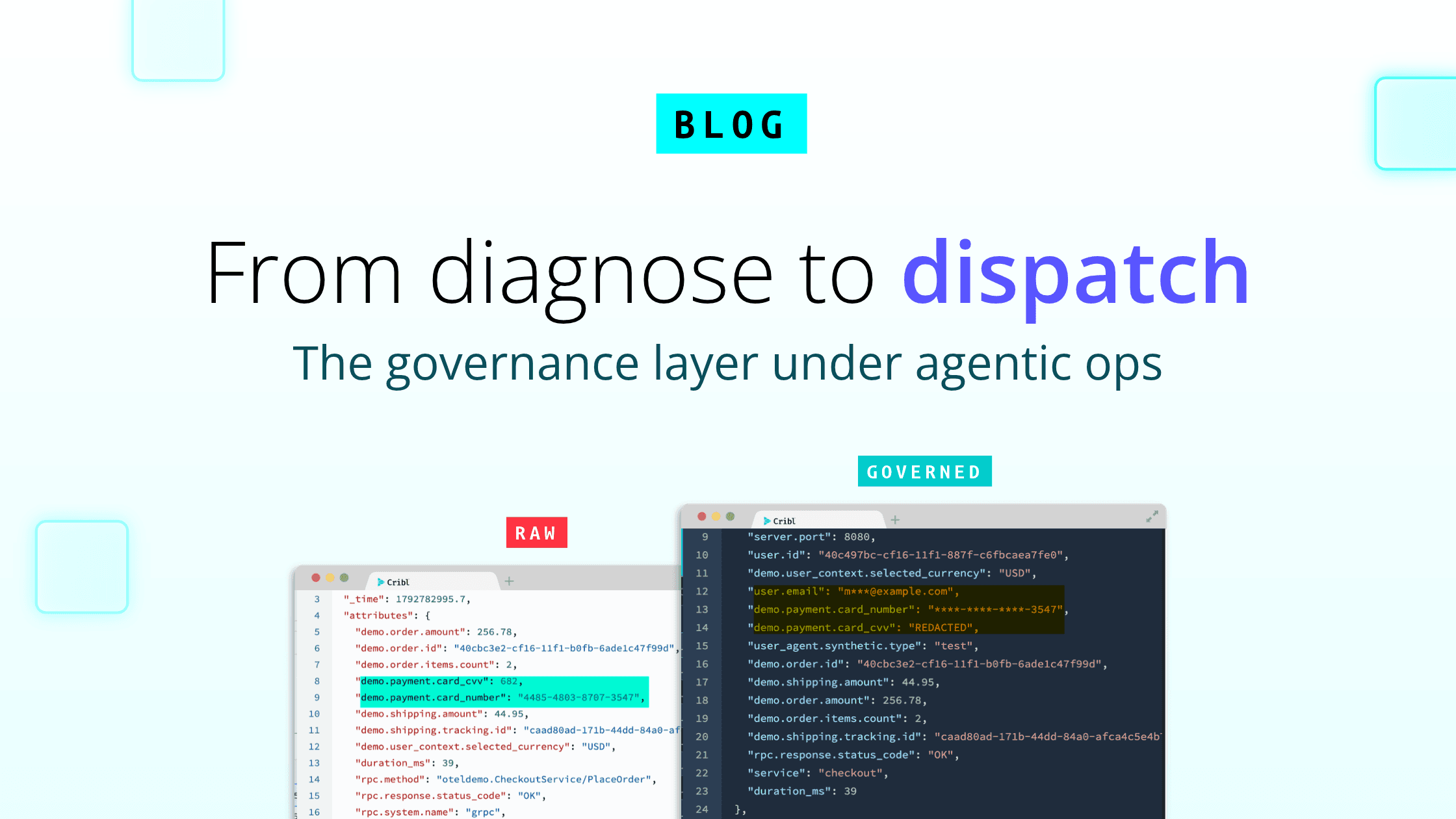
On the governed side, the agent-ready pipeline applies three differentiated controls before the data lands — because the right action differs by field: mask the PAN to last-four, minimize the email to first-char-plus-domain, and drop the CVV outright. All three cover the serialized raw event the agent reads over MCP.
RAW · CRIBL SEARCH Figure 1 (raw) — one checkout, in the clear
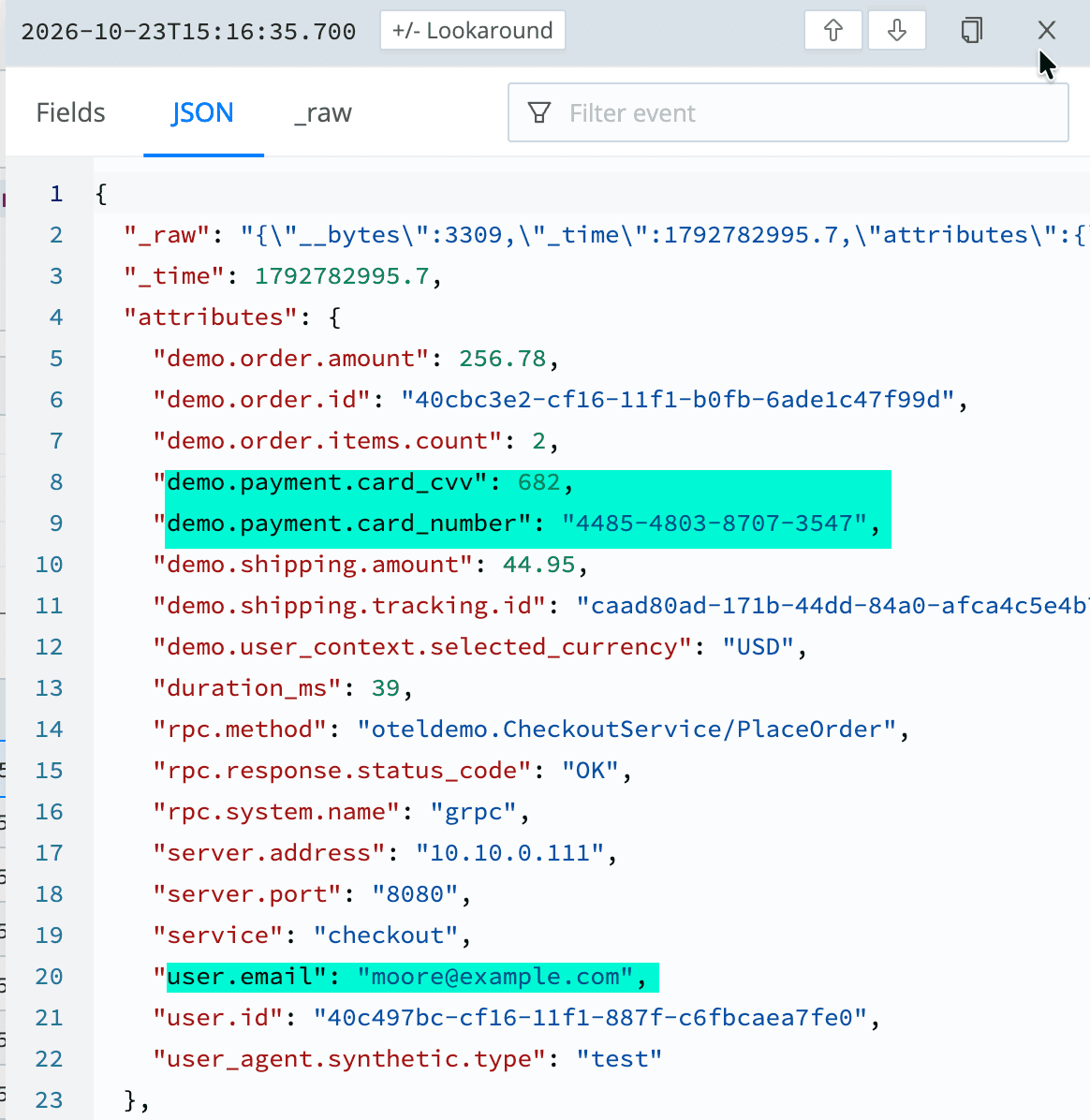
Raw: user.email: moore@example.com, card_number: 4485-4803-8707-3547, card_cvv: 682 — PAN, CVV, and email all reach the agent in the clear.
GOVERNED · CRIBL SEARCH Figure 1 (governed) — the same order, governed
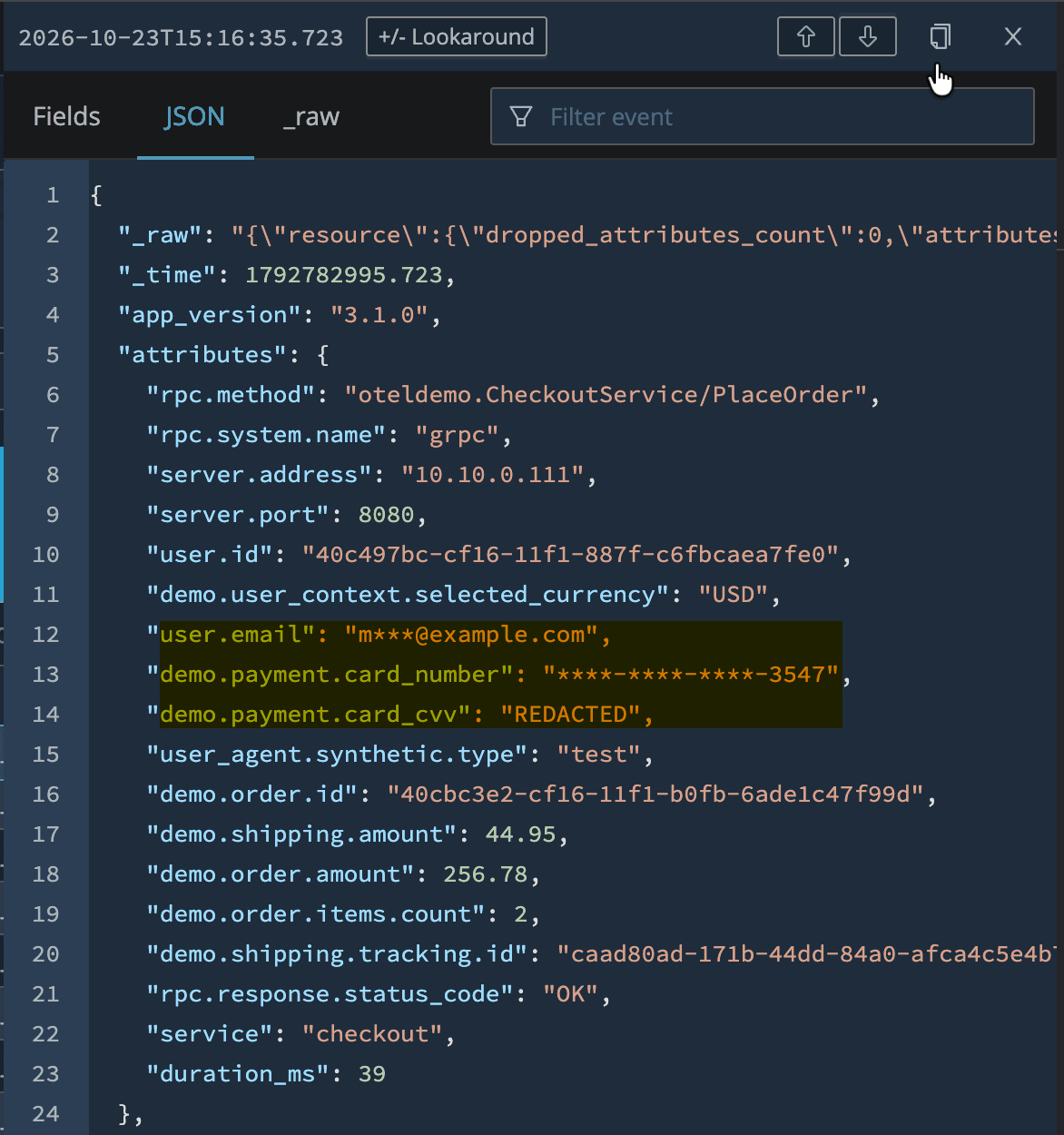
Governed: the same order ($256.78) — m***@example.com, ****-****-****-3547, card_cvv REDACTED. Email minimized, PAN to last-four, CVV dropped. The agent loses nothing it needs; you lose the liability.
And payment data isn’t the only thing stripped. CloudTrail attaches credential material to every call — the access-key ID, principal ID, and session context. The agent-ready pipeline drops all of it from the change feed while keeping who made the change, so the agent gets the actor’s identity for accountability but never a usable AWS credential.
RAW · CRIBL SEARCH Figure 1b (raw) — credentials in the change record
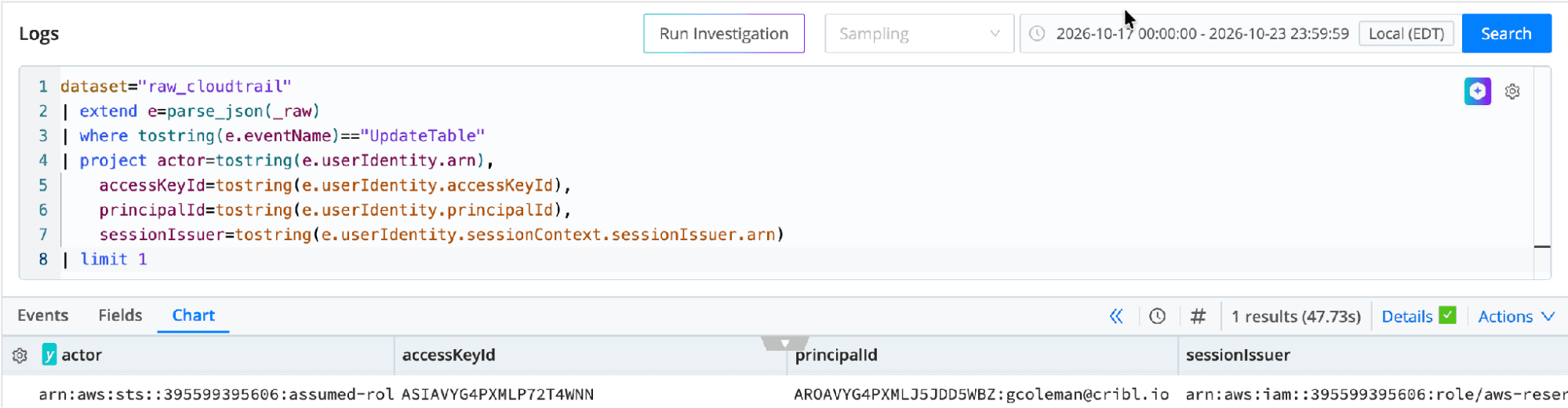
Raw: the change carries accessKeyId (ASIAVYG4PXMLP72T4WNN), principalId, and the session issuer — AWS credential material the agent has no use for.
GOVERNED · CRIBL SEARCH Figure 1b (governed) — who, not the credential
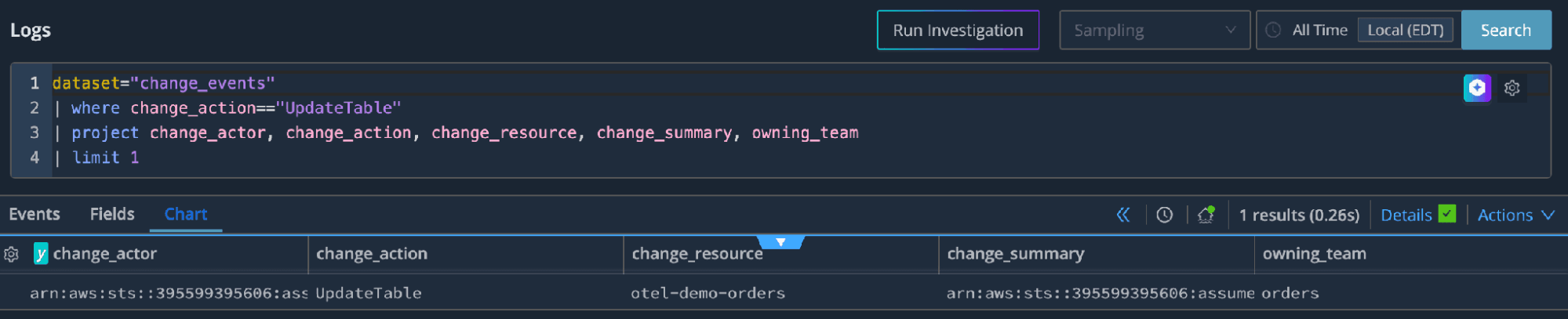
Governed: change_actor is kept for accountability and owning_team: orders is added — but the access-key ID, principal ID, and session context are gone. Who made the change, not the key to impersonate them.
Leg 2: trustworthy context, not just less data
Minimization is the defensive half. The other half of well-governed data is context — governed facts about your environment riding along with the telemetry, so the agent reasons from them instead of guessing at them.
On raw, NeuBird is already a strong investigator. It nailed the technical root cause in five minutes: the single UpdateTable, the 10→1 cut, the throttling exception, the ~86% drop, and the Terraform apply behind it — with a full remediation plan.
RAW · NEUBIRD NeuBird’s raw-side remediation plan
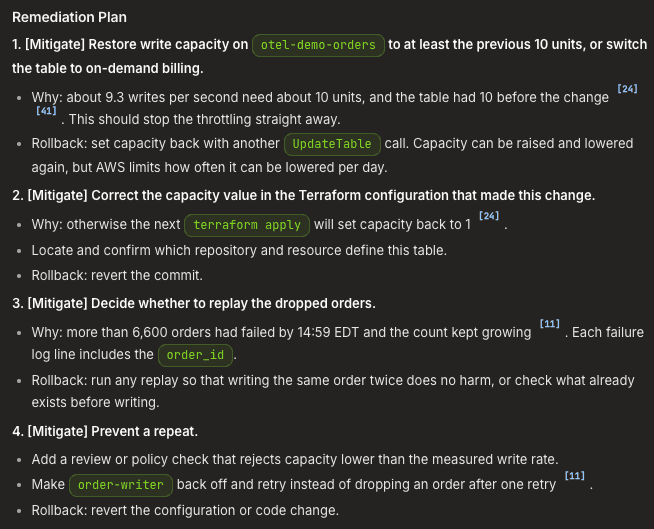
Even on ungoverned data, NeuBird returns a thorough, staged fix with rollback steps. The floor is high — this isn’t about the agent being weak.
On governed, the same agent went from a correct diagnosis to a dispatchable one. It read ownership straight off the enriched event — fields a service-catalog lookup put there, joined once on a normalized service_name:
"owning_team": "orders", "slo_tier": "2",
"slack_channel": "#orders-oncall", "pagerduty_service": "PD-ORDERS"
The raw miss isn’t NeuBird’s limitation — it’s the data’s. On raw it did the right thing: it refused to guess and told us exactly what it would need.
RAW · NEUBIRD Figure 2 — “who owns the fix” on raw
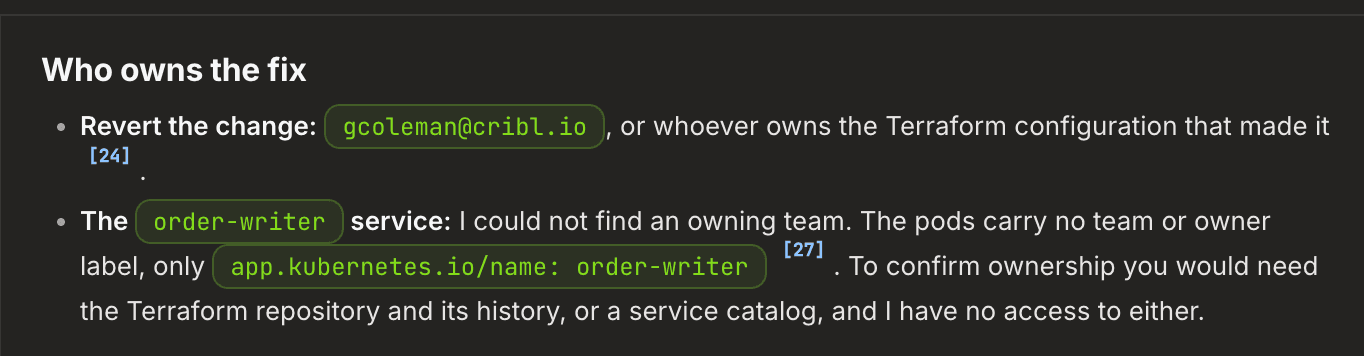
Raw: “I could not find an owning team… you would need a service catalog, and I have no access to either.” No agent can cite an owner that isn’t in the data.
GOVERNED · NEUBIRD Figure 2 (governed) — “who owns the fix”
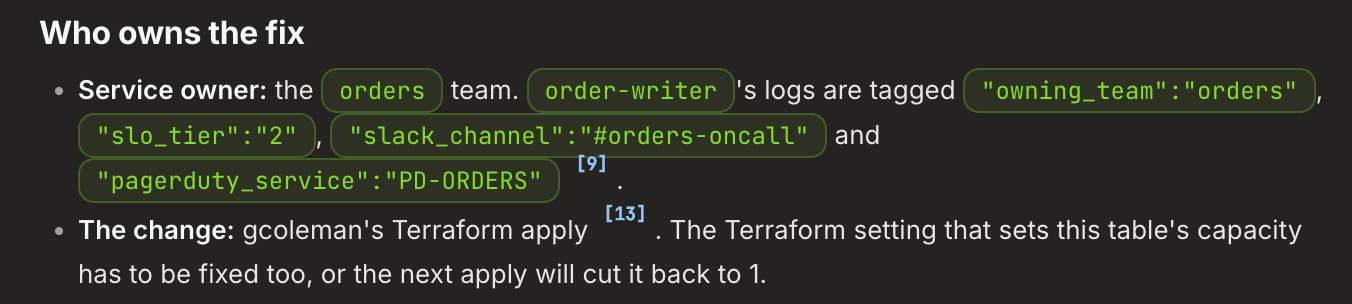
Governed: the orders team — owning_team:orders · slo_tier:2 · #orders-oncall · PD-ORDERS, read straight off the enriched event. It didn’t deduce the owner; it read a governed fact and routed the page.
The tell: without context, even a strong agent follows a false lead
The sharpest evidence isn’t the missing owner — it’s what absent context did to the reasoning. With no enrichment to lean on, the raw telemetry led the agent toward a problem that didn’t exist: it read ~195k events with no container metadata as a pipeline failure, a second active incident. But nothing had actually broken — those events never carried service_name or Kubernetes labels to begin with. That missing metadata is simply how telemetry looks before a pipeline enriches it, not a sign that collection was degrading.
RAW · NEUBIRD Figure 3 — the false lead (raw only)
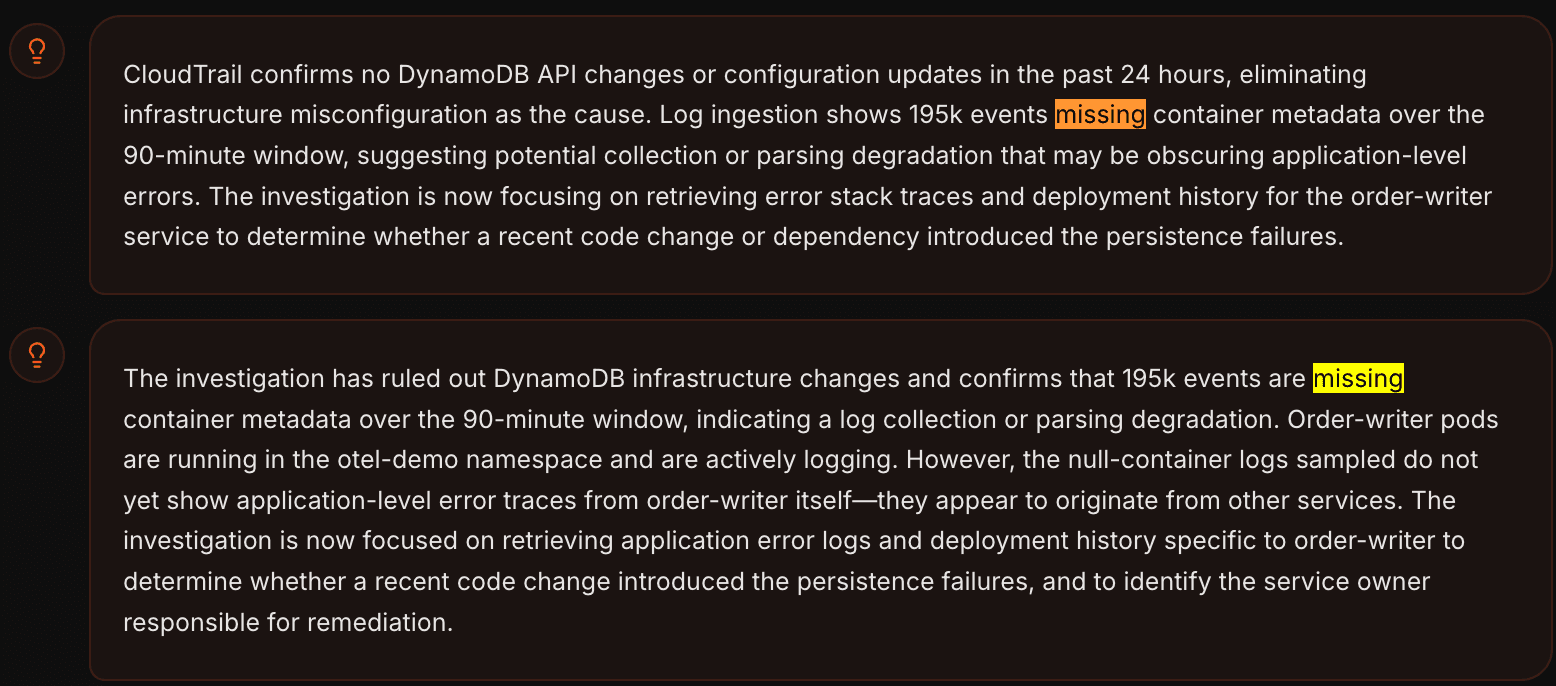
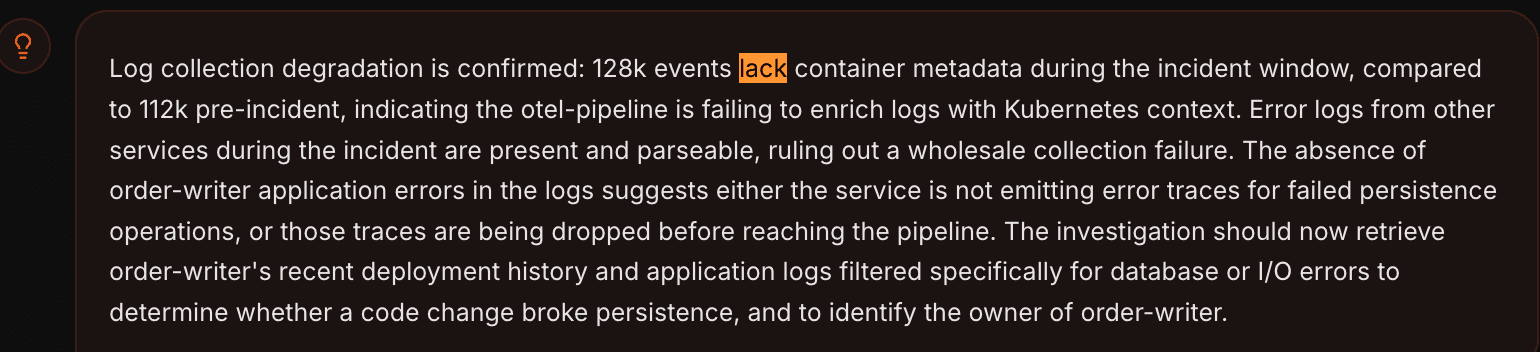
“Log collection degradation is confirmed… the otel-pipeline is failing to enrich logs with Kubernetes context.” There was no degradation — just raw telemetry with no service_name. On the governed side this branch never opens. There is no governed mirror — that’s the point.
Why doesn’t the governed run ever say this? Because the pipeline fills in exactly the field whose absence tripped the raw agent. The agent-ready pipeline promotes Kubernetes and service identity — service_name, k8s_namespace_name, k8s_pod_name, k8s_container_name — onto every event, and derives it for the signals that don’t natively carry it (events, KSM metrics). So on the governed side there is no “events missing container metadata” population to observe, and the false lead can’t form. The same normalization that hands the agent the owner also removes the false lead.
The same gap, as a query you can run yourself
You don’t need an incident to see this. The most basic question in observability — “group this by service” — fails on raw telemetry. One query, one bucket:
RAW · CRIBL SEARCH Group by service, on raw
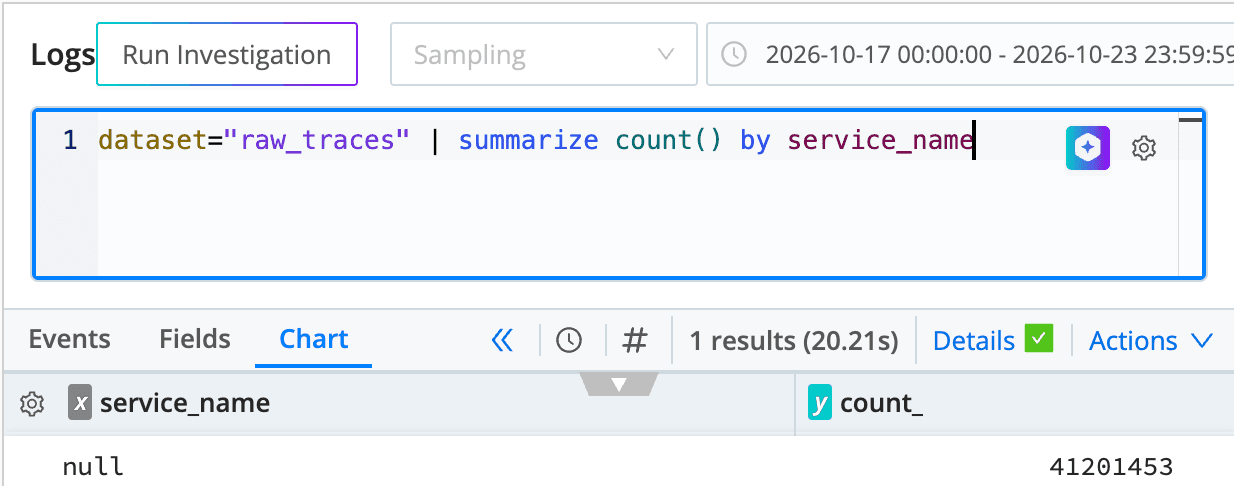
Raw: 41,201,453 spans, one bucket — service_name is null. The field an agent would group by doesn’t exist.
GOVERNED · CRIBL SEARCH The same query, on governed
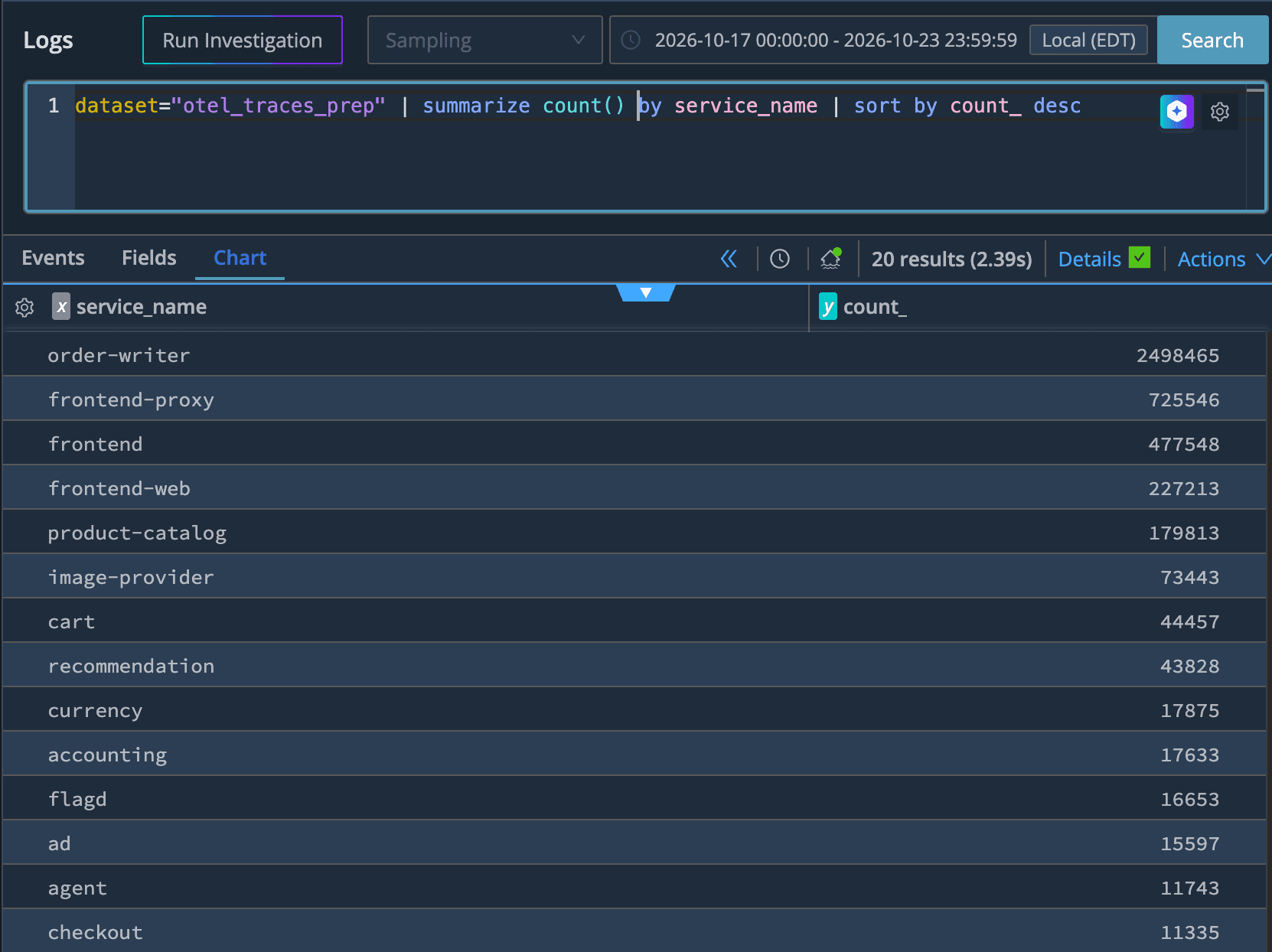
Governed: every service, already named — order-writer, frontend, checkout, cart, recommendation… The pipeline promoted service.name to a flat field on every span.
The names aren’t lost on raw — they’re buried. Dig into the nested resource attributes and they resolve:
RAW · CRIBL SEARCH The data was there all along
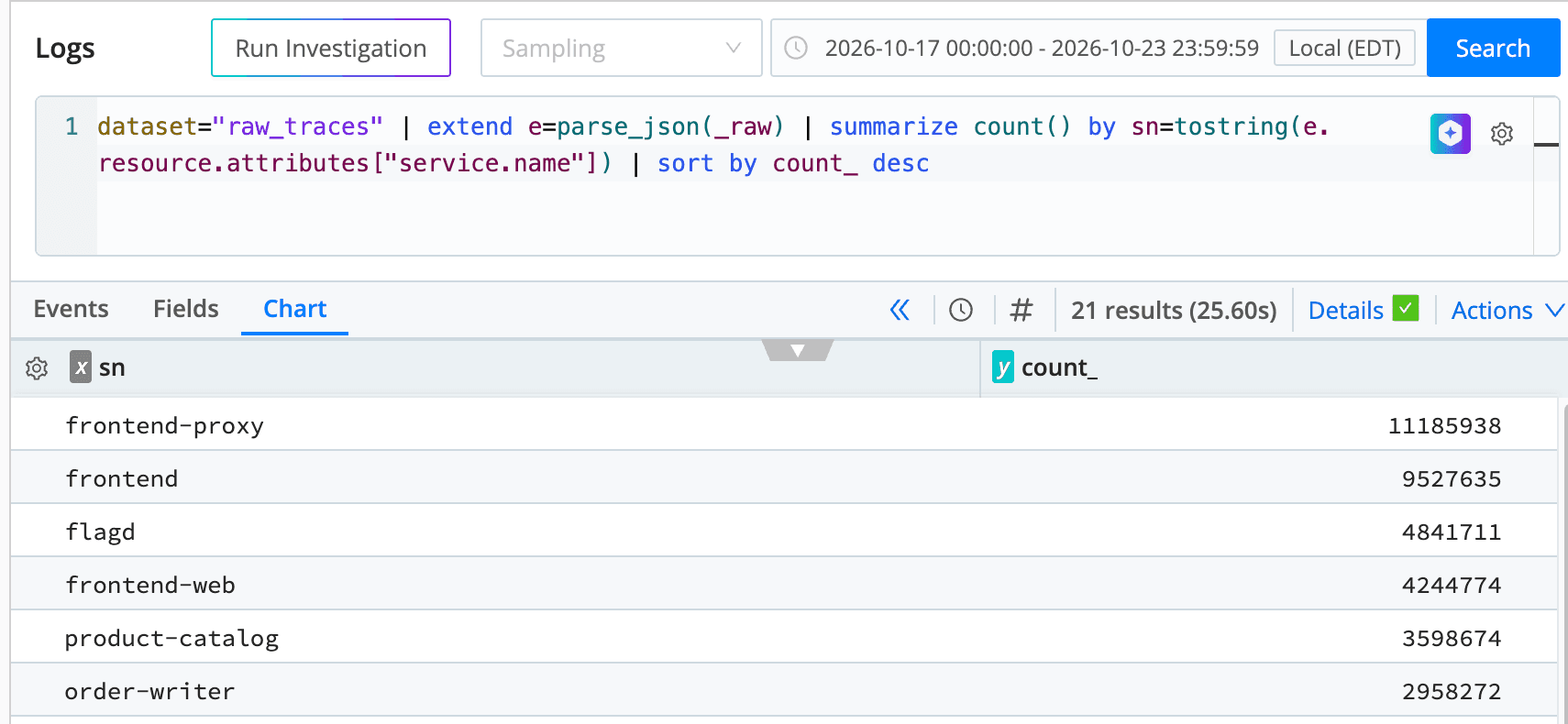
The same names appear — but only via resource.attributes["service.name"]. The agent gets them only if it already knows the exact path, for this signal, for this emitter. Normalization does that join once, upstream.
That’s the move: the agent reads a field instead of reverse-engineering a schema. “Group errors by service,” “which pod,” “who owns it” all become one-field lookups — which is exactly why the governed run never had to invent a pipeline failure to explain what it couldn’t see.
It also had far more room to wander. Over a week, the raw CloudTrail feed carried 133,535 management events — read-only lookups, dry-run checks, and a constant drip of automation from security scanners, EKS, and compliance bots. The governed change feed held 73: every actual change a person made, and every one of them from the same operator. The needle the agent is hunting for is roughly 1 in 1,800.

Cribl Search, Oct 17–23. Raw = unique CloudTrail management events (every API call); governed = changes made by a person or their IaC, with read-only, dry-run, and automation (service roles, Wiz, Cloud Custodian, LogicMonitor) dropped in the pipeline.
Even the fix differs
Both plans reach the same core actions — restore capacity to at least 10 or go on-demand, fix it in Terraform, replay the dropped orders by order_id. Two things set them apart. The governed plan opens with a [Verify] step — read the table’s live capacity and throttling metrics before touching anything — and it assigns the durable fix to the orders team by name. The raw plan’s equivalent step is unowned: “add a review or policy check,” with no one to hand it to. Same insight; one plan is dispatchable, the other is a to-do list without an assignee.
GOVERNED · NEUBIRD Governed remediation plan
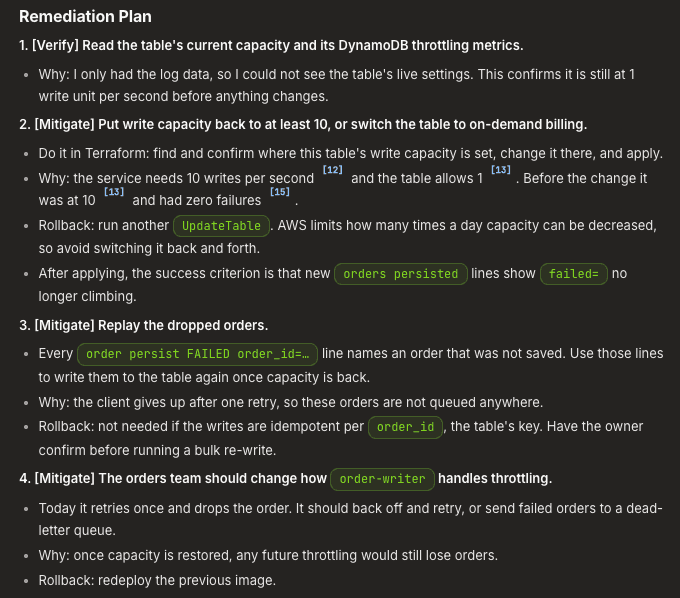
Step 1 is [Verify], and step 4 names the orders team — the plan knows who acts. The raw plan above has the same preventive idea with no owner attached.
Same answer, different ending
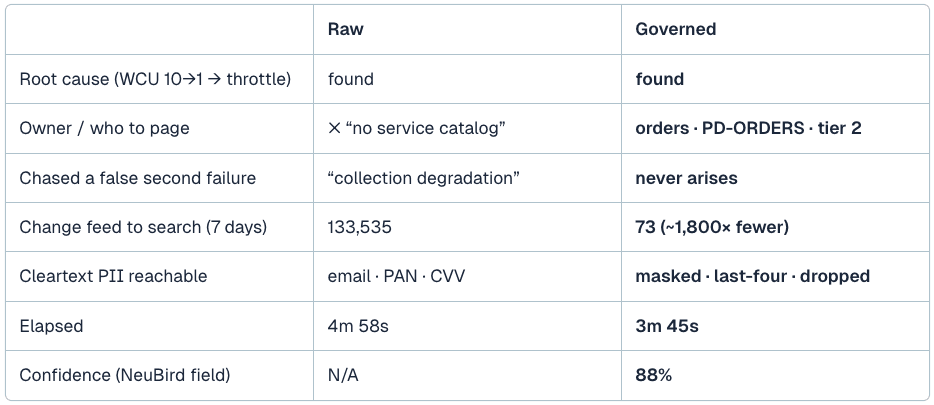
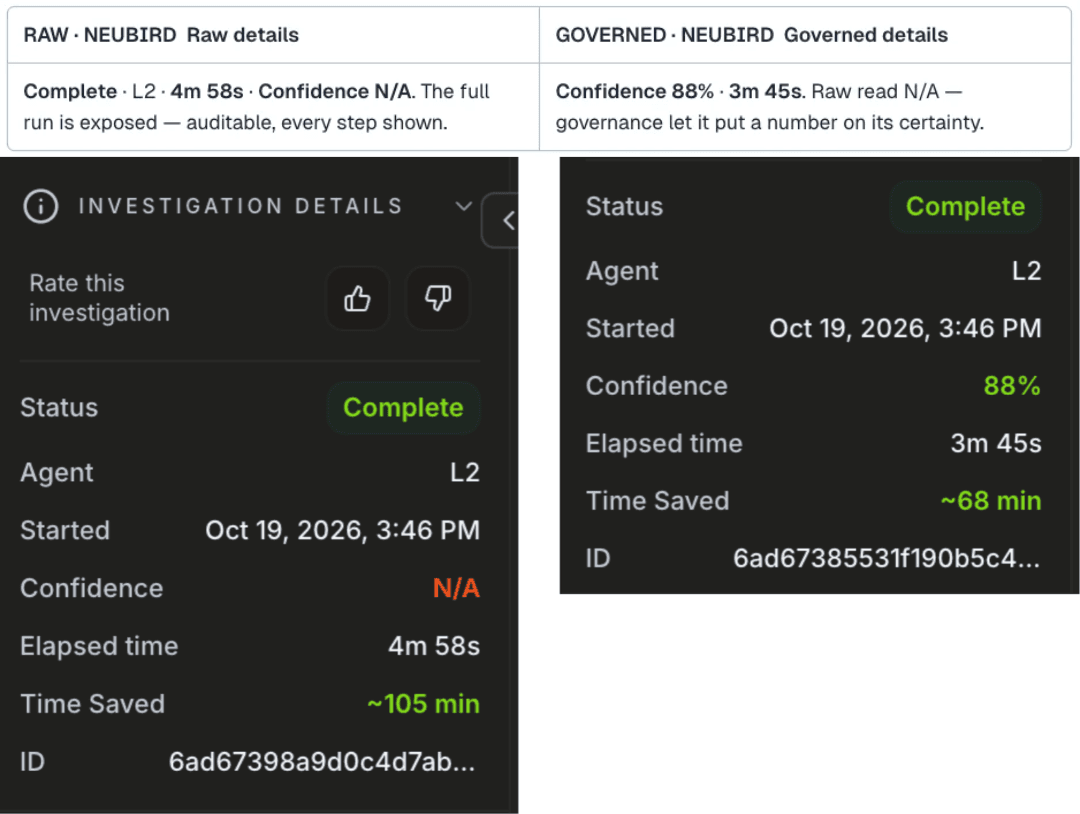
What the pipeline did, by the numbers

The reduction is the tail-sampling — keep every error and slow span, 5% of the happy path — plus dropping flagd polling and below-INFO logs. The 17 added fields aren’t padding: they’re four joins the pipeline does once, on every event — a service catalog (owning team, SLO tier, Slack, PagerDuty, runbook, repo), namespace metadata (environment, business unit, criticality, cost center), a deployment feed (version, git SHA, deploy time, change ticket), and node topology (AZ, instance type, nodegroup). On raw, each is a lookup the agent — or a human at 2 a.m. — would have to make by hand, if the source were even reachable. And normalization collapses 20 differently-named service identities into one service_name, and three error encodings into one span_status.
What each chair gets
If you’re the SRE, the governed run is the difference between a diagnosis and a dispatch: root cause, owning team, channel, PagerDuty service, SLO tier, and the change behind it — cited, in four minutes — instead of staring at app.kubernetes.io/name: order-writer at 2 a.m. You still make the call; you’re just not reconstructing ownership from pod labels.
If you’re the data engineer, the leverage is the point: you masked the CVV and joined the service catalog once, centrally, on normalized fields — and every consumer downstream inherits it, the agent included. (71% of teams with a governance program report high trust in their data; 50% without. This is the mechanism under that number.)
Better together
It’s worth being explicit about the division of labor, because it’s the whole point. NeuBird is an active reasoning engine, not a log parser. It connects to the stack over MCP, forms its own investigative hypotheses, runs iterative queries across disparate signals, and synthesizes a root cause in minutes. The investigation reasons for itself — what it reasons over is the one thing we changed.
Which is the whole thesis in a line: an agent’s output is only as sharp as its context window. Handed the raw firehose, NeuBird still did the professional thing — faced with missing service tags and unpopulated metadata, it refused to invent an owner and told us exactly what it was missing. That’s rigor, not a weakness. Handed a governed, pre-enriched stream, the same rigor becomes leverage: it reads standardized service names and ownership keys straight off the event, skips the manual lookups that pin a human SRE at 2 a.m., ties the throttling to the Terraform change, pins the exact DynamoDB capacity cut, verifies the live metrics, and routes the page to the right PagerDuty service. The agent didn’t get smarter; its context did — and a brilliant diagnosis became a dispatchable remediation.
That’s the division of labor worth remembering: NeuBird brings the reasoning; Cribl governs what it reasons over. Neither replaces the other, and the distance between the two runs is the value each side adds.
What we didn’t measure, and won’t fake
The governed run wasn’t flawless — it briefly considered a pod restart before converging. Both runs reached the correct technical root cause; the governed win is that one answer was dispatchable and the other you’d finish by hand. Per-investigation token counts aren’t exposed, so we don’t report them. And speed isn’t the headline — four minutes vs. five is noise. Governance won on what the agent was safe to see and able to do.
And the data was one AI talking to another
Here’s what makes this more than a lab exercise. The application NeuBird was investigating runs its own AI services — a chatbot, an agent, an MCP server — and their telemetry is LLM telemetry: prompts, completions, tool calls, token counts. That’s the stream flowing into another AI.
GOVERNED · CRIBL SEARCH The app’s own AI, as telemetry
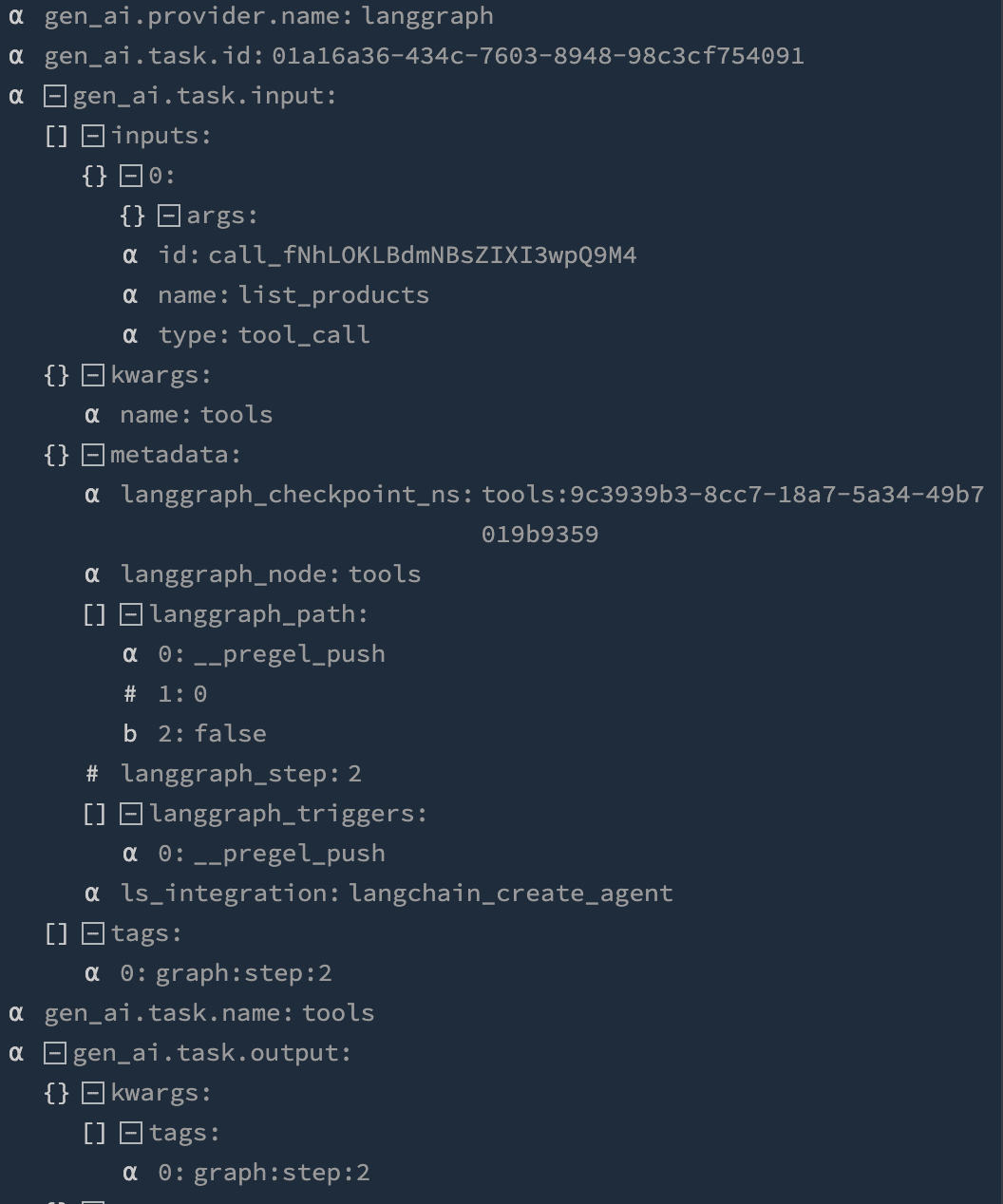
A single governed span from the app’s own agent: gen_ai.provider.name: langgraph issuing a tool_call — list_products — through langchain_create_agent, with gen_ai.task.input and gen_ai.task.output captured as gen_ai.* telemetry. This is one LLM’s prompt-and-tool activity recorded as data — and it’s exactly the kind of stream that flows into NeuBird’s model next.
Prompts are exactly where fresh sensitive data turns up — a customer’s message, a key someone pasted into a chat — so without governance it rides straight into the investigating model’s context, the same way the CVV did. Governing the pipeline was never only about one payment event. It’s about controlling what one AI is allowed to tell another.
Want to see it on your own data? Spin up a Cribl Cloud free tier, govern one dataset — mask the sensitive fields, enrich against your service catalog — point an agent at both, and inject a change you already know the answer to. The gap will tell you everything.