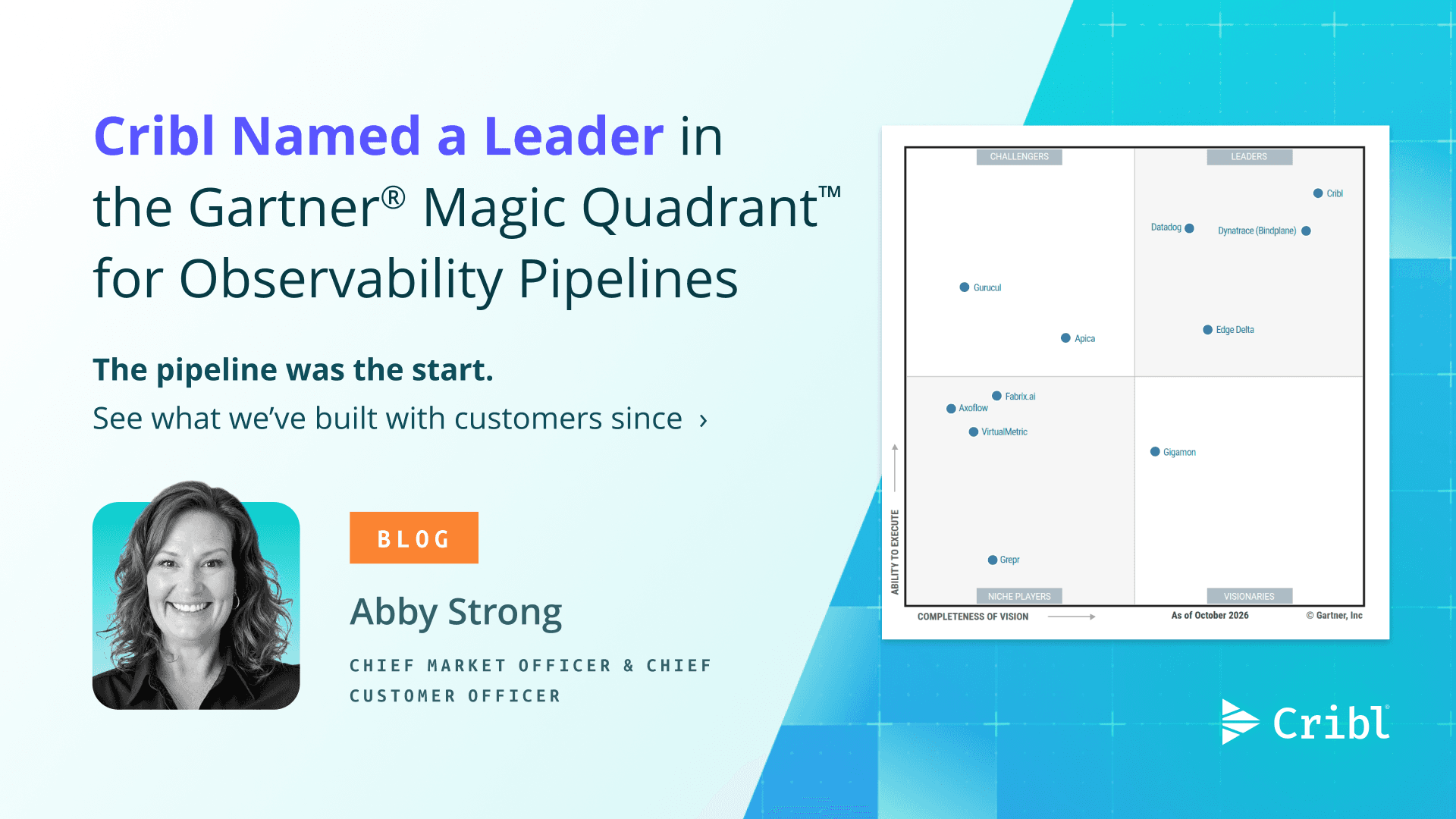

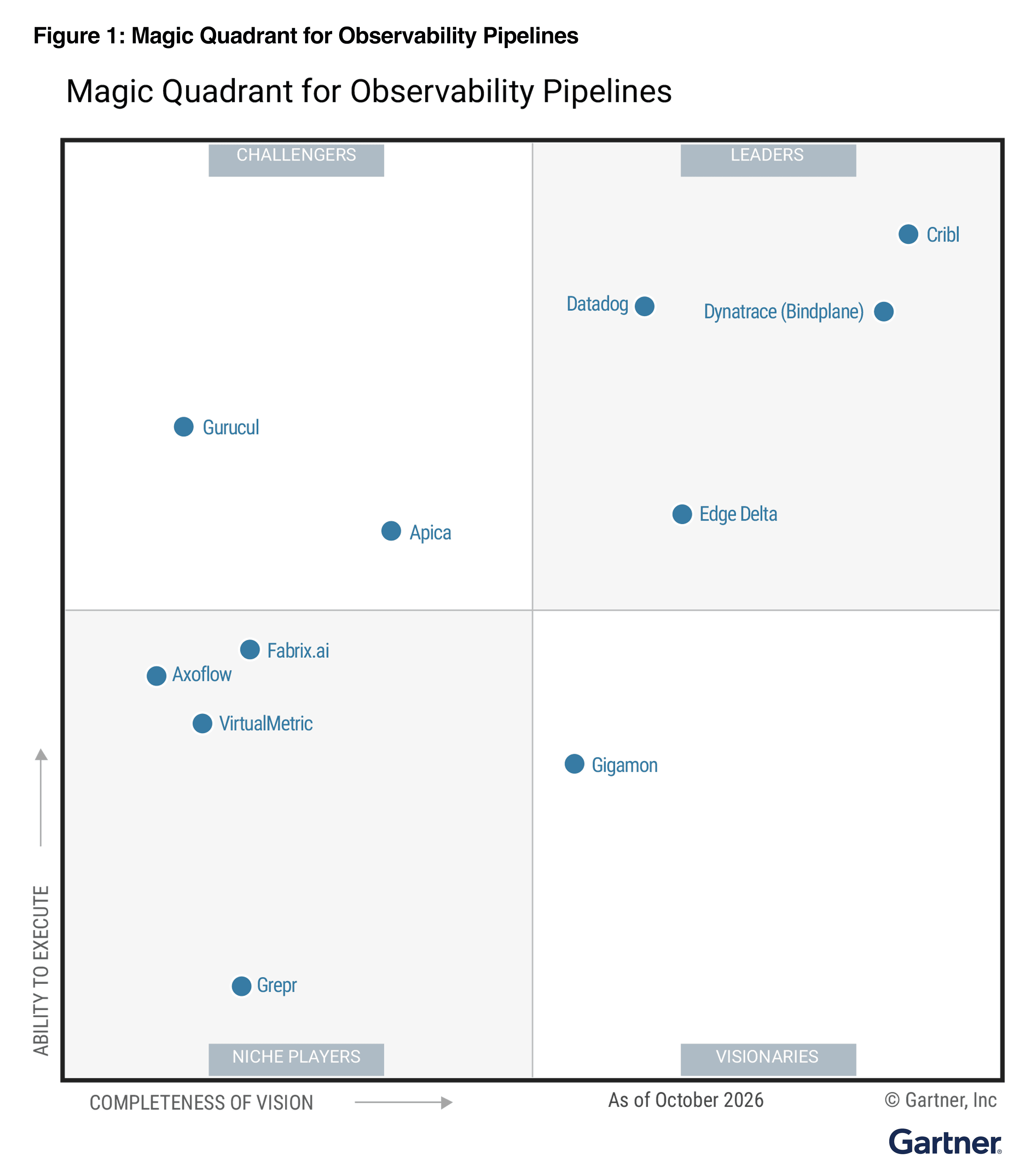
Today, Gartner named Cribl a Leader in its first-ever Magic Quadrant for Observability Pipelines. Of the 11 vendors evaluated, Cribl was positioned highest in Ability to Execute and furthest in Completeness of Vision.
In 2018, our CEO Clint Sharp wrote The Observability Pipeline, describing "a streams processing engine that unifies data processing across all types of observability data." The idea had a name but no product, so we built the first enterprise version, got it into the hands of a few customers, and spent the years since turning it into a category. Today, over half the Fortune 100 rely on Cribl to control their security and observability data.
Back then, most teams managed fast-growing telemetry with scripts, forwarders, and a lot of patience, and every new tool added cost and complexity. The customers who bet on us early changed that with us. They put a young product in the path of their most critical data, told us exactly what to fix, and pushed us to get better. To every one of them, thank you. This recognition belongs to those customers as much as it does to our team.
In our view, a first Magic Quadrant also says something about the market. Observability pipelines are now a category that enterprises evaluate, budget for, and depend on. Excelling in it means keeping the pipeline and its integrations open as larger vendors build or buy their own, and letting customers continue to shape what we build next. The best evidence of where that is going is what they've already built on top of it.
The pipeline changed who was in control
I spend most of my time with customers, and one theme comes up again and again: the pipeline gives teams control over their data before it belongs to any particular tool. It sits between sources and destinations, which is where teams decide what to keep, what to reduce, where to send it, how to protect it, and what they're willing to pay for.
That control matters because the tools around the data keep changing. Sources keep getting added, new security products emerge, and new observability use cases take hold. AI brings new demands for high-quality telemetry and new questions about privacy, cost, and governance, and customers shouldn't have to rebuild their data foundation every time the next tool arrives.
What customers asked for next
Once customers had control over data in motion, they started asking what else they could do with the same foundation. Each answer became part of the platform:
Keeping telemetry without paying to store it twice led to Cribl Lake, which gives customers low-cost retention in open formats they control.
Simplifying data collection from endpoints and processing data before it travels led to Cribl Edge, which provides unified fleet management and uses open formats to send data anywhere.
Searching data without moving it first led to Cribl Search, which queries data in existing stores, in Cribl Lake, or in our high-performance Lakehouse Engines.
Detecting threats on the same platform led to Cribl Detect, which brings detection to that data without another architecture to stand up.
Making that data available to applications and AI agents led customers and partners to build on the Cribl platform, using their telemetry to create customized views and workflows that solve even harder security and IT problems.
Every one of these came from customers who trusted us with their data and wanted more value from it. Their requests shaped the roadmap far more than any plan we drew up on our own.
One foundation, more choice
Customers want the freedom to use the tools that work for them today and the flexibility to change them tomorrow. That's why Cribl brings collection, routing, processing, storage, and analysis together on one foundation. With it, customers can:
Run the solutions they need and replace the ones they've outgrown without ripping out what's underneath.
Govern once, with access, privacy, and compliance controls that apply across their environment.
Build around the workflows they already have.
Every enterprise has its own context and its own way of working. Customers want tools they can open up, adapt, and use alongside the systems they already trust.
Why the foundation matters in the AI era
AI raises the stakes on all of this. An AI system is only as useful as the data it can reach, and an agent tied to a single tool reasons over a fraction of the picture. Working from a shared foundation that spans an organization's telemetry gives it the context to do much more.
AI is also creating more applications, more infrastructure, and more telemetry, while budgets grow far more slowly. Customers need to process more data at a lower cost, protect sensitive information, and control what flows to which model.
That's why the observability pipeline is an important piece of Cribl's AI Platform for Telemetry, which gives people and AI systems faster, safer, and better-governed access to the data they need. The pipeline has given customers that control for years, and the platform extends it to the next generation of workloads.
Starting where customers are
Nobody has to rip and replace anything to work with Cribl. Most customers start with the pipeline and expand when they're ready, one workload at a time, and a growing number start with Cribl Search before they ever touch the pipeline. However customers begin, we earn every new workload on its merits, with predictable pricing, practical interoperability, and products that work well with the other tools customers choose. That's what being open means to us.
What comes next
For us, being named a Leader in this first Gartner Magic Quadrant for Observability Pipelines reflects the pipeline we built with our customers. We feel it also validates the problem they've been solving, which is how to get more value from growing volumes of telemetry while keeping choice, control, and flexibility.
The next phase will bring new tools, new workloads, and new AI use cases, and the foundation should make each of those changes easier for customers. That's what we'll keep building with them, one workload and one customer need at a time.
Read the full 2026 Gartner Magic Quadrant for Observability Pipelines here.
Gartner Disclaimer
Gartner Disclaimer Gartner, Magic Quadrant for Observability Pipelines, Pankaj Prasad, Andre Bridges, Neil Young, Andrea Curry, [12, November 2026]
Gartner does not endorse any company, vendor, product or service depicted in its publications, and does not advise technology users to select only those vendors with the highest ratings or other designation. Gartner publications consist of the opinions of Gartner's business and technology insights organization and should not be construed as statements of fact. Gartner disclaims all warranties, expressed or implied, with respect to this publication, including any warranties of merchantability or fitness for a particular purpose.
Gartner and Magic Quadrant are trademarks of Gartner, Inc. and/or its affiliates.
This graphic was published by Gartner, Inc. as part of a larger research document and should be evaluated in the context of the entire document. The Gartner document is available upon request from Cribl.