At Cribl, we believe software is a people business. One of the clearest expressions of that belief is our annual in-person Manager Summit.
Four years ago, we held the first summit in Napa with 100 managers attending a two-day experiential event. This year, 175 joined us. Over that same period, our Manager Effectiveness score has increased nine points. That kind of progress takes sustained investment.
The case for investing in managers is straightforward: they have an outsized impact on every employee’s experience. They drive engagement. They build or break teams. In a remote-first company, where someone’s manager is often their most consistent connection to the culture, that impact is amplified. At Cribl, investing in managers is a key pillar of our people strategy.
We design the summit with the intention and production quality of a major conference, and it is built entirely around our 175 managers and the challenges they are navigating at Cribl right now. We invest in a customized and curated curriculum every year because time together is rare, and we want to make every minute count.
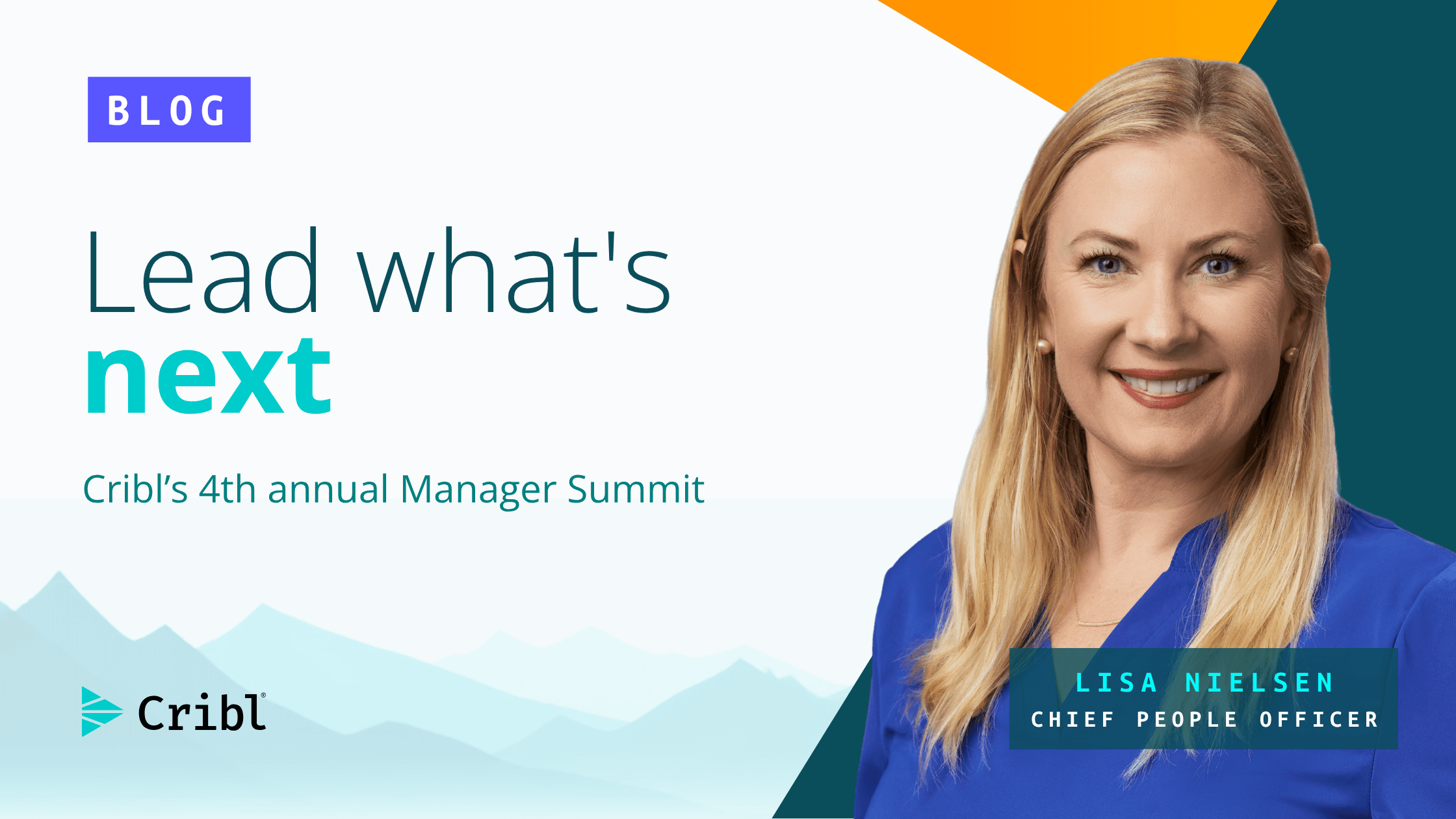
This year’s theme, Lead What’s Next, reflected what we are asking managers to navigate: stronger execution at a faster pace of change, increased ownership in decision-making, and the integration of AI into how they and their teams work.
After doing this four times at Cribl, it is clear that format matters as much as content. This year we facilitated a series of small group discussions with all 175 managers: 16 concurrent conversations across four topics, each facilitated by a manager we had prepared ahead of time. Managers rotated through 4 themes: Hitting Our Goals, Staying Human, Troubleshooting AI, and AI Org Design. In each theme groups spent time answering hard questions like What’s the most important thing we need to do to ensure customer health? How are you building and maintaining connection with your direct reports? and What parts of AI have lived up to the hype?
As they moved between tables, managers who do not normally work together - across functions, levels, and tenure - found connections between their work. We could have run the World Café all day. Managers are already asking us to bring it back next year. When we asked what mattered most, the answer was not a single session. It was the opportunity to hear from, and be heard by, peers they might not otherwise get to know.
We also held 12 breakout sessions designed, built, and delivered by 16 of our own people managers. Our SVP of Business Operations, Farrah Bui, and Director of Software Engineering, Rachel Prisock, led a session that explored how managers can use AI to build themselves a Chief of Staff and reclaim time for higher-value work. Chief of Staff to the CPO, Jess Ellison, and Sr. Director of Revenue Operations, Joanna Zheng, tackled managing up and across; your relationship with your manager is a system of mutual dependence. Managing your half well makes both of you better.
And, back for a third year, CFO Zach Johnson and VP of FP&A Adrian Tan led the fan-favorite session on unit economics and how our managers can contribute to our company’s growth rate target.
Our CEO, Clint, closed the summit by sharing where Cribl is headed. Our strategy is showing real traction, and the market is moving toward AI-native telemetry - an area where we are already leading. Managers need that context. You cannot lead what is next if you do not understand what next is.
One manager who has attended all four summits told us this was the best one yet. I believe her.
As I said, our Manager Effectiveness score is nine points higher than it was when we held our first summit. The summit is not the only reason for that progress, but it is an important part of our sustained investment in our leaders.
And we will continue to invest in our managers so Cribl remains the place where we do our best work.