
Your AI telemetry has a story to tell. Are you listening?
Chances are, you’re only hearing part of the story. That matters because one AI interaction is a performance, cost, security, quality, and compliance event, all at once. Traditional tools were built to consume only one of those signals at a time.
A 200 status in 200 milliseconds tells you nothing about what the model said, what it leaked, or what it cost. And the questions that matter most surface months later: Which prompts leaked PII, which model swap caused drift, who burned the token budget.
We've seen some teams use top AI observability platforms that are specific to frontier models or collection points. There’s no complete dataset of telemetry or a way to explore and investigate across all the models, providers and tools you have. Once again - only part of the story is told, and you’re left to your imagination to finish that story.
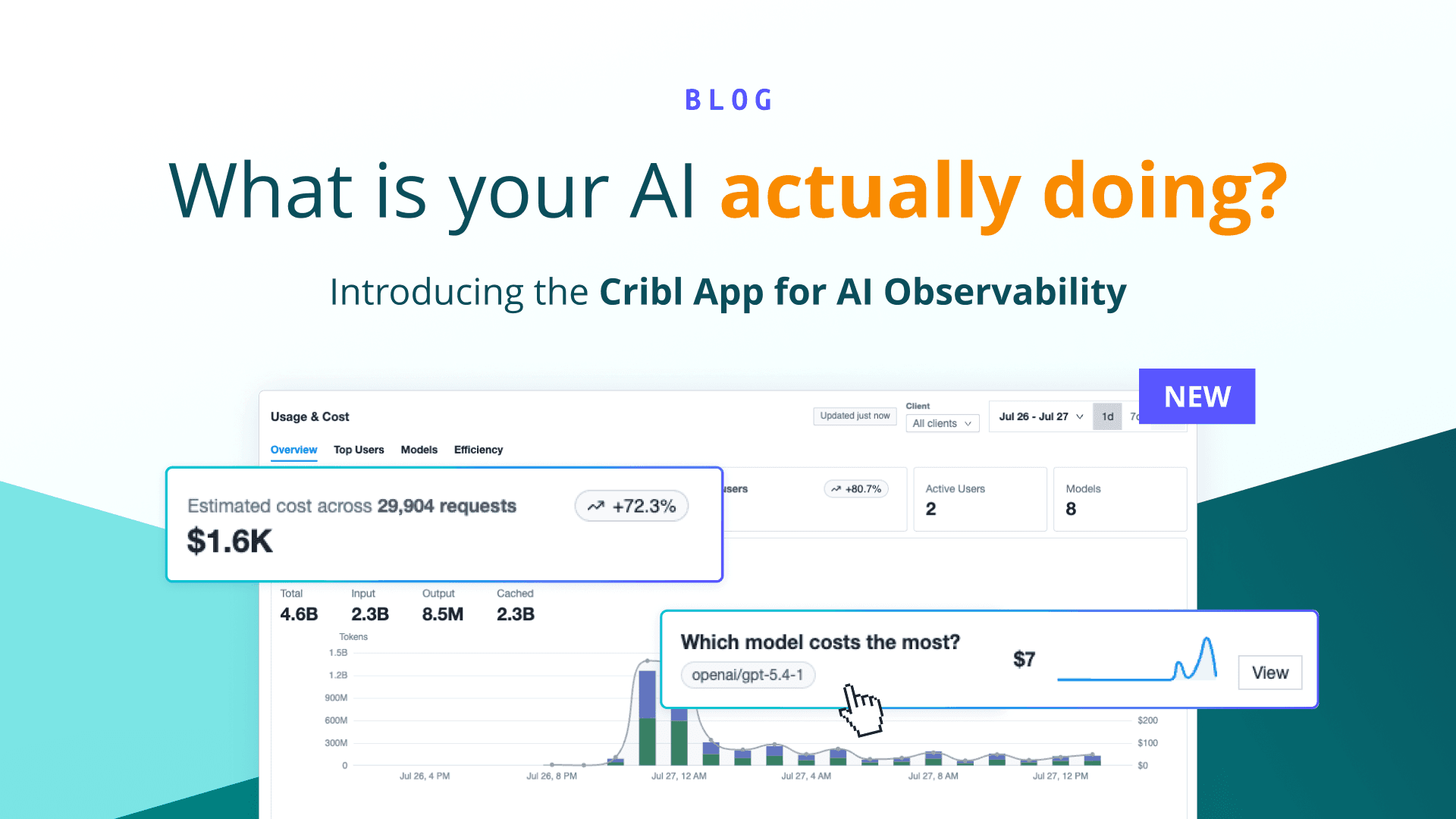
That's why we built the Cribl App for AI Observability.
The Cribl App for AI Observability gives teams one place to search, investigate, and report on AI telemetry across models, tools, and environments. It is the first Cribl-supported app built on top of Cribl’s AI Platform for Telemetry, which provides a shared telemetry foundation. As a result, your AI data is never trapped inside a single-purpose AI telemetry management tool.
When you install an app on Cribl's AI Platform for Telemetry, it gives you the visibility and capability to collect, transform, and store data in lightning-fast Lakehouse engines. From there, you can analyze it however you want — through search, a dashboard, or one of the app's built-in visualizations.
So what can this app do for you? Let's explore its main capabilities.
Usage and cost
See who's using which AI tools, how much, and what it costs — by model, team, and time.
Usage and Cost Dashboard — spending trends, token consumption, top users and models, LLM efficiency anti-patterns, and an activity heatmap.
Org View — a hierarchical roll-up of spend, tokens, and requests across your organization.
Goals and Monitors — continuously evaluate live data against targets you set, like month-to-date token spend vs. budget.
Usage efficiency — expose LLM efficiency issues so you can improve token efficiency and model effectiveness.
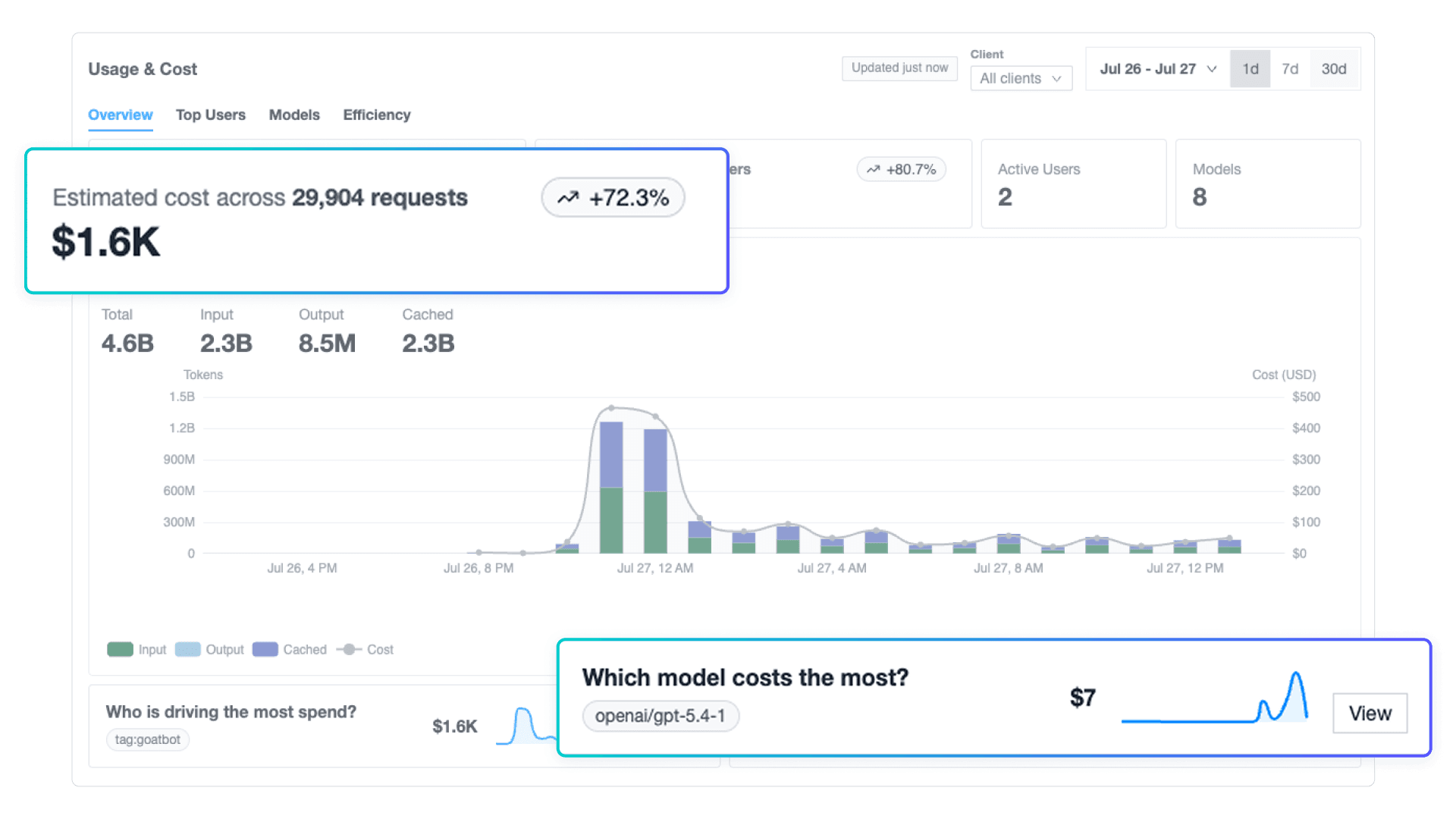
AI Observability - Usage and cost
Security and detections
Find sensitive data before it becomes an incident.
Security and Compliance Dashboard — sensitive data exposure rates, findings by type and user, tool-call audit, content risk indicators.
Sensitive Data Traces - Locate exactly where sensitive data appears in a trace or session — broken down by subcategory, including PII, credentials, and API keys.
Analyze findings over time – by category, user, model, and tool.
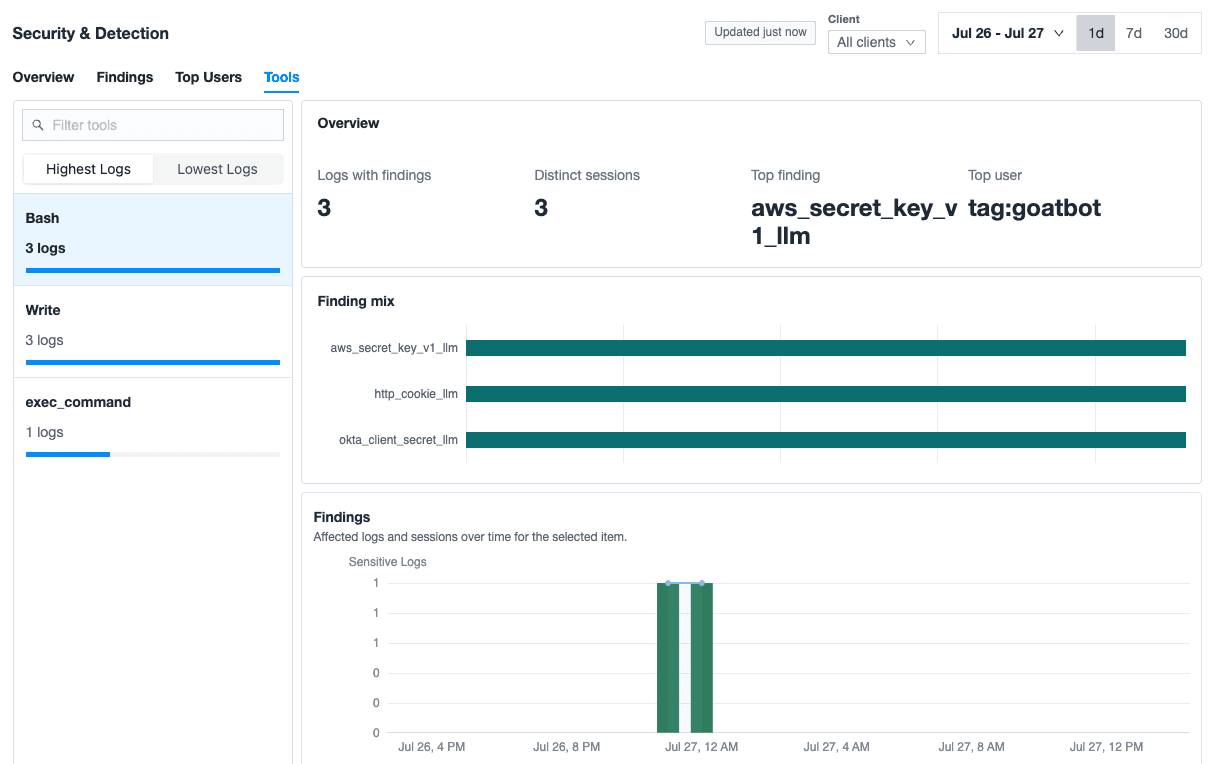
AI Observability - Security tools detection
AI insights and investigation
Move from a dashboard straight into the session or trace where something went wrong.
Sessions and Traces — end-to-end trace visibility: filterable session lists, span timelines, full prompt, response, and tool-call payloads.
AI Insights — a conversational AI agent for querying usage, cost, and security data across your org, in plain language.
AI-generated briefs – surface what needs attention, so teams don't have to go hunting for problems.
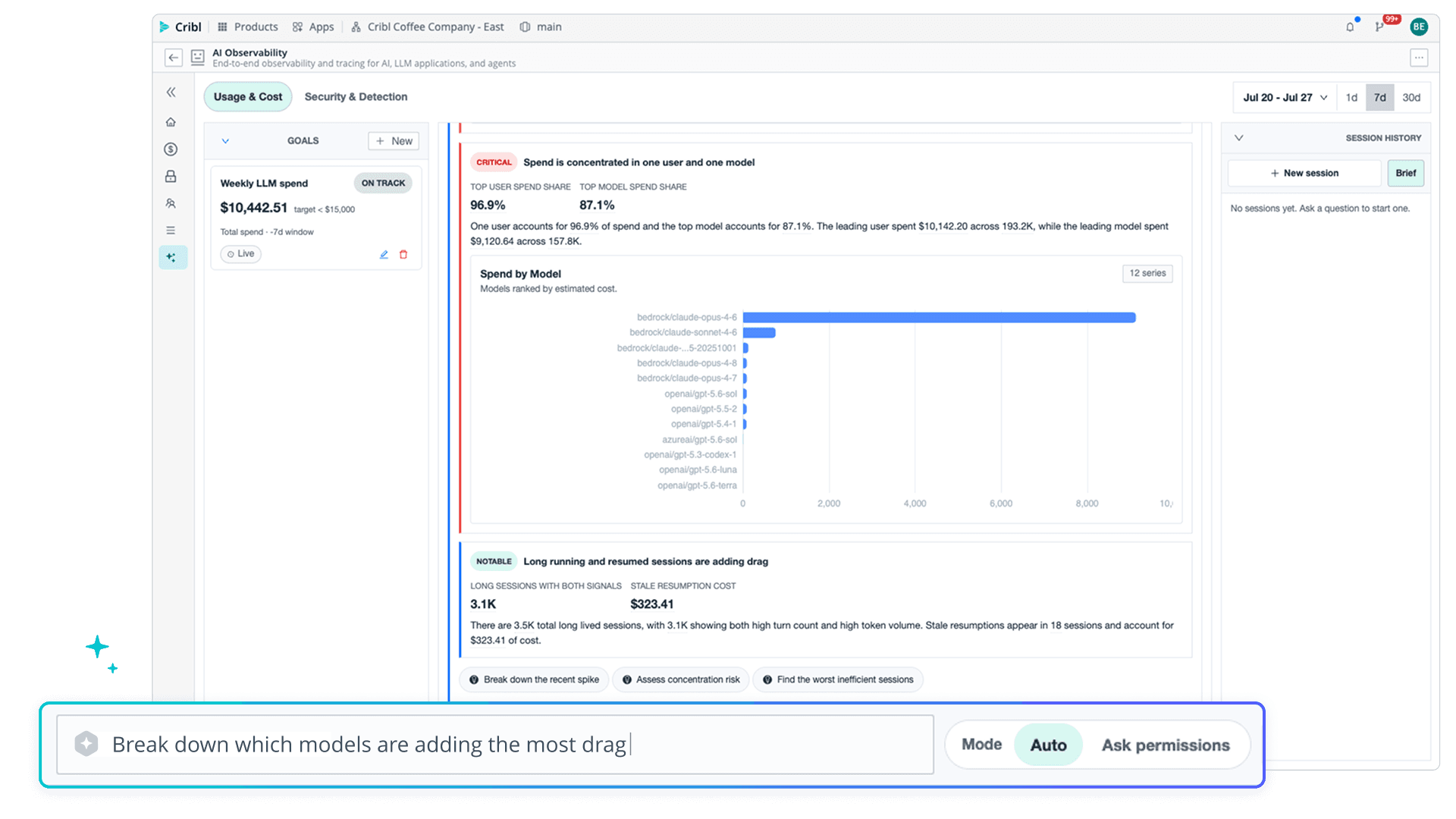
AI Observability - AI generated brief for security and detections
One telemetry layer. Every team gets its own view. Everyone hears their AI telemetry story.
Getting started
Since the Cribl App for AI Observability runs on top of Cribl's platform, you'll need Cribl.Cloud up and running in your organization. Once you do that, getting the app is simple. Go to the Cribl App for AI Observability repo on GitHub and follow the instructions on the README file. Once the app is installed, start it and you'll see a setup wizard. It walks you through connecting your AI telemetry services and setting up the datasets where that data will be stored.
If you’re new to Cribl, watch it in action with a custom demo. You can also connect with our team at contact@cribl.io to learn how it can work for your organization. You can also join the conversation in our Slack community to share ideas, ask questions, and learn from other users exploring the future of AI observability.