
Introduction
AI observability sounds simple. In practice, it is anything but simple. Most organizations use LLMs to run their business and build apps that integrate with LLMs. Many have large GPU-driven infrastructures to support AI. But very few have visibility into how their AI LLMs and infrastructure truly behave. That gap shows up all at once in cost, quality, security, and governance.
This same lack of visibility also creates new risks. AI telemetry (if it's even being collected) often contains PHI and PII, creating compliance risks. Meanwhile, 59 percent of security leaders confirm or suspect shadow AI, which means many teams only see the AI usage they already know about.
For platform and observability leaders, the takeaway is not "buy another AI dashboard." It is to collect the right data once, shape it well, and make it easy for every each team to explore their data.
The Challenge
Between the exponential growth of AI in your company and the unique nature of how AI operates, ignoring the problem today will snowball into catastrophe tomorrow.
EVERYONE WANTS AI OBSERVABILITY DATA JUST NOT THE SAME DATA.
Platform teams want one collection pass; security wants shadow Al and activity consolidated; FinOps wants cost tied to teams and models; engineering wants to trace failures across the stack, not stitch together three tools. The data's too sensitive and voluminous for one-size-fits-all access.
TRADITIONAL TOOLS WEREN'T BUILT FOR AI.
Models are wired into apps, retrieval systems, copilots, agents, and GPU infrastructure, each emitting telemetry. A model can return HTTP 200 in 200ms and still produce garbage, leak data, or burn money — something uptime dashboards can't see.
ECONOMICS GET UGLY FAST.
Agent traces can carry 200+ KB of detail, and GPUs push telemetry volumes well beyond ordinary infrastructure. Routing it into expensive ingest tools turns observability into a budget problem.
THE HARDEST QUESTIONS ARRIVE LATE.
Security asks what sensitive content hit a model last quarter; FinOps asks who burned budget after the bill lands; compliance wants records the hot tier dropped. Add shadow Al evading controls, and no product solves this.
MULTI-MODEL, MULTI-VENDOR, MULTI-EVERYTHING.
As teams continue to experiment and evolve with Al, they are bringing lots of models, vendors, agents, connectors, MCP servers and harnesses together. More and more of the organization is using Al in some capacity. Understanding how teams use it requires a telemetry-first approach. That can bring data from all of these Al attributes together into one shared view.
AI OBSERVABILITY DEMANDS FLEXIBILITY.
OpenTelemetry's GenAI conventions are spreading, but still evolving — schema churn comes with the territory. Your approach must evolve.. Your telemetry will keep changing, and your management approach needs to change with it.
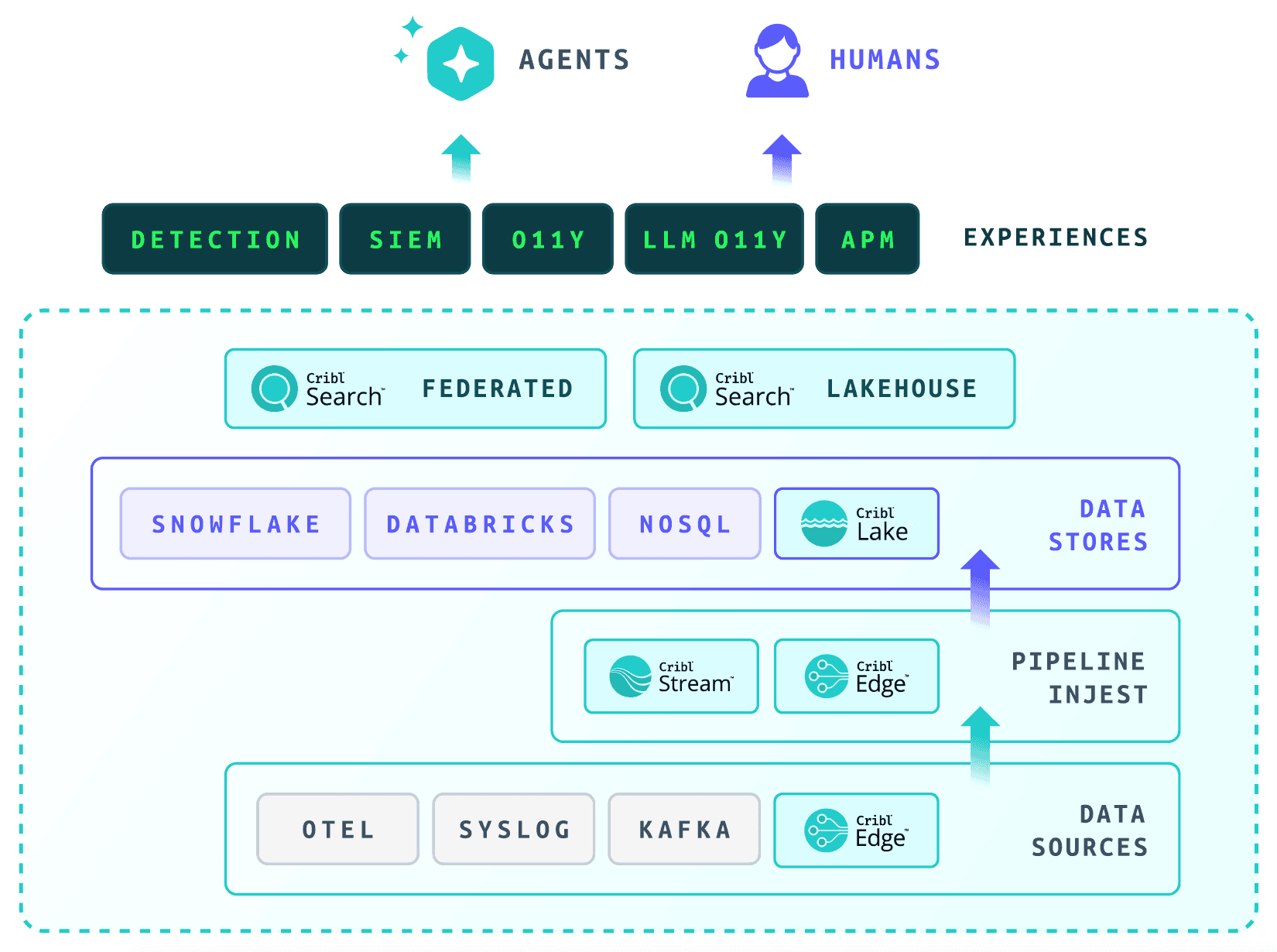
Cribl: The AI Platform for Telemetry
Cribl gives organizations the choice, control, and flexibility to collect, route, enrich, and store telemetry from any source to any destination, at the scale and economics modern AI workloads demand.
A telemetry-first approach to AI observability
Cribl treats AI observability as a telemetry problem, not another monitoring silo. Rather than each team collecting its own copy of AI telemetry — or funneling every signal into one destination — Cribl provides:
A control layer for collecting, shaping, governing, and routing telemetry
A place to analyze AI observability data using your choice of tools
A platform to build and use apps that help you answer the questions you have
Cribl App for AI Observability
The Cribl app for AI Observability gives teams one place to search, investigate, and report on AI telemetry across models, tools, and environments. A guided experience makes connecting to AI telemetry sources fast and easy, and takes the work out of building dashboards and reports for stakeholders. Built on Criblˇs AI Platform for Telemetry, the app lets you visualize AI usage and costs, detect sensitive data and security issues, and identify inefficiencies in model usage. AI-driven insights and investigations let you dig deep and understand AI prompts, completion paths, and AI model performance.
Full-fidelity history, on demand
Effective AI observability depends on full-fidelity history and strong analysis. Cribl Lake stores LLM and infrastructure telemetry at low cost; Cribl Search turns it into insight via ad hoc investigation, dashboards, and scheduled searches — so teams can ask long-tail questions months later without rehydrating to a hot tier.
Trust and safety, built in
AI telemetry needs careful handling before it crosses trust boundaries. Cribl Guard masks prompts, completions, API keys, PII, and PHI in flight, while preserving fields needed for debugging, governance, and cost monitoring. Cribl can also correlate instrumented usage with network egress to surface ungoverned AI use.
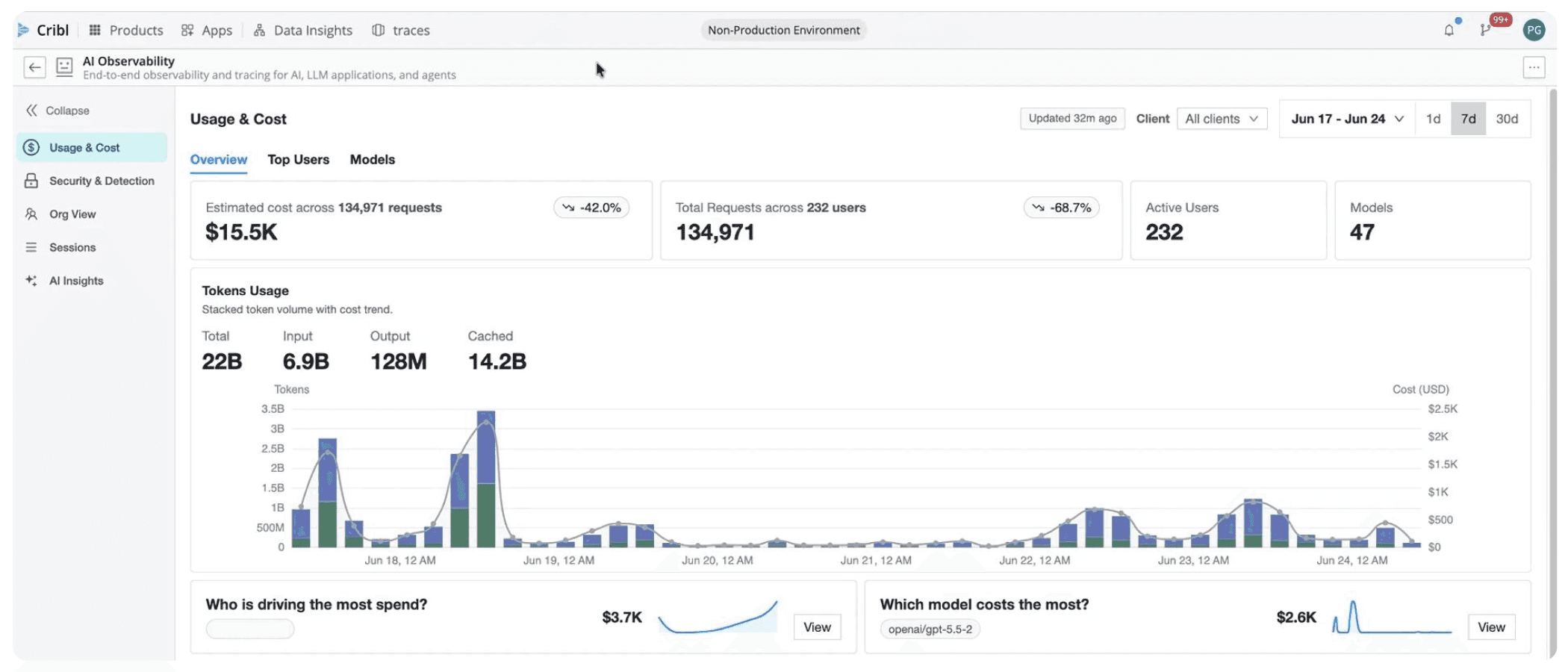
One telemetry layer, every team
SRE — performance and reliability context
Security — risky usage and policy-relevant events
FinOps — usable chargeback inputs
AI engineering teams — visibility into model and infrastructure performance
Summary
AI observability is the discipline of turning AI telemetry into something every team can trust, afford, and use. As AI adoption spreads across applications, agents, and GPU infrastructure, Cribl give your teams the choice, flexibility and control to collect AI observability telemetry once, govern it well, route it wisely, and give people clear visibility and answer to the questions they have about AI observability.