
Cribl Detect extends our Al Platform for Telemetry into a complete solution for detection, response, and investigation, with open architecture that preserves choice and control.
The challenge
Legacy SIEMs are buckling under Al-era data growth. Monolithic models force teams to move data into a rigid, tightly coupled infrastructure, priced per GB on ingest. As data volumes rapidly outpace security budgets, traditional SIEMs force a tradeoff between visibility and cost. Teams have to choose whether to store data before they understand its security value.
Data that could make the difference between quick detection and containment versus an undetected threat and costly breach might never reach the SIEM. Schemas and configurations drift, detections break down, and false negatives allow threats to go unnoticed. During investigations, analysts pivot between tools and sift through incomplete or inaccessible data that leads to dead ends and poor security outcomes.
The Cribl solution
Cribl Detect breaks down the monolith. Ingestion, analytics, and storage are separate, so detection, hunting, investigation, and Al-driven operations can run on telemetry wherever it lives, not just what's been paid for, ingested, and indexed.
Posture management shows where you're covered and where to fill gaps. Streaming detections create real-time signals, and correlations uncover slow-burn threats. Al-powered investigations reason across the full security estate, not just what's inside one platform, to accelerate investigations and quickly contain threats.
Know your coverage, detect where the data flows
Cribl Detect shows where you're covered and pinpoints where you're missing detections or telemetry. Detection runs in stream, before you've decided where that data will live-whether that's Cribl Lake, Lakehouse Engine, or any other destination. You don't have to wait for data to be ingested, indexed, and stored before it adds value.
Shifting detection upstream breaks the coupling between what you need to detect and what you can afford to store. Teams can expand detection coverage without expanding SIEM ingestion costs, closing the gap between telemetry growth and security budget.
Immediate: signals before storage
Cribl Detect analyzes telemetry for suspicious activity as it moves through the pipeline, creating immediate signals that accelerate response and containment. Security value starts before data ever reaches its destination, not after.
Cost-aware: tiered storage and routing
Not all telemetry has the same security value, so it shouldn't cost the same to store it. With the broader Cribl platform, tiered routing sends data to storage destinations based on value: hot storage for high-value, frequently searched telemetry, and low-cost storage for full-fidelity historical data. Teams pay for analysis and retention based on the data's security value, not a one-size-fits-all ingestion price.
Connected: correlations uncover slow-burn threats
Some threats unfold slowly across multiple sessions, systems, and days. Cribl Detect chains individual detection signals into correlation searches, surfacing the nuanced attack chains and advanced persistent threats that an isolated alert or single rule would miss.
Detection shouldn't have to wait for storage. Cribl Detect applies security logic in the pipeline, so telemetry can be evaluated for threats no matter its ultimate destination.
From signal to action: alerting and response
Detection creates value when teams can act on signals quickly. Cribl Detect aggregates related signals into streamlined alert workflows. Analysts get detailed views offindings, not scattered lists of raw events. Alerting workflows connect with the tools teams already use for triage, response, and case management.
Automated: Al-driven triage and response at scale
Al-powered alert analysis ensures only genuine threats are escalated. From there, response actions can be triggered in a single step. Analysts spend less time sorting signals from noise and more time acting on what's real.
Connected: built for downstream workflows
Cribl Detect integrates seamlessly with downstream response tools and workflows: notification channels, IT service management ticketing systems, and SOARs. Alerts carry the full context for effective run books, so analysts spend less time reconstructing what happened and more time containing
the threat.
Cribl Detect turns aggregated signals into clean, actionable alerts - connected to the notification, ticketing, and SOAR tools your team already relies on.
Investigate the entire estate: open, Federated Search
Cribl Detect uses Federated Search to let analysts query telemetry wherever it lives-within Cribl, other data lakes and object storage, another SIEM, or any other APl-accessible platform-without duplicating and centralizing it. Investigations are no longer limited to what one platform has indexed. Results are aggregated into a single, unified view, eliminating the tool-switching and dead ends that come from pivoting between disconnected systems. Al-powered natural language searches let analysts ask questions of their data directly, instead of constructing every query by hand.
Federated: one search across any store
Cribl Detect queries live sources directly-including data lakes, object storage, other SIEMs, or any APl-accessible platform-without moving or rehydrating data first. Whether telemetry sits in Cribl or somewhere else, it's reachable from the same query, accelerating investigations and reducing time to containment.
Al-powered: natural language search
Cribl Search goes beyond just answering natural language questions to run queries. Our Al copilot reasons across telemetry, detections, and historical context to help analysts move from an initial alert to a supported explanation of what happened, suggesting next steps along the way.
Open by design: no lock-in, no dead ends
Cribl Detect is built on open data, open storage, and open standards like OCSF and KQL, so investigations aren't constrained by any single vendor's schema. Analysts and the Al agents working alongside them can reason across the entire security estate instead, not just one platform's data silo.
Cribl Detect gives analysts and AI agents the power to investigate telemetry anywhere it lives—within Cribl or other storage—without stitching together results by hand.
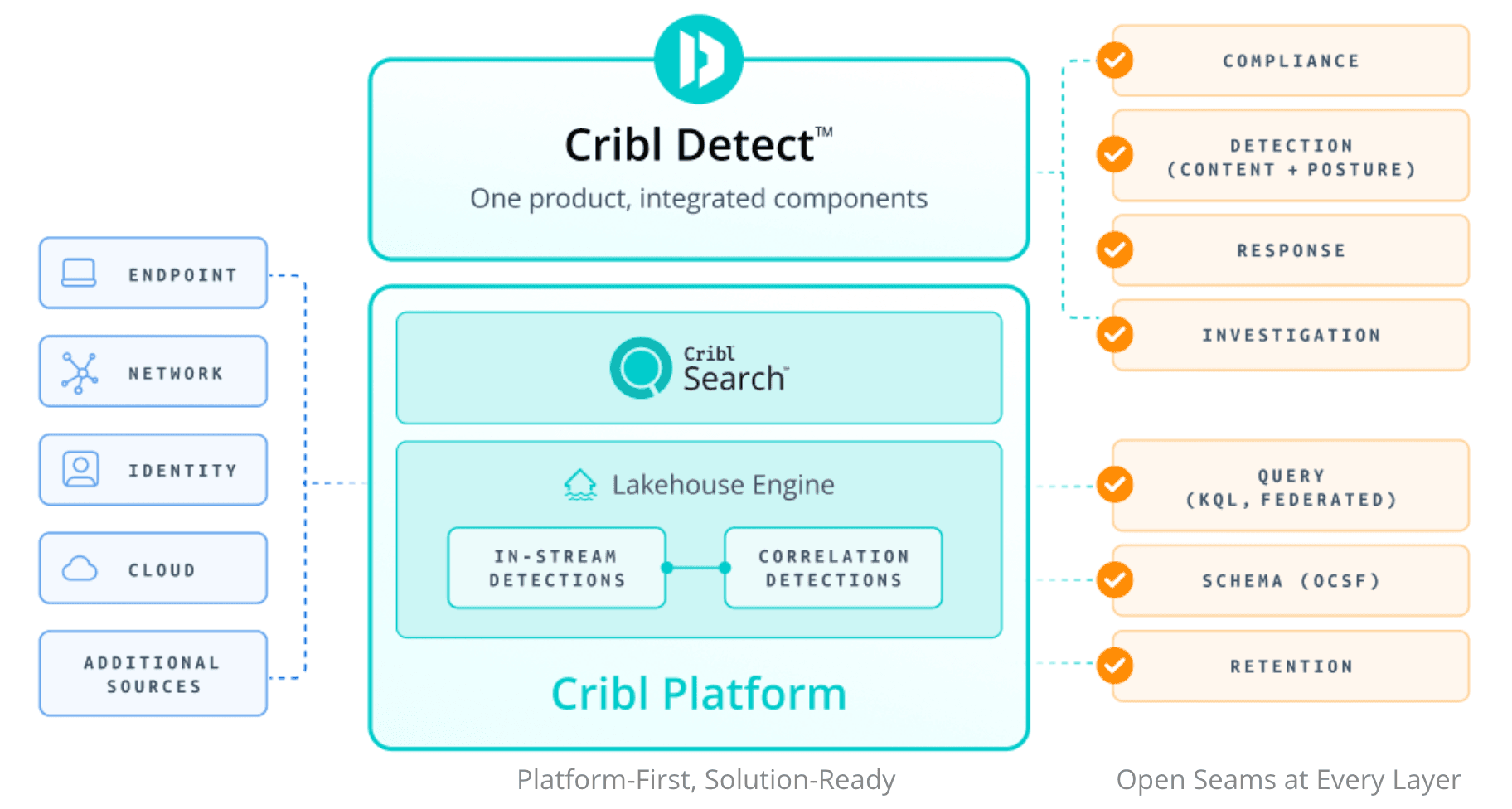
Facets of Cribl Detect
COVERAGE AND POSTURE MANAGEMENT
Most SIEMs don't help you understand where you're missing detections or telemetry, or whether rules are working. Detection posture management moves the conversation beyond simple detection and alerts. It shows where you lack detections or telemetry for key threats, which rules aren't working, and what detections to prioritize next.
Teams get a clear view of coverage across the MITRE ATT&CK framework, with targeted recommendations for which rules and telemetry can close the gaps. Cribl Detect also pinpoints rules that have been silently failing due to schema and configuration drift, so teams can proactively fix them before they turn into missed threats.
RULE TEMPLATES + DETECTION LAB: JUMPSTART DETECTION DEVELOPMENT
Cribl Detect includes 8,000 production-ready detection rule templates covering a wide range of threat scenarios. Instead of building detections from scratch, teams start from proven rules, with workflows that quickly tailor them to their specific environmental context.
For anything the rule templates don't cover, Detection Lab gives the team an intuitive, Al-assisted workflow to build new detections. A familiar chat interface helps create, validate, and tune rules without deep query language expertise. Guided by detection engineering best practices, Detection Lab quickly turns identified gaps into working rules in a fraction of the time it takes to manually create a detection.
THREAT INTEL + ENRICHMENT
Cribl Detect enriches alerts and investigations with the internal and external context needed to quickly respond and investigate incidents: threat intelligence, identity and asset details, and other relevant context across the organization. Analysts don't need to manually piece this together; it's all embedded right into their response and investigation workflows.
External sources keep that context current, surfacing emerging APT activity, new CVEs, and evolving adversary tactics as they become relevant. Internal context ties findings back to specific users, endpoints, and systems in your environment. Instead of aggregating it manually from multiple sources, analysts start with the full picture attached to every alert.
Differentiators
OPEN
Freedom to run security analytics your way. Cribl Detect decouples detection, investigation, and analytics from proprietary storage. No vendor-specific schema, no data trapped behind one query language. Built on open standards like OCSF and KQL, it integrates with your existing infrastructure instead of forcing replacement or migration, keeping your architecture portable and future-proof as it evolves.
EARLY & CONTINUOUS
Detection doesn't wait for storage, and it doesn't stop at deployment. Cribl Detect applies detection logic in the pipeline, creating signals on telemetry the moment it moves. Detection posture management keeps that coverage sharp over time, showing where key threats lack detections, which rules have silently broken down, and what to prioritize next - turning detection from a one-time deployment into a program that keeps improving.
ECONOMICAL
Security data shouldn't cost more to keep than it's worth. CribI Detect separates the economics of retention from analytics. Full-fidelity telemetry can live in open, low-cost storage without the premium pricing legacy SIEMs attach to every byte, preserving historical evidence for investigations, hunting, and compliance long after the event. Detection for all of your data, not all of your budget.
CONNECTED
Response and investigation are only as good as the data made accessible to their workflows. Al reasons across telemetry, detections, and context from the full security estate, not just what's been indexed inside one platform, for fast, effective investigations. Automated triage and response help eliminate noisy alerts and escalate real threats, so analysts can focus on what actually matters.