The challenge
Every CISO is being asked to modernize security operations fast: reduce ingest cost, simplify the stack, and get the SOC ready for Al. The problem is that most teams are working in environments they do not fully understand. Telemetry keeps growing year over year, pipelines keep multiplying, and every change introduces another place where a detection can silently stop firing. As the bill rises, teams are forced to decide what data to keep, where to send it, and how to modernize without losing coverage. The result is a data challenge with direct security impact: if you cannot see the flow, you cannot trust the outcome.
The solution: better together
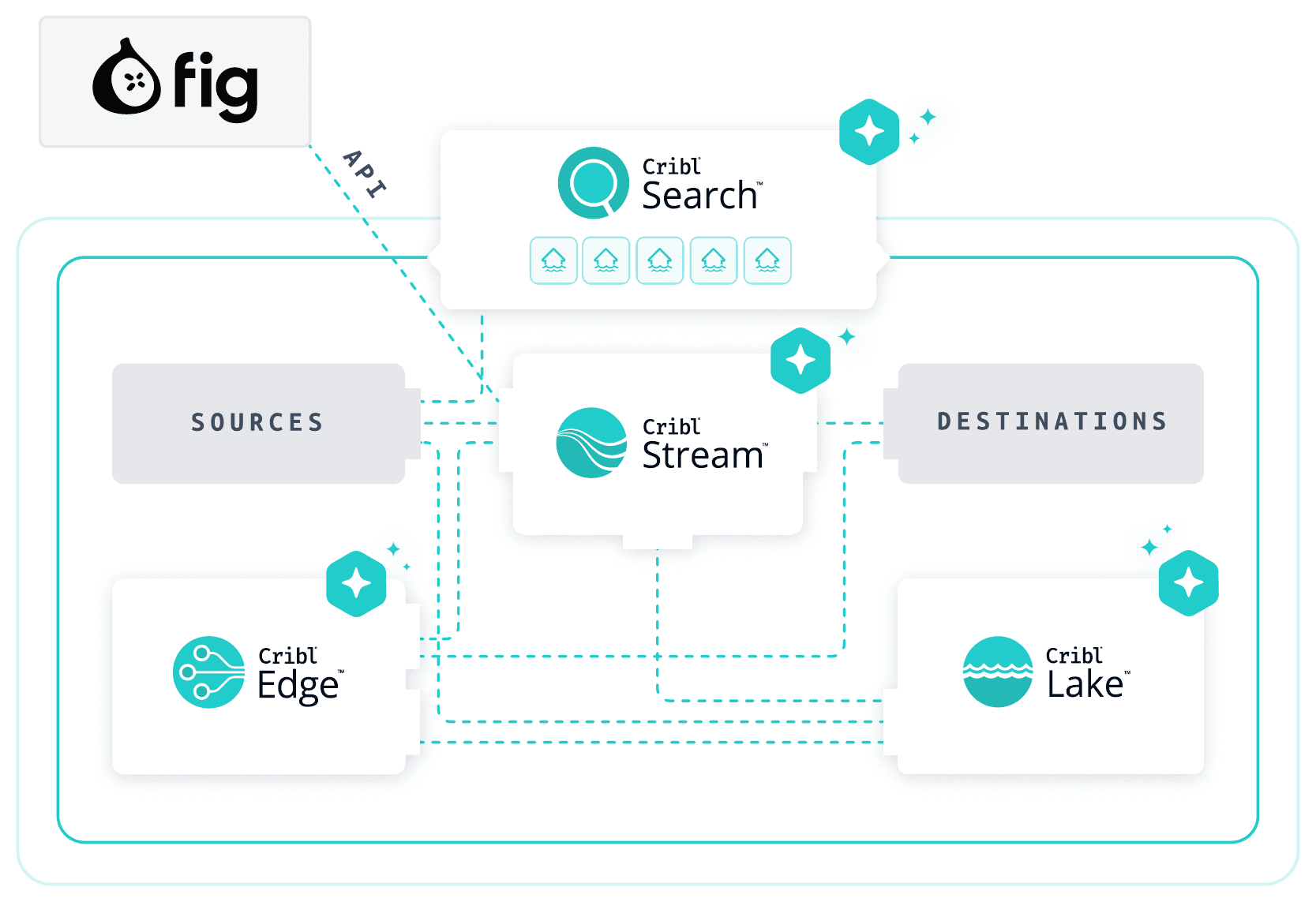
Cribl gives security teams control over exploding telemetry volume without locking them into rigid architectures. Teams can collect data once, shape and reduce it, and route it to the SIEMs, lakes, and analytics tools that make sense for the job. Fig ensures detection and response stay resilient as that telemetry foundation evolves. Together, Fig and Cribl help teams modernize in parallel: Cribl can replay sources into a new environment while Fig proves detections still fire before cutover. Cribl can filter, drop, and reroute data to control cost, while Fig flags when downstream detections would be affected. The result is faster SOC modernization, lower data-management friction, and more confidence that change will not break security outcomes.
The benefits of using Cribl and Fig
MIGRATE WITHOUT COVERAGE GAPS
SOC modernization and SIEM migration do not have to mean blind trust. Cribl can replay sources into a new detection environment in parallel, and Fig can validate that detections still fire before you cut over. Teams move faster, reduce migration risk, and prove parity instead of assuming it.
CUT SIEM COST WITHOUT CUTTING COVERAGE
Cribl helps teams filter, reduce, and reroute telemetry across detection environments and security data lakes so expensive platforms get the data that matters most. Fig shows the moment a downstream detection would feel the change, helping teams trim spend without losing the alerts and coverage they depend on.
BUILD AN Al-READY SOC FOUNDATION
Al in the SOC depends on clean telemetry and reliable underlying security logic. Cribl manages telemetry for both humans and agents at the scale Al requires, while Fig helps ensure detections, response flows, and security logic remain intact as the foundation evolves. That gives teams a safer path to operationalizing Al without scaling broken playbooks.
Summary
Security teams do not just need more telemetry. They need a way to modernize the systems around that telemetry without breaking detection and response in the process. Cribl provides the control plane for collecting, shaping, routing, and replaying data across a changing security stack. Fig provides the resilience layer that finds broken flows, validates detections, and gives teams confidence that change will not quietly create new blind spots. Together, they help organizations modernize faster, reduce SIEM cost, expand coverage, and create a stronger foundation for Al-driven operations. This is how teams turn SOC modernization into something they ship, not something they survive.
About Fig
Fig leads Security Operations Resilience, helping teams find and fix broken security flows and safely build, simulate, and deploy detections and configuration changes without breaking what works.
Get started with Cribl and Fig today.
Run a joint Fig+ Cribl assessment on your stack to identify what is broken, what is missing, and where to modernize first using findings from your real environment.