
Signal vs. noise: why your current stack tops out

Platform engineering has hit a breaking point. Modern systems throw off a flood of logs, metrics, and traces from thousands of containers, functions, and APIs, and your team is supposed to make sense of all of it in real time.
Instead, you get a signal-to-noise crisis. You spend as much time sifting through irrelevant or redundant data as you do fixing real issues. Every tool ships its own collectors, dashboards, and alerts, so each one adds another stream of tickets, pings, and charts.
You don’t lack data. Your data lacks structure and a shared foundation. As you scale across hybrid and multi-cloud, telemetry grows faster than your ability to normalize, enrich, and connect it to real incidents. Static alert rules and manual correlation can’t keep up with the volume or variety, and MTTR suffers.
Underneath all of this is a design problem: monolithic solution architecture. Every vendor welds their app to its own infrastructure, so you re-buy ingestion, routing, and storage with every new tool and duplicate telemetry into yet another silo. That’s how you end up with expensive tools, noisy alerts, and blind spots, all
at once.
Why platform engineers need an AI Platform for Telemetry
The answer isn’t one more tool or fewer solutions. It’s a whole new foundation, an AI Platform for Telemetry.
Instead of every app shipping its own tightly bound infrastructure, the AI Platform for Telemetry gives you one shared, AI‑native telemetry foundation that sits between sources and destinations. Collection, routing, processing, storage, and federated search all live in this decoupled layer, and your reliability solutions run on top.
For platform engineering, that shift matters because:

Collect once
You collect telemetry once and shape it anywhere, instead of plumbing every new tool separately.

Reduce noise
You enforce signal discipline upstream, so lowvalue noise never reaches your alerting tools.

Review complete data
You give AI and humans the same prepared telemetry so agents can reason over complete, structured data, not just fragments locked in each vendor’s stack.
Cribl is this AI Platform for Telemetry, purpose‑built for IT and security teams. Because the infrastructure is decoupled from the apps, you keep the solutions you like, replace ones you’ve outgrown, and add new AI‑driven workflows without ripping out your data foundation.
Cribl: the AI Platform for Telemetry, built for reliability
Cribl gives platform engineers a shared telemetry foundation with six core products that work as a repeatable pattern
Cribl Edge
Collects telemetry close to the source (hosts, containers, endpoints), enriches and filters it, and forwards only what matters.Cribl Search
Queries data wherever it lives, in Cribl Lake or other stores, giving you federated search and investigation across silos without bulk data movement.Cribl Stream
Becomes your telemetry control plane, centralizing, normalizing, enriching, and routing data across tools while reducing noise and volume.Cribl Notebooks
A shared workspace to stitch events together, annotate investigations, and use AI-assisted summaries for incidents and postmortems.Cribl Guard
Scans data in motion for sensitive information and masks or removes it before it lands in high‑cost stores or downstream tools.Cribl Lake
A neutral, long‑term telemetry store for retention, replay, audits, and future analysis or migrations.
Together, these products and capabilities form a decoupled, AI‑native platform that’s open with no lock‑in. You keep choice and control over schemas, data stores, and tools, while your telemetry flows through one foundation that’s tuned for reliability, not vendor silos.
Before Cribl: reactive fatigue at scale

Most teams try to combat alert fatigue with incremental tuning. You tweak thresholds in Datadog, Prometheus, or Splunk software, hoping to quiet the noise. But you’re still reacting to whatever reaches those tools, which often includes duplicate events, unstructured logs, and inconsistent fields.
Typical symptoms look like this:

Alert overload
Thousands of alerts per day, most of which require no action.

Data fragmentation
Late or fragmented alerts during incidents because context lives in different tools and tickets.

Mismatched data
By the time your monitoring platform sees the data, the damage is done. Your telemetry pipeline has already forwarded everything, including low‑value events that drive alert churn and stress your engineers. That’s how you end up with violated SLOs, depleted error budgets, and burned-out experts stuck in firefighting mode.
With Cribl: intelligent filtering and upstream context
Cribl’s AI Platform for Telemetry flips that pattern. Instead of shipping everything directly into your tools, you route all telemetry through the shared platform first.
A typical reliability workflow looks like this:
1. Collect at the edge with Cribl Edge
Agents sit close to hosts, containers, and endpoints.
Edge enriches events with basic metadata and drops obvious noise, such as repetitive health checks or debug logs, before they ever leave the node.
2. Enforce signal discipline in Cribl Stream
Every event enters a vendor‑agnostic pipeline where Stream inspects, filters, and enhances telemetry before it hits any tool.
You align schemas and normalize timestamps, tag events with service owner and environment, and suppress redundant noise.
Natural‑language editors let engineers describe desired filters or routing in plain English and convert them into robust functions, speeding configuration and making complex logic accessible across the team.
3. Protect data in motion with Cribl Guard
Guard uses AI to detect and mask sensitive fields (like PII) in real time, protecting compliance without sacrificing fidelity.
This happens in‑stream, so your downstream observability tools receive clean, governed data only
4. Store smart with Cribl Lake
High‑value, contextualized telemetry goes to your primary tools.
Just in case data routes to Cribl Lake or object storage like S3 for low‑cost retention.
When you need full‑fidelity forensics, you use Stream’s replay to pull historical data back into your tool of choice without re‑instrumenting anything.
5. Investigate anywhere with Cribl Search and Notebooks
Cribl Search queries data where it lives, across Cribl Lake and external stores, giving you a single search fabric over what used to be silos.
Cribl Notebooks becomes the collaborative home for investigations, where teams bring in events, metrics, and context, then use AI-assisted summaries to generate incident reports and clean handoffs.
Now, your alerting tools can see filtered, enriched, governed telemetry - no more raw firehose of data. That cuts alert noise, improves triage, and gives every incident a clear owner and consistent context.
How this improves SLOs, humans, and budgets
Once you treat signal quality as a reliability input, not an afterthought, the business impact is hard to miss

SLO stability
Cleaner, less noisy alerts make error budgets easier to manage and protect, which keeps uptime closer to your targets and reduces surprise violations.

Human performance
When unnecessary pages disappear, engineers spend more time on systemic improvements and less time muting alerts. That supports better morale and stronger retention.

Financial efficiency
Routing only high‑value telemetry into high‑cost tools keeps ingestion spend predictable. Lower‑value data can live in Cribl Lake or object storage, ready for replay or audit without driving up daily tool bills.

Reliability culture
Platform engineers can reclaim time for strategy and automation. Reliability becomes an engine for business continuity, not just a cost center that absorbs noise.

That’s how teams like iHerb used Cribl Stream to manage 5TB of daily data, reduce load on analytics tools, improve uptime, and free engineers to focus on higher‑value work instead of running a custom logging pipeline.
“Outages are costly for us as an e-commerce organization. Cribl Stream allows our engineers to use their time and expertise on minimizing downtime and other important tasks.”
— AARON WILSON | SR. SITE RELIABILITY ENGINEER | IHERB
Proactive reliability through data intelligence
Reactive tuning won’t keep up with the velocity of modern systems. To move from chasing alerts to preventing them, you need upstream control over the health and structure of your telemetry.
With Cribl’s AI Platform for Telemetry:
Telemetry is structured at ingest and schema‑flexible by design, so both AI agents and humans operate on the same enriched data.
Cribl Stream normalizes and routes telemetry to all your monitoring tools at once, which makes trends like rising latency or error spikes visible in near real time.
AI features, like natural‑language pipeline editing and AI-assisted incident summaries in Notebooks, give junior engineers more leverage while freeing senior staff for deeper architecture and reliability work.
Instead of staring at dashboards trying to infer what happened, platform engineers can see clean signals early, trigger automation, and address issues before SLOs break.
MTTR optimization beyond alert reduction
Cutting noise is only half the story. You also need to resolve real incidents faster when they do happen.
Cribl supports MTTR reduction in three ways:
1. Faster root cause through data quality
Consistent labels (like environment, cluster, application, request path, and owner) travel with every event, making cross‑tool correlation straightforward.
When deeper forensics are required, you replay historical telemetry from Cribl Lake into your analysis tool without rebuilding collectors or pipelines.
2. Automation and decision support
Pipelines in Stream can tag events with priority, trigger runbooks, or route formatted alerts with context directly into Slack or your incident system.
AI‑assisted summaries in Cribl Notebooks help you quickly capture what happened, why, and what to do next, making incident reports and handoffs less painful.
3. Shared context across teams
Because the platform feeds identical, normalized data to multiple destinations at once, Platform Engineering, Infrastructure, Security, and Development teams all see the same underlying event context in their tools.
Post‑incident reviews start from shared truth, not dueling data sets.
TAKEAWAY
As data quality improves and response accelerates, organizations see a shift from reactive incident management to proactive reliability engineering, with fewer after‑hours fire drills and stronger cross‑team collaboration.
Scaling reliability practices without scaling toil

As your organization matures, reliability challenges shift from “fix incidents quickly” to “keep reliability consistent across teams and services.” You can’t solve that by adding headcount alone. You need discipline and reuse.
The Cribl platform helps you scale reliability without scaling toil:
Automation and reuse - Routing configurations and functions in Cribl Stream can be managed as code and reused across environments, so new teams inherit proven patterns instead of starting from scratch.
Shared data fabric - Cribl Stream and Cribl Lake create a common data fabric. Development, operations, platform engineering, and security draw from the same normalized event data. That turns reliability into a shared language instead of isolated wins per team.
Continuous reliability tuning - Teams use replay to test new filters or routing logic against historical telemetry before rolling changes into production. Each tuning cycle sharpens forecasting, trims alert volume, and shortens detection times.
Over time, this becomes a flywheel. Telemetry hygiene reduces MTTR, which frees time for automation. Automation improves resilience, pushing MTBF higher. Each iteration strengthens the next release.
How Cribl, the AI Platform for telemetry, fits in your stack
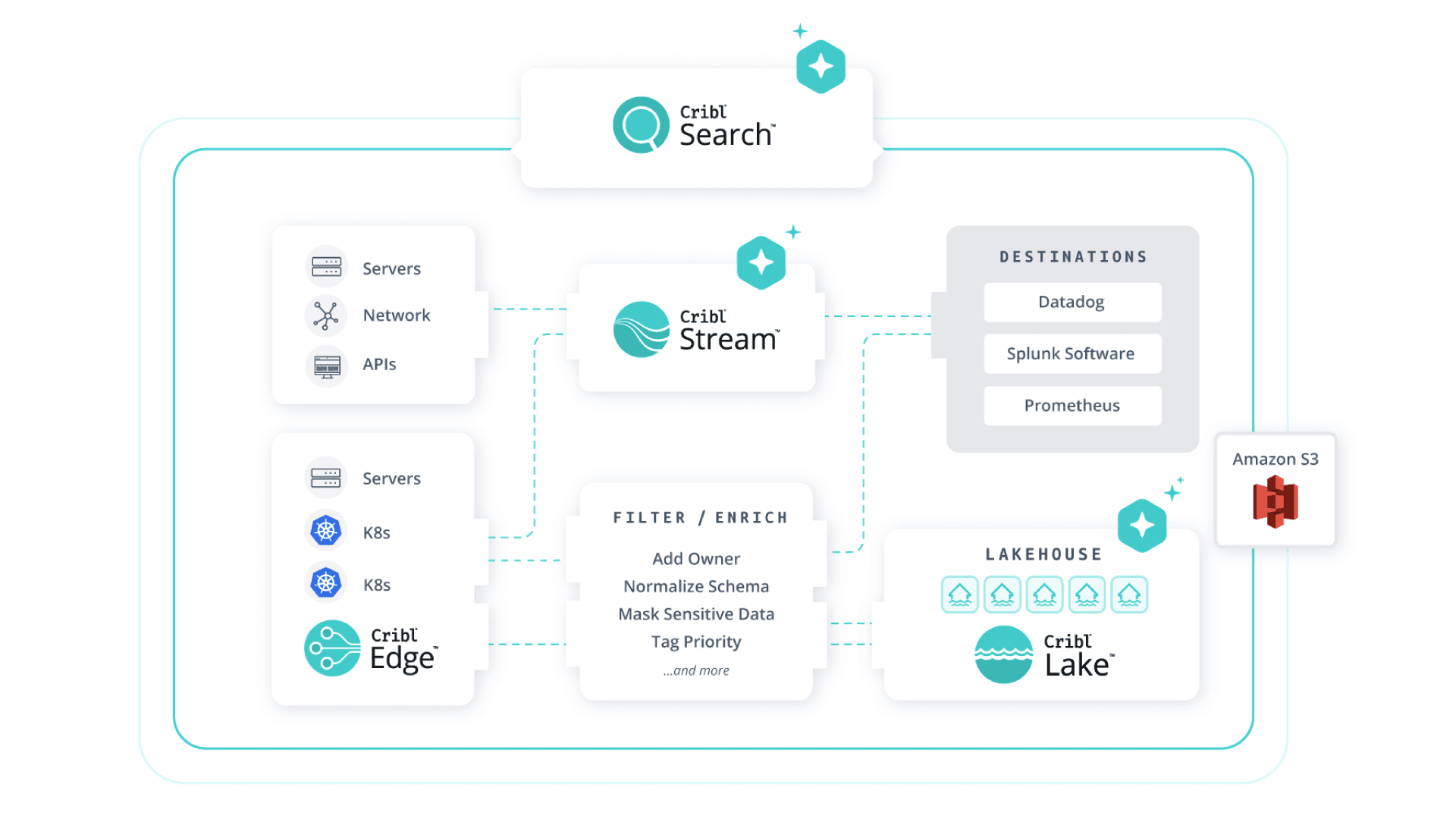
You don’t have to rip and replace observability tools to adopt Cribl. You plug the platform in between your sources and destinations:

You keep the tools that work. Cribl makes them better by feeding them trusted, enriched, AI‑ready telemetry from one shared platform.
Delivering reliability without compromise
Modern reliability is as much about culture as technology. The organizations that win are the ones that turn data into trust: clean signals, shared context, and credible metrics.
With Cribl as your AI Platform for Telemetry, you:
Consolidate your telemetry infrastructure instead of duplicating it per tool.
Govern data once and apply policies everywhere, across observability and security stacks.
Give AI and humans the same prepared data, so agents can act like a virtual teammate, not a bolt‑on widget.
Scale reliability practices across teams without scaling toil or locking into a single vendor.

Platform engineering teams get choice, control, and flexibility, while uptime, MTTR, and MTBF move in the right direction for the long term.