
AI-ready observability
If you're struggling with rising Splunk software licensing and infrastructure costs, this guide walks through six proven tactics filtering, routing, preprocessing, metrics, performance, and operational optimization that help reduce Splunk software ingest volume, improve search performance, and build an AI-ready observability pipeline for Splunk software with Cribl, the AI Platform for Telemetry, without locking you into any single analytics vendor.
Cribl is also the Data Engine for IT and Security: an open, cloud-native platform that sits between your sources and tools to give you choice and control over how telemetry is collected, routed, transformed, and analyzed. It is:

Open
Open Works with everything; open formats and an open ecosystem so your data remains your data.

Focused
Focused Purpose-built for the needs of IT and Security teams, meeting you where you are rather than forcing a single stack.

Performant
Performant Built for petabyte-scale telemetry, billions of events per second, and thousands of unique schemas.

Versatile
Versatile An elastic architecture where Stream, Edge, Search, and Lake can be composed like layers to match your environment.
Filtering out the noise
The first and easiest option to optimize your Splunk software licensing and infrastructure charges is to filter out extraneous data that is not contributing to insights.
By employing a simple filter expression, an administrator can reduce the volume of raw data destined for Splunk software in the first place and reduce Splunk software ingest volume before it ever hits your indexes. You can apply the filters to drop, sample, or suppress events. All of these filtering options can be configured based on metadata, such as hostname, source, source type, or log level, or by content extracted from the events, or both.
For example:
Dropping: 100% of this type of data is discarded or routed to a cheaper destination.
Sampling: If there are many similar events, only 1 out of a defined sample set is sent to Splunk software.
Dynamic Sampling: Low-volume data of this type is sent to Splunk software, but as volume increases, sampling begins.
Suppression: No more than a defined number of copies of this type of data will be delivered in a specified time period.

Indexed data takes approximately 4X more space to store than raw machine data.
The result is less total data and a higher percentage of useful data. It's also good practice to deploy Splunk software for high availability, which typically replicates indexed data three times. This means that for every bit of data sent, it takes 12X more resources to store it there compared to inexpensive object-based storage. In many environments, simply applying these basic filters can drive double-digit percentage reductions in data volume, in some cases over 50% in targeted datasets.

As newer privacy and AI workloads increase the sensitivity of telemetry, customers can pair traditional volume reduction with Cribl Guard Background Detection, which continuously samples pipeline data to automatically detect and optionally mask sensitive patterns such as PII, secrets, and regulated data before they ever reach Splunk software reducing compliance risk while you optimize ingest volume. Recent Guard improvements introduce purpose-built transformer models that run inside Cribl Workers (so sensitive data never leaves your environment), significantly reducing false positives and false negatives, and give you a choice between deep-detection and speed-optimized models so you can balance fidelity and throughput across different pipelines.
Routing to the most cost-effective destinations
Routing data to the appropriate tool for the job is another way to save money on Splunk software.
As mentioned above, indexed storage can take about 12X the resources as object storage, with linear costs to match. Another way to potentially reduce Splunk software licensing and infrastructure costs is to route data to a more cost-effective location instead of storing it all there.
A key advantage here is separating the system of analysis from the system of retention, which can be an inexpensive storage option like Cribl Lake, Amazon S3, or a host of other storage options. These stores are generally pennies on the dollar compared to indexed data in block storage and allow administrators to capitalize on the lower cost and increased compression ratios while still complying with data retention requirements.
This solution also allows an administrator to retain a full-fidelity copy of the original logs, in vendor-agnostic raw format (in case of future tooling changes), and concurrently deploy the filtering options from above to significantly reduce the data sent and retained in Splunk software indexed storage.
Many Splunk software customers see 30% savings or more just by employing these first two steps, filtering and routing, since the cost of retaining data is linear and continuously increasing as data is added.
An important consideration when separating the system of analysis from the system of retention is ensuring there is a way to retrieve data from the system of retention without having to wait to thaw out cold storage or send someone to find it on a tape backup system. Cribl Stream lets you easily and cost-effectively retrieve stored data with our Replay feature.
Replay lets administrators specify parameters, such as user, date/time, or other information, that identify which data to retrieve from object stores and send to Splunk software or another tool for immediate analysis.
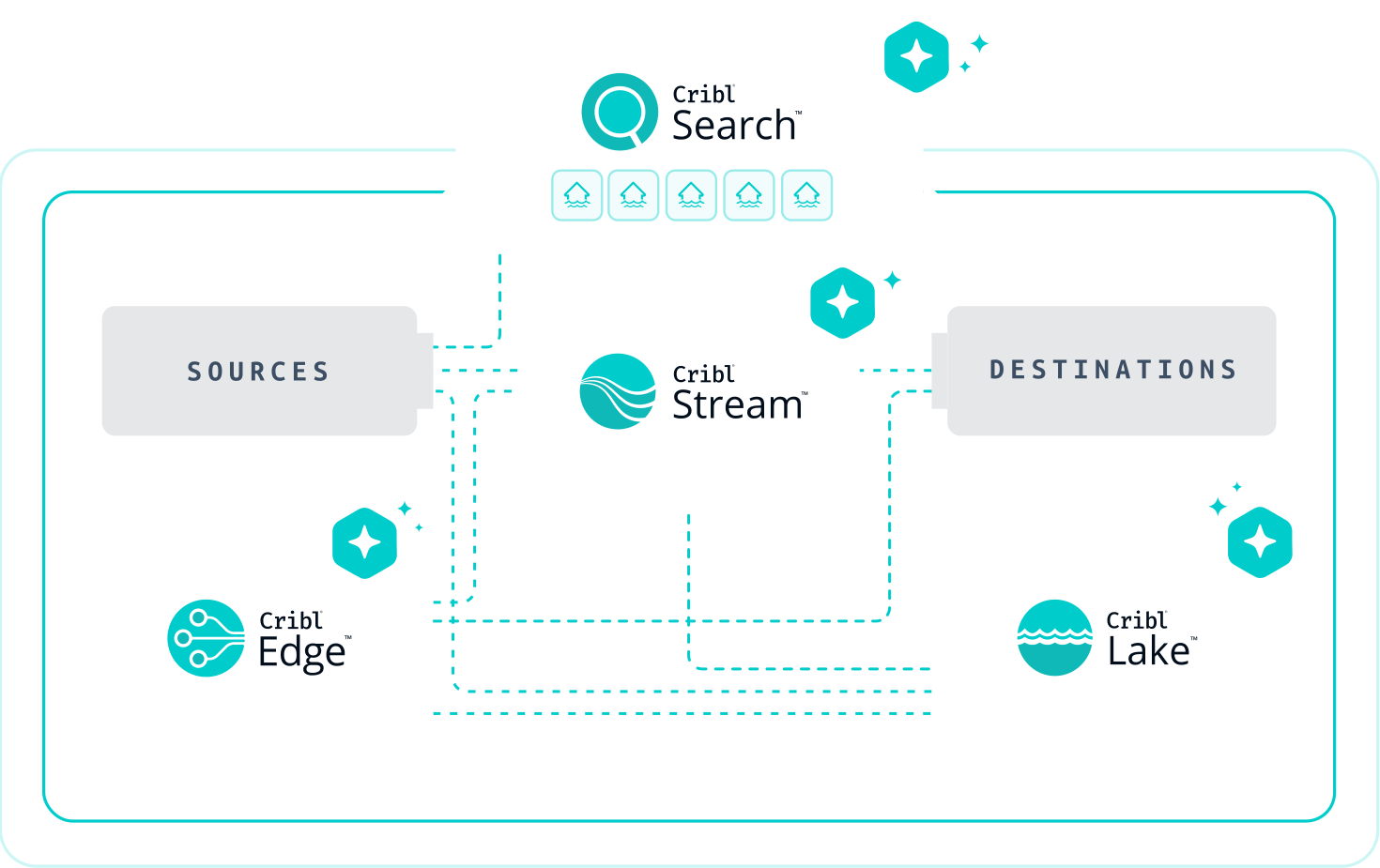
With the introduction of Lakehouse Search Engines in Cribl Lake and enhanced federated search pushdown in Cribl Search, teams can now run high-performance, search-in-place queries directly against Cribl Lake, Amazon S3, and Azure Blob (including data routed away from Splunk software) without rehydrating everything back into indexed storage, further reducing Splunk software license and infrastructure consumption while preserving fast access to historical data.
These routing patterns now extend beyond Splunk software to adjacent analytics platforms: Cribl Stream's native integration to Microsoft Fabric Real-Time Intelligence lets you route enriched, optimized telemetry from the same pipelines feeding Splunk software into Fabric Eventstream as a first-class data source, simplifying multi-platform strategies without duplicating ingest infrastructure.
Cribl can also ingest Al usage telemetry, such as OpenAI API usage and ChatGPT Enterprise compliance logs, into the same vendor-agnostic pipelines you use for Splunk software. By treating Al usage as first-class telemetry, you can route detailed prompts, responses, and cost data to Splunk software, Cribl Lake, or other stores for security monitoring, compliance reporting, and FinOps analysis, all without locking into a single Al or logging stack.

Improved data access
Improved data access Cribl lets you easily and cost-effectively retrieve stored data with stream replay.
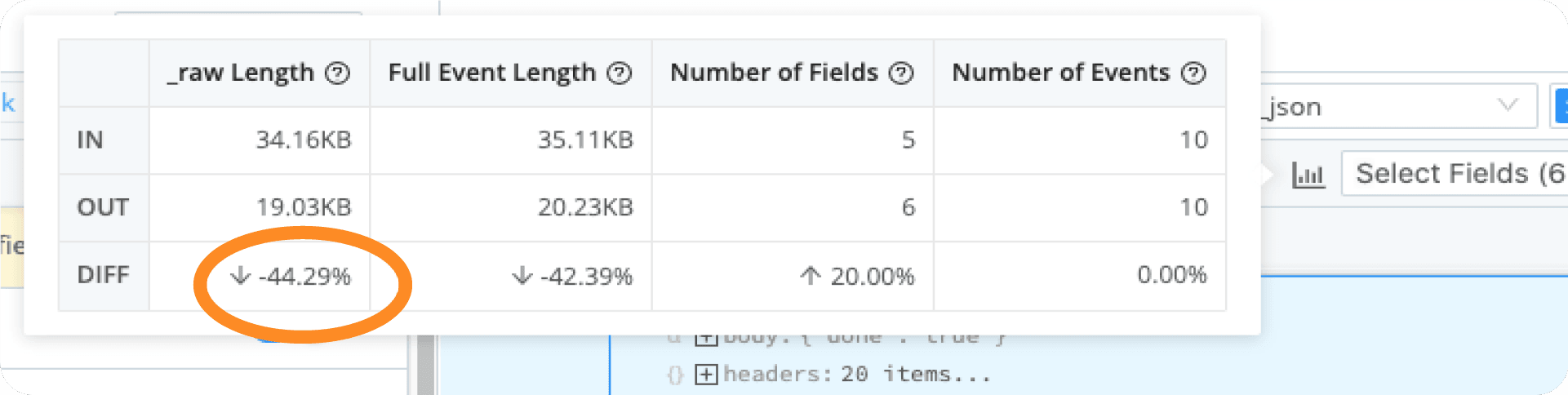

Administrators can see up to 75% reduction in log volume just by getting rid of fields that do not contain any data at all.
Reducing volume with pre-processing
In addition to filtering machine data to optimize your Splunk software deployment, another option is to reduce the volume of the events themselves. While a verbose set of logs can aid in troubleshooting, it's fairly common to see many unnecessary or unwanted fields within a specific event.
By using pre-processing capabilities in Cribl Stream, you can trim the event itself by removing NULL values, reformatting to a more efficient format (XML to JSON, for example), dropping duplicate fields, or even changing an overly verbose field to a more concise value.
While the number of individual events may be the same when using pre-processing, depending on the dataset, administrators can see up to 75% reduction in log volume just by getting rid of fields that do not contain any data at all. This directly reduces Splunk software storage, improves compression, and can lower CPU utilization during search.
As organizations standardize data lifecycles across multiple destinations, these same pre-processing pipelines can feed Lakehouse Search Engines and downstream Al workloads, ensuring that what lands in low-cost object storage or Cribl Lake is already normalized and compressed for efficient, search-in-place access, not just cheaper storage.

Administrators can adopt a discerning data management strategy using data storage techniques which are fit for purpose.
Compressing logs into metrics
Many of the highest-volume data sources come from having to ingest extraneous information just to access a single useful statistic, otherwise known as a metric.
Web activity logs, NetFlow, and application telemetry are great examples of this type of event, and another way to realize significant savings in Splunk software is to aggregate logs like this into summary metrics. Since a metric usually contains only a name, a value, a timestamp, and one or more dimensions representing metadata about the metric, they tend to require much less horsepower and infrastructure to store than log files.
Stream lets administrators extract fields of interest, using built-in Regex Extract or Parser functions, and then publish the result to metrics. Once aggregated, administrators will see a major reduction in event counts and data volume, and then can choose whether to send those metrics to Splunk software, or potentially route the metrics instead to a dedicated time series database (TSDB), such as InfluxDB or Datadog for efficient storage and retrieval.
These metric-oriented reductions can now be combined with Cribl Guard Background Detection to ensure that even when you retain detailed logs in Cribl Lake or object storage for later replay, Cribl Guard automatically detects sensitive patterns and masks or drops them during aggregation improving both cost efficiency and security posture without requiring hand-written rules for every new source.
High performance
When it's literally a matter of national security, rapid identification and resolution of issues is of critical importance.
Analysts at many federal agencies use Splunk software to dig into and clarify potential anomalies, and Accenture Federal Services (AFS) brings Stream into the mix to ensure those analysts get the best performance possible.
Analysts were building many searches just to build lookup tables; we had hundreds of searches scheduled just to build out IP lookups. Using Stream makes Splunk software more efficient by letting you save your search resources for faster searching instead of having to build metrics to search.
GARED SEATS | SECURITY ENGINEER | ACCENTURE FEDERAL SERVICES
For investigations that span Splunk software indexes and data retained outside Splunk software, Cribl Search now offers Cribl Search investigations, an AI-assisted investigation experience that generates queries, analyzes results, and summarizes findings from natural language prompts. It also provides collaborative Notebooks that serve as a virtual war room for multi-user investigations, accelerating time-to-insight without forcing all data into a single analytics stack.
New unified, AI-powered Search capabilities bring data ingest, storage, high-speed analysis, and agentic AI together in a single, end-to-end system. Simplified ingestion and AI-driven parsing and extraction let teams onboard data in minutes; a high-speed, automatically schematized store keeps it always ready for fast analysis; and Cribl Notebooks plus agentic AI can guide collaboration and investigations. The result is dramatically faster, more efficient investigations, often up to 10. faster than traditional log management architectures, while still allowing Splunk software to remain a primary analytics interface for many teams.
This helps both humans and AI agents work from the same, consistent telemetry story.
Decreasing operational expenses
Reduce costs using Cribl Stream
Reduce costs using Cribl Stream One last way to reduce spend on Splunk software is simply to reduce the number of hours and resources dedicated to supporting it.
By employing functions such as filtering, parsing, and reformatting in Cribl Stream, you can reduce the overall noise to such a degree that finding the valuable and necessary information takes far less time in Splunk software (or any other data analysis platform). Once events are optimized before being indexed, crafting the necessary search is easier, and the actual search itself runs faster as well. This not only reduces the time to insight, but it also removes the burden of bloated infrastructure, constant juggling of content and compliance requirements, and building out custom solutions to solve a point problem.
In addition, consolidating multiple tools into a single, centralized interface further reduces the operational overhead associated with observability deployments. Administrators can replace the functionality of intermediate log forwarders, like Splunk software's heavy forwarder or Logstash, and other open source tools such as syslog-ng or NiFi, with Stream. The obvious advantage here is fewer tools to install, manage, and maintain, but Stream also delivers increased efficiency by consolidating ingestion, processing, and forwarding of data streams for centralized visibility and control.
Cribl's platform investments over the last six months further decrease operational friction: the new FinOps Center gives you detailed dashboards for usage and cost across Cribl Cloud services, helping teams proactively manage and forecast spend associated with both Cribl and downstream analytics like Splunk software; Cribl as Code and an expanded Terraform provider make it easier to manage complex routing and filtering topologies as code; and Cribl Guard Background Detection continuously scans pipeline data to flag or remediate sensitive patterns without manual rule-writing, reducing the operational burden of data governance.
Cribl Insights delivers centralized monitoring and alerting across your Cribl environment, retaining recent history to detect anomalies such as sudden data volume drops, format changes, and stalled pipelines, then sending actionable alerts into your existing workflows.
Cribl Workspace and extended Insights support for non-main workspaces give each team or tenant its own health view and autonomy while preserving centralized governance; dev, test, staging, production, and managed customer workspaces can all be monitored consistently.
The Cribl MCP Server, now generally available for both on-prem and Cribl.Cloud deployments, exposes system metrics, alerts, configurations, Cribl Lake datasets, and Cribl Search capabilities through a standard Al integration layer, allowing Al assistants to help operate and tune your Cribl-plus-Splunk-software environment while still honoring your routing and retention strategies.
Frequently asked questions
How can I reduce Splunk software licensing costs without losing important security data?
Place Cribl, the AI Platform for Telemetry and the Data Engine for IT and Security, in front of Splunk software to filter duplicate and low-value events, route cold data to low-cost object storage or Cribl Lake, and convert high-volume logs into metrics.
You keep full-fidelity copies in vendor-agnostic storage while only sending the most valuable data to Splunk for indexing, which helps you optimize Splunk licensing and infrastructure costs without sacrificing visibility.
What is the best way to separate Splunk software search from long-term retention?
Use Cribl Stream to separate your system of analysis (Splunk software) from your system of retention (Cribl Lake, S3, Azure Blob, or other object stores). Replay and search-in-place capabilities in Cribl Stream, Cribl Lake, and Cribl Search let you retrieve or query historical data on demand, so you donˇt have to keep everything in expensive Splunk software indexes.
How does Cribl help make my Splunk software environment AI-ready?
Cribl builds an AI-ready telemetry architecture by normalizing and enriching telemetry as it flows through Cribl Stream, protecting sensitive data with Cribl Guard Background Detection, and powering AI-assisted investigations through Cribl Search, Cribl Search investigations, and the Cribl MCP Server.
That gives both humans and AI agents high-quality data at lower cost.
Can I use Cribl even if I plan to keep Splunk software as my primary SIEM and observability tool?
Yes. Cribl is intentionally vendor-agnostic.
Most customers continue to use Splunk software as a primary analytics and SIEM platform, while Cribl handles collection, routing, optimization, and replay as an observability pipeline for Splunk software. This combination delivers more value from your existing Splunk software investment while keeping your options open for the future.
Summary
Splunk software is a leader in the data analytics industry for a reason, but that superior experience can get bogged down by noisy data driving up processing and storage requirements. To separate the signal from the noise, Cribl, the AI Platform for Telemetry and the Data Engine for IT and Security, gives IT and security teams an open, vendor-agnostic way to collect once, route and transform anywhere, and power AI-ready investigations for both humans and agents delivering full data independence and control to optimize your Splunk software deployment. Implementing even a couple of these options using Stream can cut your log volumes dramatically.
With the addition of Cribl Lake and its Lakehouse Search Engines, Cribl Search with federated search pushdown and Cribl Search investigations, Cribl Guard Background Detection, AI-ready integrations like the Cribl MCP Server and Bring Your Own AI Model, plus new capabilities for AI usage telemetry, centralized monitoring, and control-plane security, organizations can now combine cost-optimized Splunk deployments with AI-assisted, search-in-place analytics across data in motion, at the edge, and at rest all without locking themselves into a single vendor's storage or query engine.

This strategy is the foundation of a modern, AI-ready observability approach.