

The challenge
You need Splunk software to handle way more data, from more places, without melting your CPUs or blowing up your budget. That means clean, flexible data routing into Splunk software, smarter decisions about what you index and where, and way to scale users and use cases without scaling hardware and licenses at the same rate.
The solution
Cribl delivers a full collection, processing, and routing layer in front of Splunk software so you can squeeze more value out of every CPU cycle and every license.
With the Cribl, the AI platform for telemetry, you can:
Route data from many sources into Splunk software without friction.
Enrich events with third-party context so searches are more useful.
Drop null values, dedupe fields, and aggregate verbose logs into metrics to boost downstream performance.
Analyze high-value data in Splunk software while cost-effectively storing the rest elsewhere.
Introduction: Doing more with your Splunk software environment
Splunk software is great at turning messy, unstructured data into answers. But as data volumes explode, you start to feel the pain: slower searches, higher CPU usage, and rising storage and license costs.
Cribl Stream steps in as a data engine in front of Splunk software. It optimizes data flows, trims processing load, and lets you treat data like a strategic asset instead of a liability Stream is a high-performance pipeline that routes data into Splunk software and reshapes it in flight, so Splunk software only ingests high-value, actionable data.
That means:
Faster searches
Lower CPU usage
Leaner, more responsive infrastructure
This paper walks through a new way to structure searches and how to use Cribl Stream, Edge, and Search with Splunk software. You'll see how to:

Cut unnecessary ingestion

Enrich data for deeper insights

Improve search speed at scale
As teams lean on Splunk software for more use cases, performance problems show up faster. Every industry is seeing data grow faster than infrastructure and budgets. On top of that, using Splunk software as a long-term data lake can get pricey, and those storage costs can hold you back from fully using your licenses.
A new strategy for enhanced performance
To keep Splunk software fast and affordable at scale, you need a smarter data strategy.
Techniques like populating index-time fields and using time-series metrics indexes can:
Speed up searches
Reduce CPU utilization
Improve overall Splunk software performance
Instead of indexing everything and hoping the hardware keeps up, you:
Ingest data selectively
Pre-process it before it hits Splunk software
Make sure Splunk software only analyzes data that's already optimized for search
That means you can support more data and more users without a matching spike in infrastructure or license spend.
Benefits of optimizing data for Splunk software

Ingest more data
Ingest more data By optimizing data before ingestion, you can handle higher volumes and support more users without a proportional cost increase.

Reduce Splunk software infrastructure size
Reduce Splunk software infrastructure size Faster, more efficient searches mean you may need fewer indexers and search heads, simplifying operations and cutting costs.

Lower overall cost
Lower overall cost With workload-based licensing that focuses on CPU, tuning data and searches is now a direct lever on your bill.

Lessen hardware requirements
Lessen hardware requirements Smarter data processing shrinks your hardware footprint—especially for Splunk software in the cloud—by making searches less resource-hungry.
Put together, these strategies help you get more value from Splunk software while staying ahead of growing data volume and complexity. You end up with a more efficient, more predictable environment even as demand keeps climbing.
Improving Splunk software performance for search and lowering CPU usage with the Cribl Suite
To keep Splunk software fast at scale, you have to rethink how you handle data. Populating index-time fields and using time-series metrics databases are key techniques to:
Cribl, the Al platform for telemetry, gives you an end-to-end way to refine and streamline data before Splunk software ever touches it.
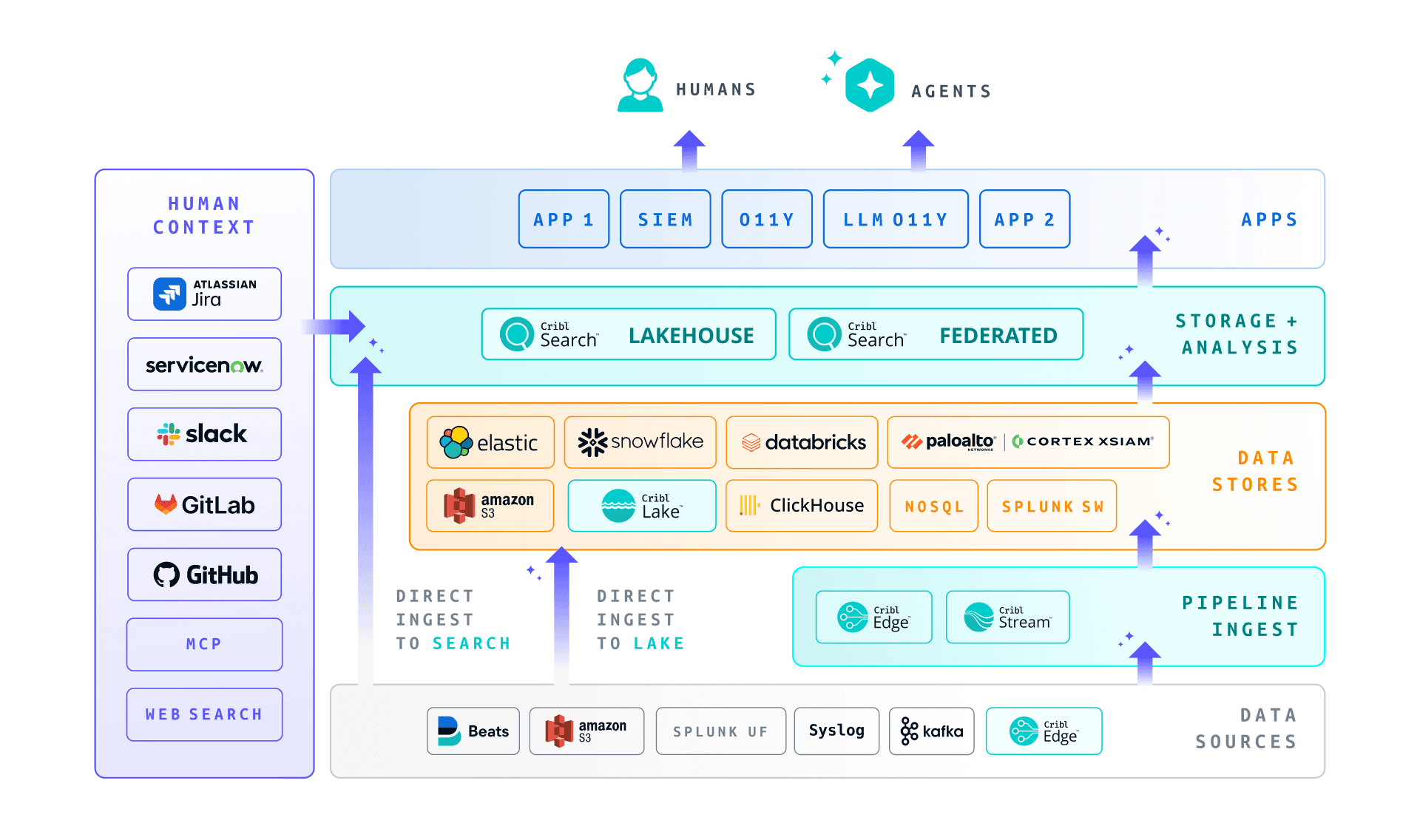
Figure 1. Cribl, the AI platform for telemetry, includes Cribl Stream, Edge, Search, and Lake.
Cribl Products
CRIBL STREAM preprocesses your data so Splunk software only works on what matters. In real time, Stream can:
Enrich events with extra context
Reduce noisy or redundant fields
Obfuscate sensitive values
By sending Splunk software only optimized data, you:
Improve query performance
Reduce storage needs
Lower processing requirements
CRIBL EDGE pushes that optimization out to the source.
Edge runs close to where data is generated and can:
Filter and reduce data volumes before they hit the network
Cut bandwidth usage
Ease ingestion load on Splunk software
You get even faster processing and lower infrastructure demand. As a bonus, by minimizing what you collect and ship, you reduce the overall attack surface and streamline data flows.
CRIBL SEARCH adds another layer of efficiency.
Search lets you run advanced, granular queries across diverse data sets, so you can:
Explore data faster
Find insights without hammering Splunk software search heads
Reduce the computational load required for many search patterns
CRIBL LAKE gives you a smarter place for the data you want to keep but do not need to index for everyday analysis.
Cribl Lake helps you retain more data cost-effectively and can:
Store lower-priority, high-volume, or long-retention data outside Splunk software.
Keep high-value, action-ready data flowing to Splunk software.
Preserve access for investigations, historical analysis, and future use cases.
You get a more balanced data strategy: Splunk software stays focused on fast search and operational insight, while Cribl Lake helps you retain more data economically. Instead of forcing one platform to do everything, you can match each dataset to the right destination and scale with more flexibility and predictability.
Recommended deployment option: Cribl.Cloud
You can deploy Cribl in several ways, including single‑instance and distributed setups. If you want speed and simplicity, use Cribl.Cloud.
With Cribl.Cloud, you:
Launch a Cribl‑hosted deployment of Stream, Edge, and Search
Offload provisioning and infrastructure management to Cribl
Get cloud‑scale elasticity without babysitting servers
As your data grows, Cribl.Cloud scales with you, maintaining Splunk software performance without constant tuning of underlying hardware.
Bringing Cribl into in your Splunk software environment gives you:
Faster searches
Lower CPU usage
A more scalable, cost‑effective data platform
Improving Splunk software performance for search and lowering CPU usage
If you're deep into Splunk software, you already know:
The tstats command is your friend for high-performance searches.
Time-series databases, such as metrics indexes, are built for fast, efficient analytics.
tstats
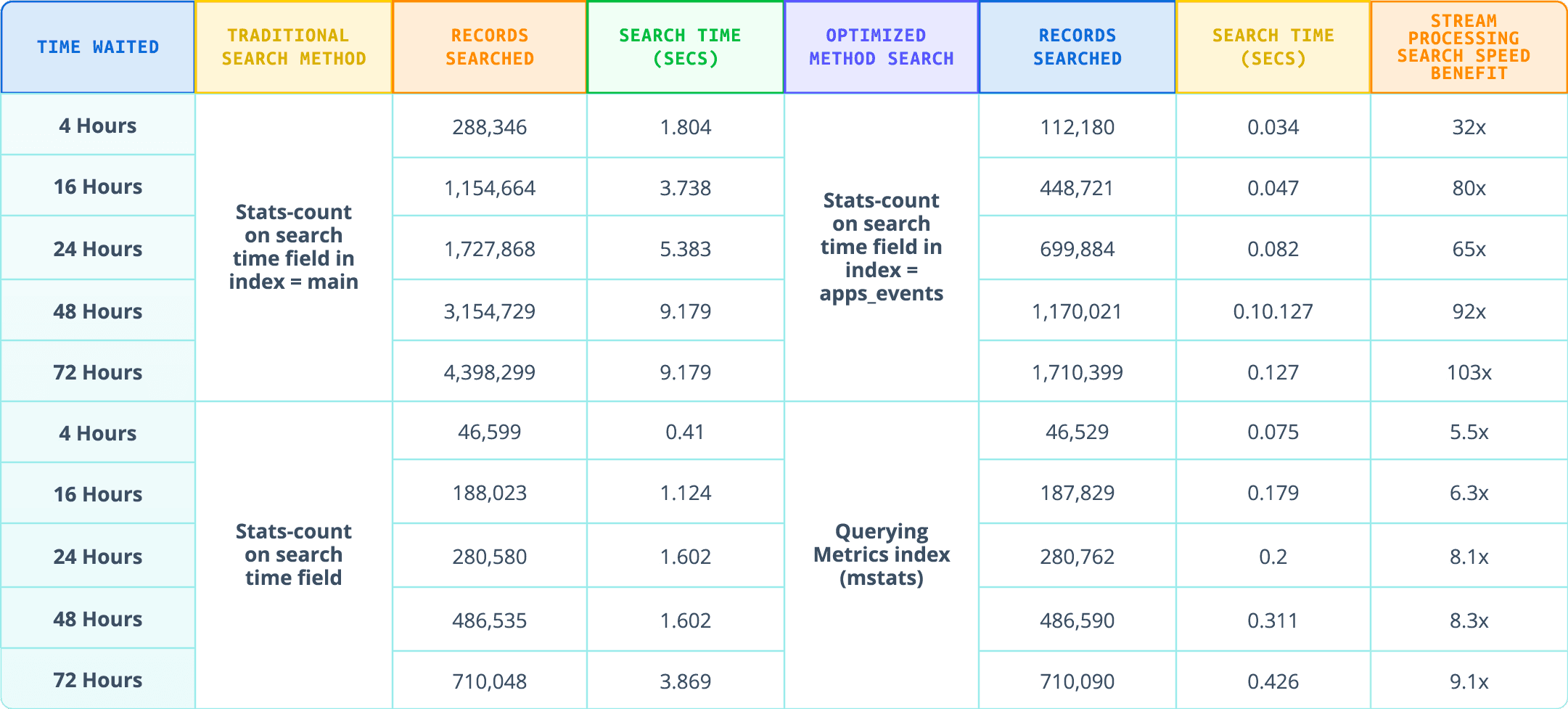
Using a set of Docker containers, Cribl Stream was shown to:
Significantly improve Splunk software search performance by populating index-time fields and querying with tstats.
Improve performance when writing to a metrics index instead of a traditional event index.
Simplify searches through an analytics workspace.
Deliver even bigger performance gains in production environments where you're searching billions or trillions of events.
Getting started: how to improve Splunk software performance with Cribl Stream
Cribl Stream is a telemetry pipeline that converts unstructured data into more structured form before it lands on disk. That makes it easier and faster to send data to:
Splunk software
Other observability tools like Datadog, Wavefront, the Elastic Stack, or Sumo Logic
Object storage like S3-compatible APls, GCP Cloud Storage, or Azure Blob Storage
Stream improves Splunk software search performance by:
Populating index-time fields and enabling tstats-based searches
Converting logs into metrics and populating m etrics indexes
Aggregating multiple events into a single record
Suppressing unwanted data so there's less to search and searches complete faster
Cribl engineers tested these approaches by generating 2 GB/day of data in Docker containers on a Mac with 8 CPU cores and 32 GB RAM. The dataset consisted of Tomcat application logs with multiple event formats in a single file.
The Cribl Stream pipeline transformed four main event types:
Events reporting response times as key-value pairs, mixed with less-structured data
Multi-line events capturing Java exception errors
Events reporting statuses and metrics inside a JSON payload
Other mostly unstructured info or error-severity events
With this processing, Stream was able to reshape the dataset and free up capacity for nearly 20% more data ingest.
Faster search performance directly translates into lower CPU usage on your Splunk software infrastructure.
Conclusion
In real-world environments, the performance gains are even more pronounced, and the takeaway is clear: Cribl, the AI platform for telemetry, helps you optimize your data and improve search performance, even when youˇre processing petabytes of data every day.
A telemetry pipeline is now table stakes, but forward-looking organizations are going further - getting their telemetry AIready and thinking about data volumes, budgets, and how humans and AI agents will work together.
Cribl Stream transforms data before it reaches its destination, cutting infrastructure and storage costs so you can do more with your Splunk software license. By transforming and enriching data on the way to Splunk software, Cribl Stream ensures Splunk software only works with the data it needs, resulting in faster searches and less strain on system resources.
Cribl Lake gives you a smarter place to store the data you want to keep but don’t need to index for everyday analysis. It helps you retain more data cost‑effectively, keep high‑value, action‑ready data flowing to Splunk software, and still have what you need for investigations, historical analysis, and future use cases. With Cribl Lake, Splunk software stays focused on fast search and operational insight, while long‑retention and lower‑priority data live in more economical storage without losing accessibility.
Cribl Edge pushes this optimization to the source, processing data where it’s created. That reduces unnecessary data transmission and processing, lightens the load on Splunk software, and improves overall efficiency, while also creating AI‑ready telemetry right at the edge.
Cribl Search extends Splunk software’s search capabilities, making data retrieval faster and more precise. That means less time and compute spent on every search and smoother operations at scale, with higher‑quality telemetry that can power both human and AI‑driven analysis.
Cribl.Cloud ties the entire suite together in a cloud-based platform that simplifies orchestration and scaling for your data operations. It gives you an easy way to manage your data infrastructure so performance and cost efficiency stay optimized across your Splunk software environment, while laying the foundation for telemetry that can feed current and future AI use cases.
When you use these tools together, you can tackle the biggest challenges of having a lot of telemetry in Splunk software: scalability, performance, and cost. As the AI platform for telemetry, Cribl helps you navigate todayˇs complex data analytics landscape, unlock deeper insights, and run more efficient operations.
As data volumes keep growing and AI becomes more central to how teams work, adaptable and efficient data management tools like the Cribl platform become even more important. Optimizing your data pipelines and making telemetry AI-ready will be essential to realizing the full power of platforms like Splunk software and the next generation of AI. With Cribl, youˇre ready to meet that future, drive innovation, and get the most value from every bit of data you own.

If you want to get started improving Splunk software performance with sample data, try our hosted sandbox, absolutely free.