
Sensitive data turns up everywhere in modern telemetry: in logs, events, payloads, and traces. Cribl Guard background detection finds it using Cribl’s purpose-built AI models, trained on telemetry and continuously improved as machine data evolves.
Earlier this year, we released Privacy 3.0, which was a new family of models that included improved decisions, per-entity thresholds and a new Pro tier to reduce false alarms.
Today we're releasing Privacy 3.1, which makes both our training data and our benchmark more like production. Earlier Privacy models were trained on carefully constructed data modeled on real log formats, a foundation that produced accurate models and remains part of our training today. Privacy 3.1 builds on it with real logs from open-source datasets, so the models learn from the messy, inconsistent events teams see in real environments. The 3.1 family, still offered in Fast, Default, and Pro tiers, is trained on more than 240,000 events. We also built an improved benchmark that better reflects production telemetry.
Learning from real-world logs
Real logs bring diversity that is hard to reproduce any other way. Formats drift, fields are reused, and the same key can hold a customer's email in one event and a shared team mailbox in the next.
For Privacy 3.1, we curated and labeled logs from dozens of real world, open source, and simulated environments, covering more than 1,000 log types. They span security simulations, cloud audit trails, honeypot captures, system logs, and sample logs from observability and security integrations.
Much of this data contains no sensitive information at all, which is true of most production telemetry, too. Routine events make up the bulk of what teams scan, so that is where false alarms pile up. Training on this data teaches the model what not to flag, which matters as much as knowing what to flag.
Scenarios modeled on real log sources
To reach systems and situations that open-source data doesn't cover, Privacy 3.1 also learns from events generated from templates modeled on real log sources, such as AWS CloudTrail, Okta, Palo Alto Networks firewalls, and Kubernetes audit logs. Each event reflects something that the system would really log, such as a firewall blocking a request or a banking transaction, and contains only the kinds of sensitive data that situation would produce: a firewall log might include an IP address, but never a credit card number. That teaches the model to judge a value by its context, like the type of log and the fields around it, rather than by its shape alone.
These events arrive in the layouts production telemetry uses, from JSON and key=value pairs to CEF, CSV, and free text. Sensitive values sit under realistic field names and next to look-alikes like license keys and serial numbers, so the model learns to tell them apart.
An improved benchmark for model evaluation
With the push towards hyper-realistic logs, also comes the need for a more challenging benchmark dataset capable of quantifying these differences. Our updated benchmark brings a new batch of test cases that are seeded with outliers, where detection is most likely to slip in production. These include sensitive values inside Windows event XML or heavily escaped JSON, in CSV columns with no headers, and buried in free-form ticket text.
The updated benchmark is designed to test generalization. No benchmark event appears in the training data. About three quarters of its events come from log types the model has never seen, and its scenario-based events come from scenarios never used in training. A strong score reflects how the models handle telemetry they have never seen, rather than how well they memorized their training data.
Improved quality, same performance
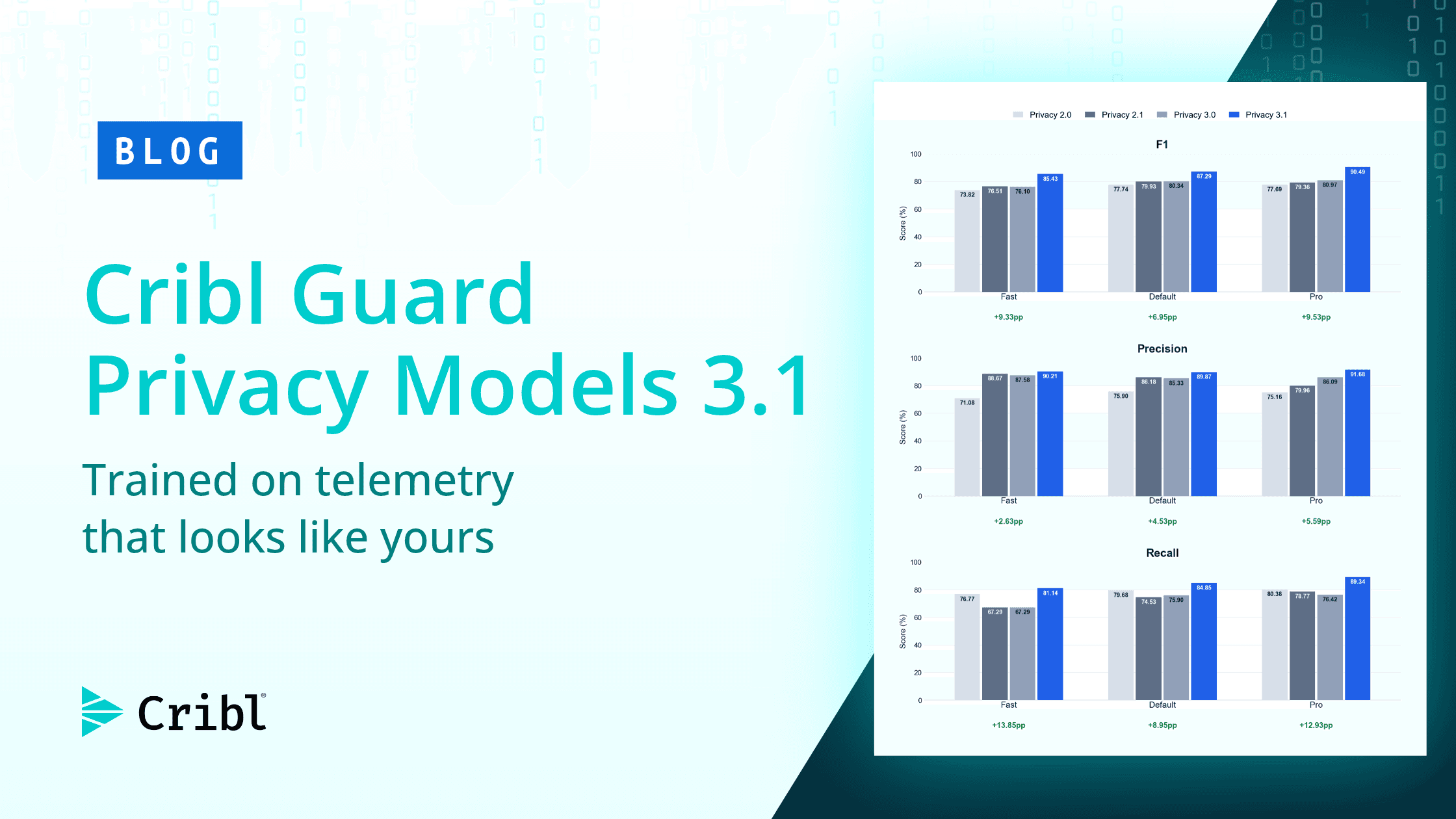
Precision, recall, and F1 across Privacy 2.0, 2.1, 3.0, and 3.1 measured against our updated benchmark:
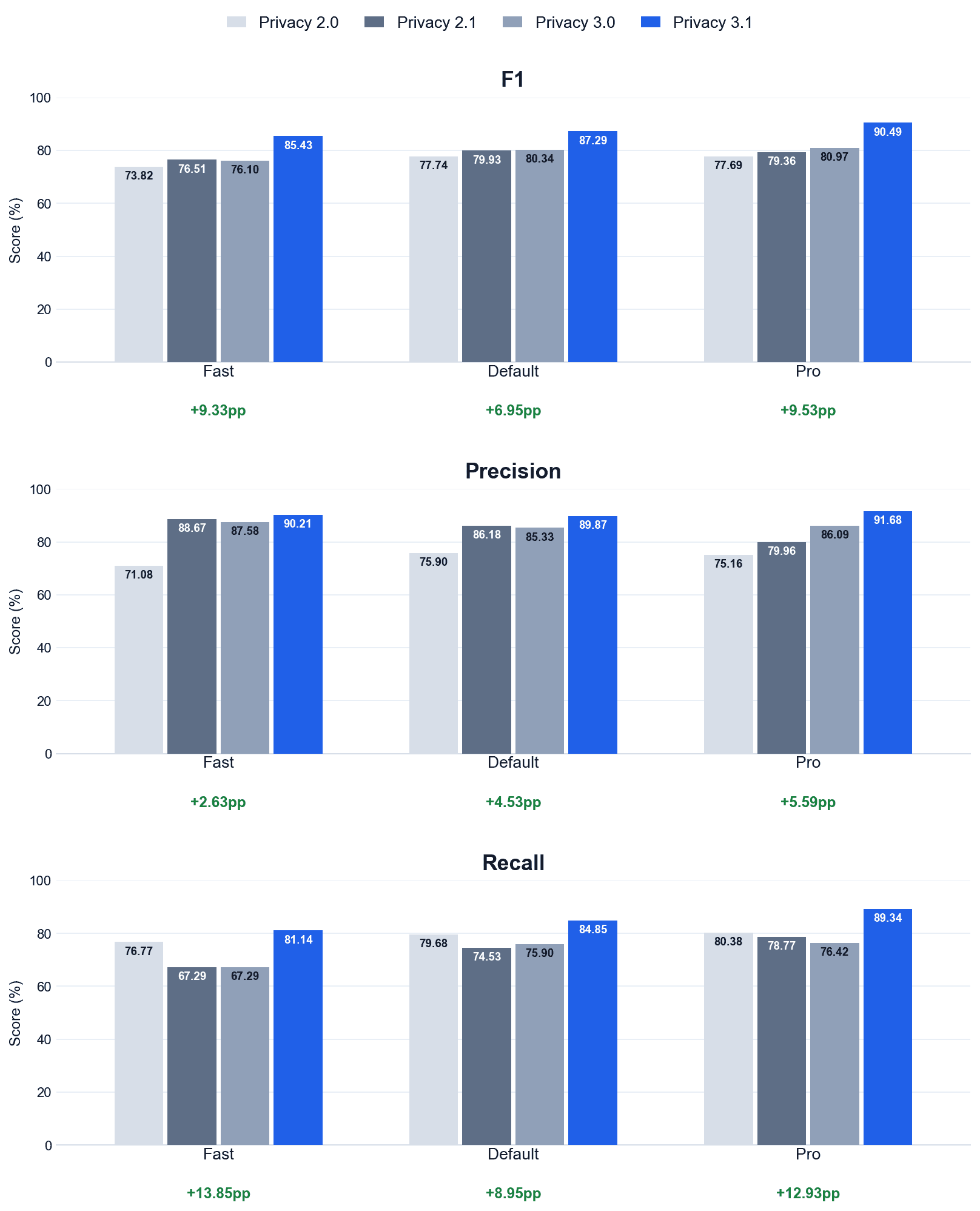
Scored on our improved benchmark, excluding entity types Privacy 3.1 no longer detects. Green numbers show the percentage-point gain from Privacy 3.0 to 3.1.
Precision reflects what share of findings are genuine sensitive data rather than harmless values that teams have to chase down. Recall reflects how much of the sensitive data actually present gets found. F1 combines the two into a single measure of detection quality.
Privacy 3.0 prioritized precision to cut noise. Privacy 3.1 keeps that focus and raises recall alongside it, with precision up by as much as 5.59 percentage points and recall by as much as 13.85 points.
The gains come at no cost to speed. The network architecture remained the same from Privacy 3.0 to 3.1, so throughput and memory usage are unchanged.
Choosing the right Privacy 3.1 model
The right model depends on what matters most for each workload:
Choose Fast when scanning volume and throughput are the primary constraints.
Choose Default for a balance of quality and performance.
Choose Pro when deeper detection and the strongest precision and F1 are worth additional compute.
A stronger foundation for protecting telemetry
Cribl Guard Privacy 3.1 learns from real-world logs, adds scenarios modeled on real log sources, and measures the results on a benchmark built to resemble production.
Most importantly, it gives teams a cleaner, more complete view of where sensitive data shows up across their telemetry, without any change in throughput.
Learn more about Cribl Guard background detection and how it can help you use AI to continuously uncover unknown sensitive data across your telemetry.
And if this is the kind of problem you like working on, we're hiring.