
For the last several years, federal cybersecurity teams have worked through the operational reality of OMB Memorandum M-21-31. The intent was sound: agencies needed better visibility before, during, and after cybersecurity incidents. M-21-31 raised the logging baseline across government and forced hard questions about coverage, central access, and investigation readiness.
In a recent whiteboard session with a federal agency, we walked through every place data gets generated across their environment. That data varies in volume, complexity, and usefulness to the tools and people analyzing it. The old approach of collecting, forwarding, and retaining all data falls apart at scale, on both cost and relevance. The exercise made the point: Visibility is not just a policy problem. It is an architecture and economics problem.
That is why M-26-14, "Ensuring Effective and Efficient Agency Logging and Network Visibility to Defend Against Evolving Cyber Threats," matters. OMB rescinds M-21-31 and replaces it with a risk-based, prioritized approach to agency logging. It is one that preserves the visibility goals while giving agencies the flexibility to implement them in a way that actually fits their architectures and budgets. For Cribl, the timing is meaningful. Cribl is the vendor-neutral control plane agencies use to collect data at the edge, shape, and route it in flight, retain full-fidelity copies economically, and search across them without moving the data first. That maps directly to what M-26-14 now asks agencies to design for: broad collection, deliberate data tiering, sensitive-data controls in the pipeline, and federated SOC access across decentralized storage.
And as of earlier this year, the full platform - Cribl Stream for collection and routing, Cribl Edge for distributed endpoint and infrastructure telemetry, Cribl Lake for full-fidelity retention in open formats, and Cribl Search for federated search across that retained data - is available to federal agencies as a FedRAMPⓇ Certified Class C (formerly known as Moderate) through Cribl.Cloud Government, exactly as the M-26-14 architecture conversation begins.
Two objectives, not one mandate
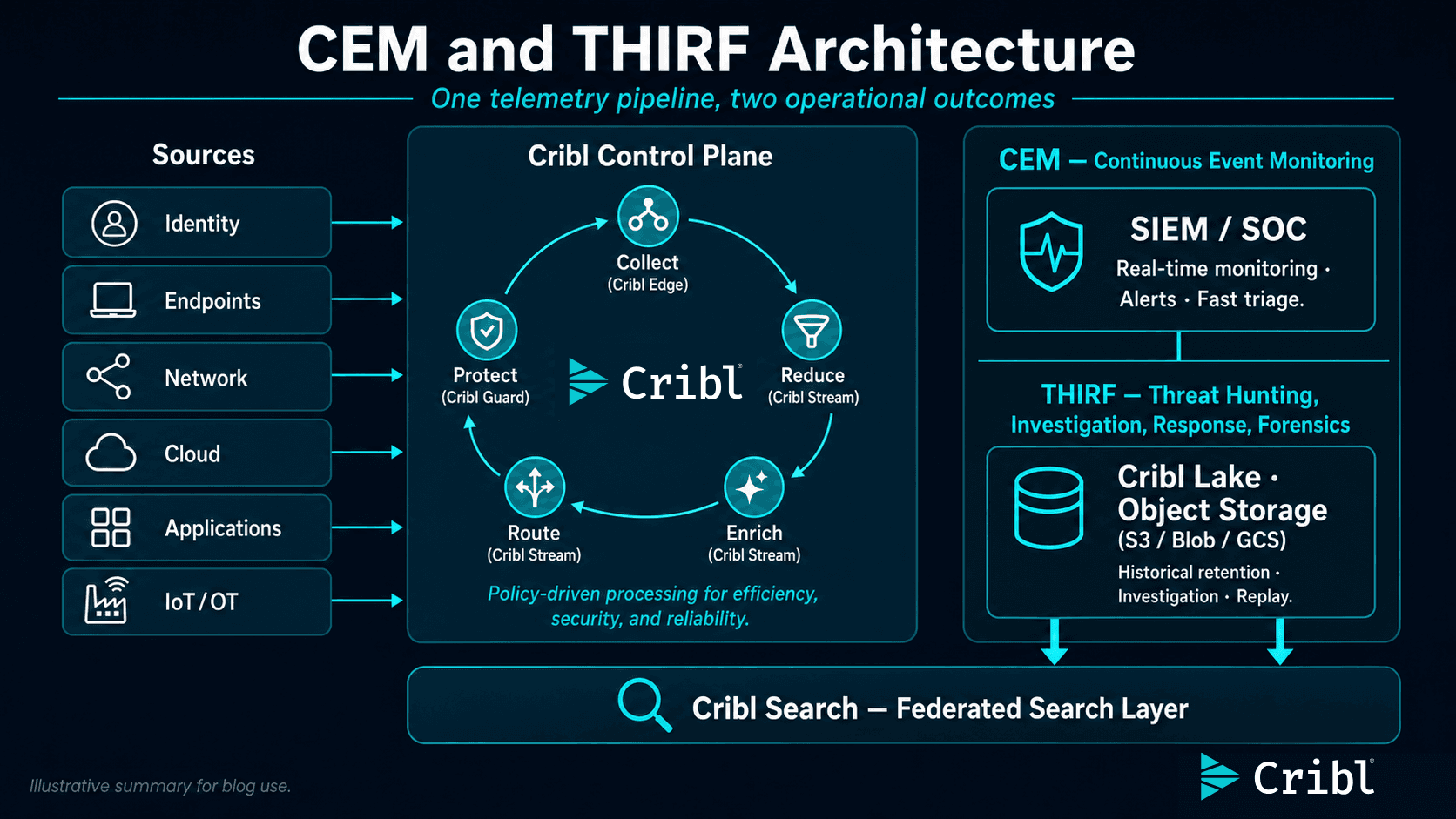
M-26-14 organizes agency logging around two clearly separated objectives:
Continuous Event Monitoring (CEM) - real-time monitoring, anomaly detection, and SOC-driven response.
Threat Hunting, Investigation, Response, and Forensics (THIRF) - post-compromise analysis, forensic reconstruction, remediation, and the ability to retrieve and centralize logs from multiple sources when needed.
This is the most important framing change in the memo. Not every log serves the same purpose. Some need to be immediately searchable because they drive detections. Others need to be retained and retrievable because they become critical during an investigation. Treating both needs identically, and routing everything into the most expensive analytics tier, is what made M-21-31 hard to sustain.
M-26-14 keeps the substance of the logging baseline: identity, network, resource access, privilege changes, infrastructure changes, suspicious activity, IOCs, anomaly detection, incident scoping, attack vectors, and automated alerting. What changes is how agencies are allowed to implement it. Log storage may be decentralized, provided logs are readily available to the top-level agency SOC. Agencies may use enterprise SIEM collection, central forwarding, distributed access authorization, or a hybrid model.
Searchable vs. retrievable: The data tiering opportunity
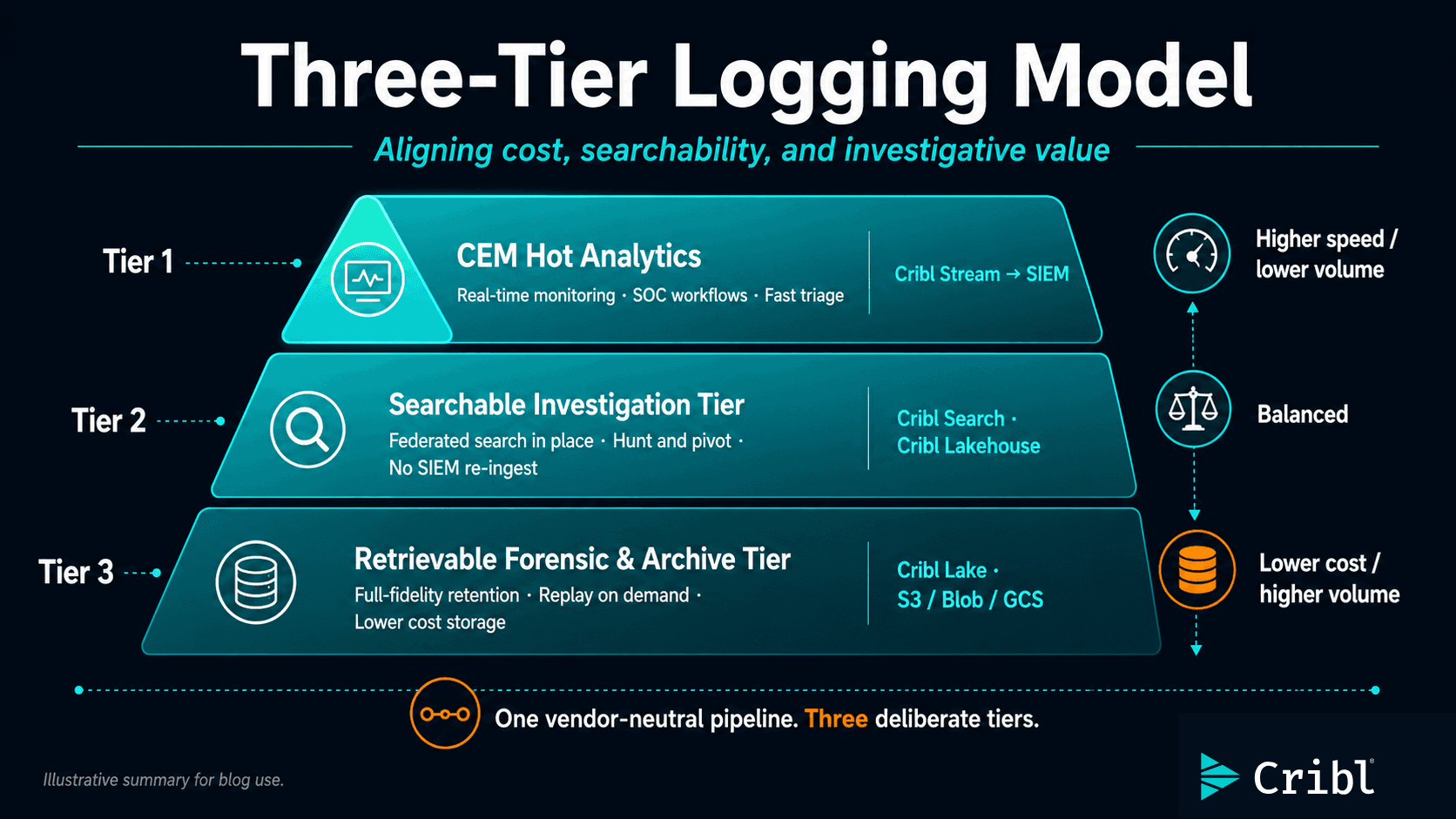
M-26-14 requires retained logs to be actively searchable for at least six months to support CEM and retrievable for one year to support THIRF. It also acknowledges that retrievable data may need intermediary steps such as replaying from long-term storage into an analytics tool, or thawing cold storage into a faster tier.
That distinction between searchable vs. retrievable is the foundation of deliberate data tiering, and it is where sustainable cost-avoidance lives in a federal logging program. The goal is not to collect less. It is to put each log in the right place, in the right format, with the right cost profile, governed by a deliberate plan.
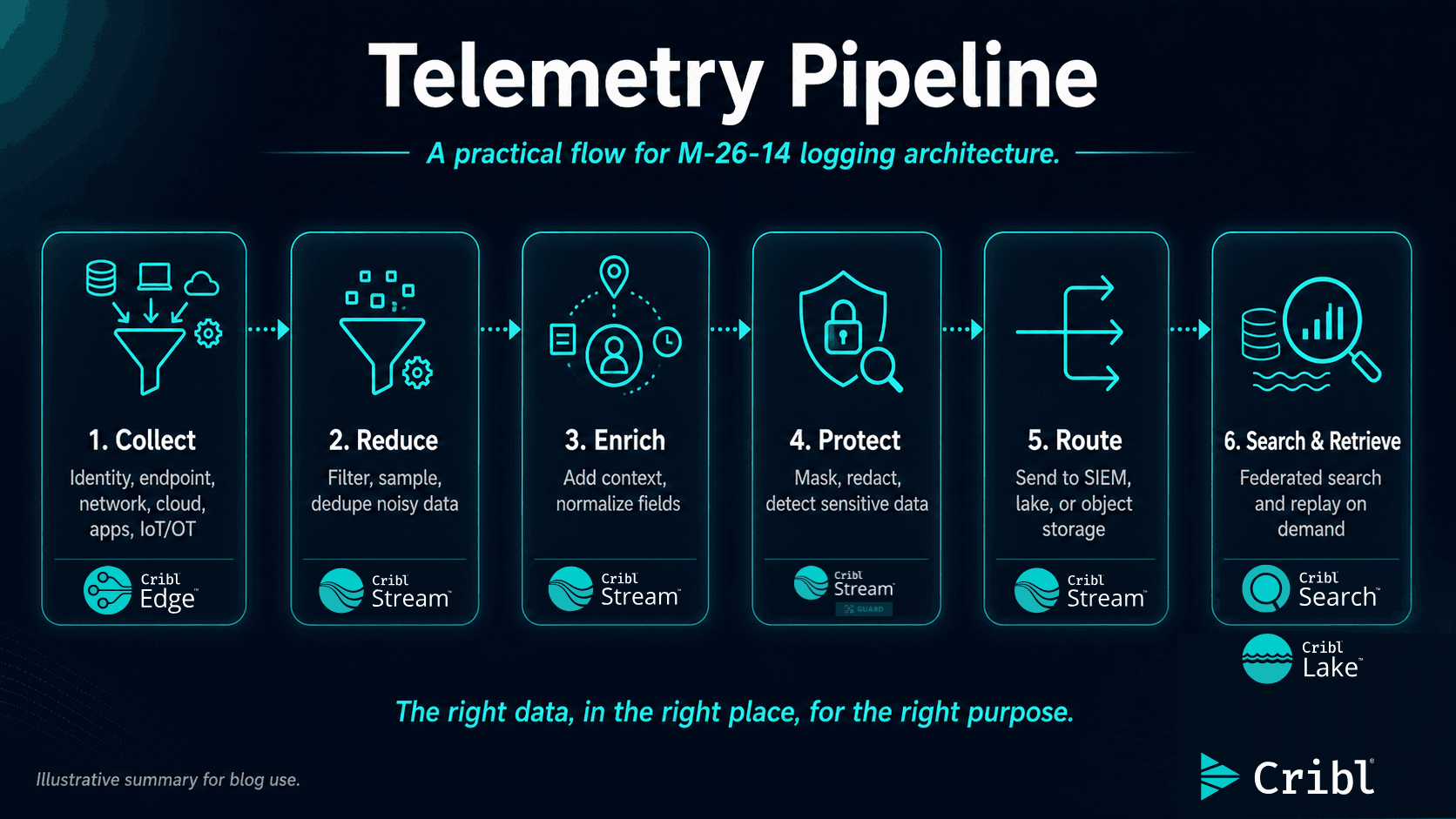
This is where Cribl Stream as a vendor-neutral telemetry control plane becomes operationally relevant. For a federal agency working through M-26-14, Stream helps answer questions like:
Which logs support real-time CEM and belong in the SIEM?
Which logs support THIRF but do not need to live in the SIEM?
Which data should be enriched, reduced, sampled, or routed before reaching the SOC?
Which sensitive fields should be masked or redacted before downstream delivery?
Across Cribl federal customers, high-volume sources such as endpoints and firewalls commonly see 40–60% volume reduction before SIEM ingest, with a full-fidelity copy routed in parallel to lower-cost object storage for investigation and retention. A federal law enforcement agency using Cribl Stream applies this same pattern to accelerate cybersecurity investigations by routing each data source to the analytic tool best suited for it, while enriching events at ingest. That is the model M-26-14 now explicitly enables.
The SOC needs visibility, not always direct ownership, of logs
One of the most consequential lines in M-26-14 is that the top-level agency SOC needs access to the right data, but every log does not have to physically live inside the SOC's primary tool. SIEM collection, central forwarding, federated access, and hybrid models are all on the table.
This is not permission to scatter logs, but rather permission to design intelligently. A hybrid architecture still needs answers to where the authoritative copy lives, what is immediately searchable, what is retrievable, how quickly, by whom, and whether responders can pivot across identity, network, endpoint, and cloud layers during an incident.
This is where federated search and replay become practical patterns rather than buzzwords. Cribl Search supports federated search across Cribl Lake and major object stores (Amazon S3, Azure Blob, Google Cloud Storage), so analysts can pivot across retained data without re-ingesting it into the SIEM first. Cribl Stream's Replay allows targeted retrieval from object storage back into an analytics tool when investigation requires it.
For agencies, this collapses the false choice between "put everything in the SIEM" and "store it cheaply but make it hard to use."
Sensitive data is a first-class concern
M-26-14 explicitly requires CISA's forthcoming Logging Reference Architecture (LRA) to address incidental exposure of sensitive data in logs and to advise agencies on protecting confidentiality and integrity of sensitive log data.
This is a real risk. The more telemetry an agency collects, the more likely logs will capture credentials, tokens, PII, PHI, financial data, or mission-sensitive content the agency did not intend to retain. Once that data is in a SIEM or replicated across tools, it is hard to recall.
The more durable pattern is to inspect and control sensitive data as close to the pipeline as possible. Federal organizations need an easy way to detect sensitive values, mask or redact fields before they reach downstream tools, and apply different handling rules by source, classification, or destination. Cribl Guard provides pipeline-based detection and field-level transformations to support this work with out-of-the-box rules and minimal end user effort.
Cribl’s model for privacy is highly performant and tailor-made for telemetry data. Newer capabilities in Cribl Guard incorporate background detections that proactively find patterns of sensitive data that have not been previously identified. This in-flight risk mitigation allows teams to quickly adapt to LRA requirements as they mature.
IoT and OT are now in scope under the memo as well. Native logging on those devices is often limited, and most agencies will need to combine network metadata, gateway logs, and asset inventory rather than relying on endpoint agents. Cribl Edge can collect from IT systems adjacent to OT environments, but agencies should expect to pair it with OT-specific telemetry sources for full coverage.
How Cribl maps to M-26-14
For federal teams operationalizing the memo, the Cribl architecture aligns cleanly with both objectives:
One of the clearest differentiators for federal teams is vendor-neutrality. Cribl is not tied to a specific SIEM, lake, or single cloud service provider, which gives agencies room to adapt as the LRA is published, updated annually, and re-interpreted by mission owners. Unlike SIEM-native collectors, which tie collection and routing decisions to a single analytics vendor, a vendor-neutral pipeline lets the LRA drive architecture choices.
What federal teams should do in the next 90 days
The Logging Reference Architecture is expected within 90 days of memo issuance, and agencies have 90 days from LRA publication to submit their first Agency Logging Plan. Initial maturity is required within 120 days, Intermediate within 180, and Advanced within 320.
Four practical steps stand out:
Separate CEM and THIRF sources today. For each log source, decide whether it supports real-time detection, investigation, or both - and where it should physically live.
Start with High Value Assets and High Impact Systems. The memo specifically directs the LRA to emphasize these. Build repeatable patterns there before scaling.
Define sensitive-data controls in the pipeline, not in the SIEM. Once data is replicated across tools, governance gets exponentially harder.
Design for change. The LRA will be updated at least annually. Architectures that rely on a single fixed destination or a single fixed retention model will not age well.
Final thought
M-26-14 resets the bar toward practical, sustainable visibility. It preserves the visibility outcomes M-21-31 set in motion while giving agencies the architectural flexibility to sustain them. It enables federal teams to operationalize that through data tiering, hybrid SOC access with federated search, sensitive-data controls in the pipeline, and vendor-neutral routing.
For agencies that lived through M-21-31, this is a chance to build on the progress already made and turn it into something operationally durable. If you’re drafting your Agency Logging Plan and want to talk through how data tiering, federated search, and FedRAMP-authorized telemetry pipelines could fit into your architecture, we’d welcome the conversation in a few unique ways:
A CEM/THIRF mapping working session,
A walk-through of a sample Agency Logging Plan
A focused architecture review against your current SIEM and storage footprint.
To learn more or get started, reach out to your account team directly or contact us here!