
Introduction
Security teams don’t hate SIEM. They hate what they have had to put up with to get value from it.
Pay more every time data grows. Send everything to one place before you can use it. Spend countless hours tuning detections, chasing false positives, maintaining brittle rules, and stitching together investigations across disconnected tools. Accept vendor lock-in because moving away can feel even more painful, disruptive, and expensive than staying. For CISOs, SOC Managers, and Detection Engineers alike, the relationship has become a familiar mix of dependence and frustration.
And yet, walking away from SIEM is not really the answer. Security teams still need the outcomes SIEM was built to deliver: visibility across the environment, effective detection, fast investigation, and confidence that the organization can identify and respond to threats. The problem is that too often, getting those outcomes requires accepting an architecture, operating model, and cost structure that were designed for a different era.
The frustrations also look different depending on where you sit. The CISO is trying to control costs, reduce risk, and avoid being trapped by a single vendor or architecture. The SOC Manager is focused on analyst productivity, alert overload, and getting investigations to move faster. The Detection Engineer is trying to answer an even more fundamental question: are we actually detecting the threats that matter, and can I trust the detections we already have?
Those tradeoffs are not inherent to SIEM. They are a product of the old way of doing it. As security data volumes explode, AI changes how attackers and defenders operate, and organizations demand more flexibility and control, it is worth asking a simple question: what if we could keep what security teams love about SIEM without putting up with everything they hate?
That is where a new way to SIEM begins.
01: CISO
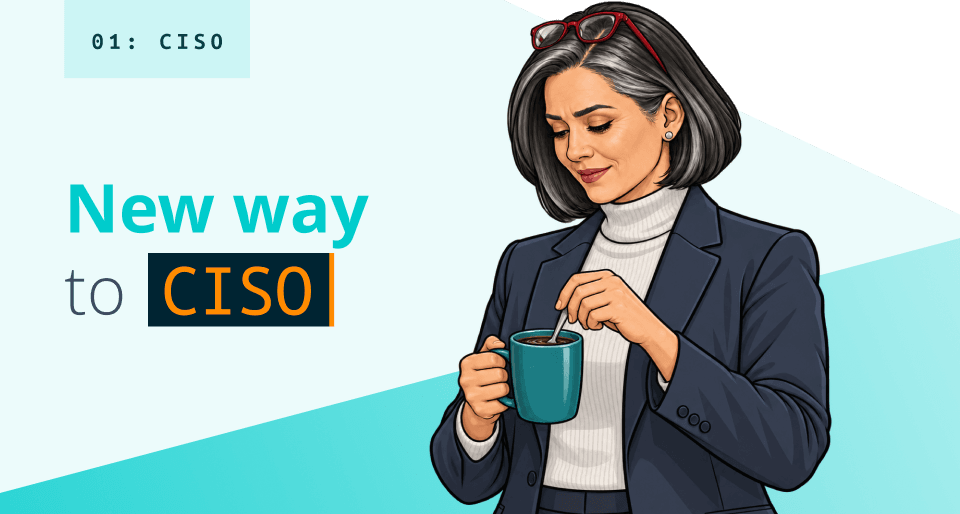
My data. Their terms.
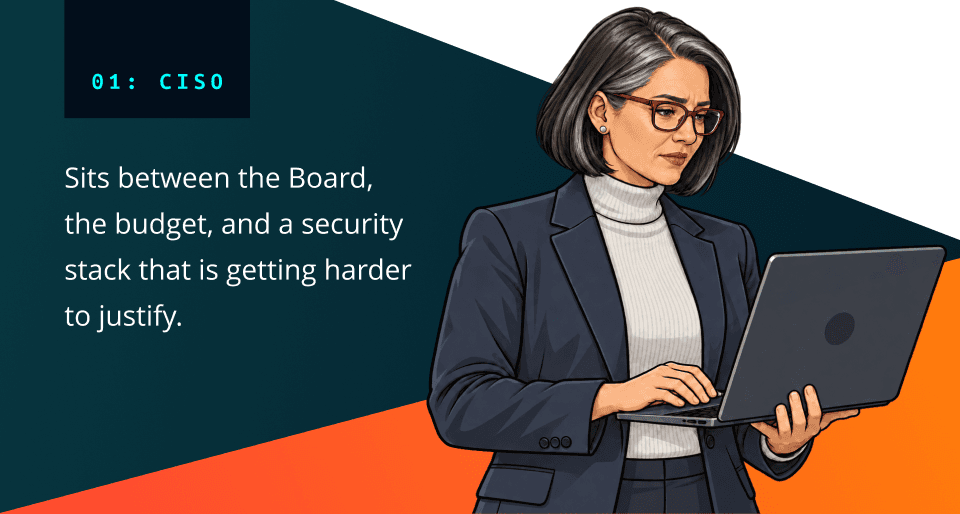
I'm the CISO. I sign the budget, answer to the Board, and spend more time in renewal conversations than I'd like to admit. I manage a team that's genuinely trying, a hefty SIEM contract, and a security posture I'm increasingly unable to explain in the language the CFO speaks.
What's bothering me:
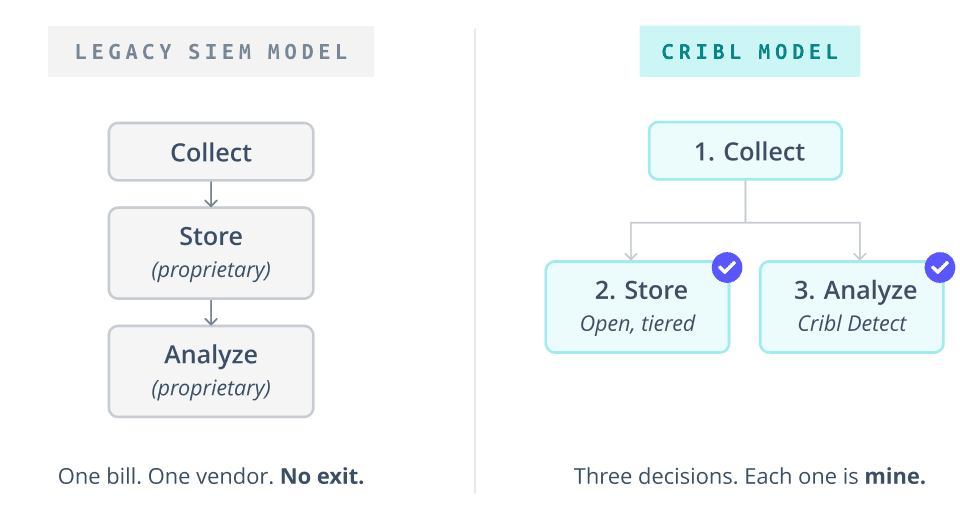
The data lock-in. When I signed the SIEM contract, I didn't realize I was signing away three separate architectural decisions: what I collect, where I store it, and what I pay per gigabyte. They came bundled. They still do. Every renewal, that bundle gets more expensive.
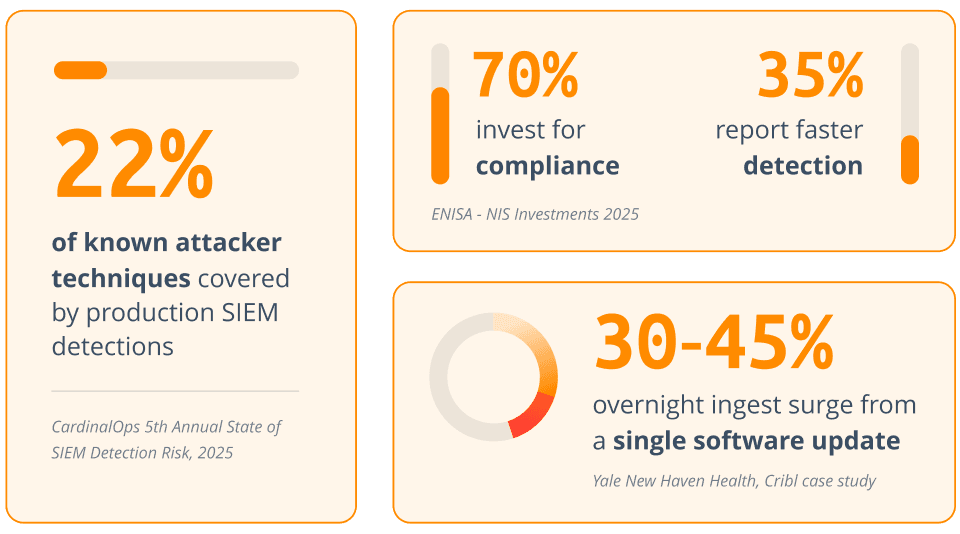
Compliance is not security. My auditors are satisfied, but I know that my current SIEM only has detection coverage for 22% of known attacker techniques1 These two facts coexist, but it bothers me to no end. In fact, 70% of security leaders invest primarily to satisfy compliance requirements according to ENISA, and only 35% report measurably faster threat detection as an outcome.2 There needs to be a better way.
The update that ate my budget. A large cloud provider pushes a routine agent update to thousands of endpoints overnight. By 9am, our SIEM ingest has spiked 30 to 45%. A license sized for 400 GB/day is now processing 600 GB/day. I'm explaining to the CFO why security spend moved because of a software update we didn't request. This is a pricing model problem, not a planning problem.
No credible exit. I looked. Getting out of a SIEM contract means migrating data, rewriting detections, retraining analysts, rebuilding integrations. The migration is the punishment for choosing wrong. (The vendor designed it that way. Their renewals team is very relaxed.
What I’m actually trying to do

Answer the Board's questions. Right now I have ticket counts. That's not an answer.
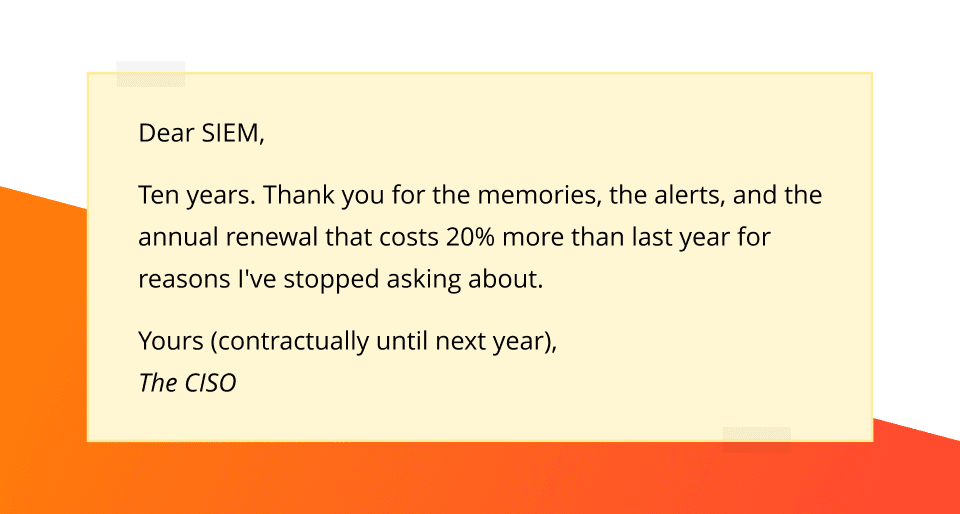
Win the budget conversation. My vendor wants a 20% uplift. My CFO wants ROI data.
Show that the program is improving. (Not just "we're compliant˛, but that our defenses are more effective.
Get out from under proprietary storage. When everything is in a vendorˇs format, at their price, in their cloud, it's not my data.
Three decisions. Mine to control.
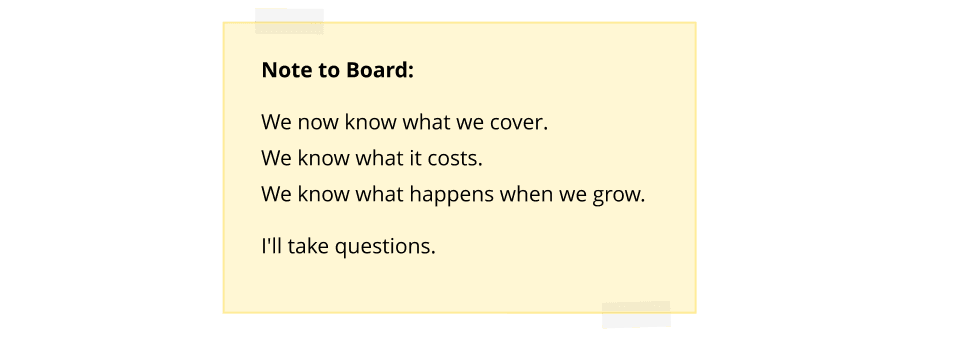
Same CISO. Different energy. The architecture changed, and with it, a conversation I'd been dreading since Q3 became a conversation I'm finally ready to have. I know what we cover. I know what it costs. I know what happens when we grow. For the first time in a while, I have answers before the questions arrive.
What changed:
I control the three decisions now. What I collect. Where I store it. What I analyze. Not bundled. Not the vendor's call. When my CFO asks why ingest spiked, I have an answer and a lever to pull.
My Board report changed. Not ticket counts. Not "we're compliant." For the first time, I can show coverage by adversary technique, mapped to our threat profile, trending in the right direction quarter over quarter. That's the question they were actually asking.
I maintain flexibility. My data is in open formats, in an infrastructure I control. KQL detections are portable. I can now make decisions that best fit my security program and goals, not just what any vendor is telling me to do.
Storage cost finally matched security value. (Full-fidelity data at predictable prices. Immediate analytics layer, right-sized. A software update no longer moves my security budget.
What I can finally do:
Answer "are we covered?" with a number, a trend line, and a plan to improve it.
Grow without fear. More cloud apps, more users, more devices. Cost scales linearly, not exponentially.
Show the program improving. Quarter over quarter. Coverage moving in the right direction. Sustainable, finally.
My AI works with the complete picture, not a fraction of it. The answers it surfaces are ones I can take to the Board.

What the Board conversation looks like now:
Detection posture management at the strategic level, not technical detail, just the output: an answer to "are we covered?"
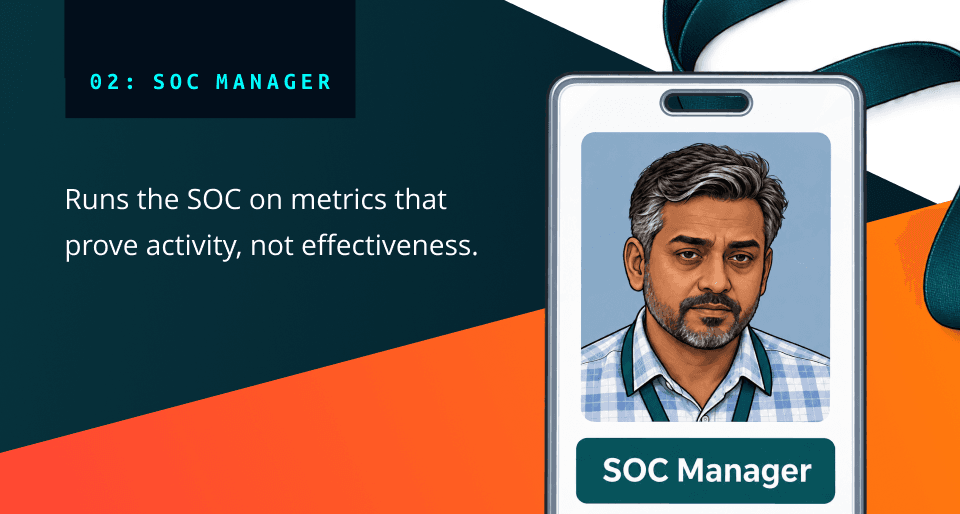
02: SOC Manager
The SIEM became the workload.
I run the SOC. I own the queue, the team, the shift schedule, and every escalation that lands at 2am. The metrics I report to the CISO measure how busy we are, not how good we are. My team is excellent, but our tools eat their time. We spend more hours maintaining the SIEM than we spend on actual investigation or improvement. That is not sustainable. I know it. They know it.
What’s bothering me:
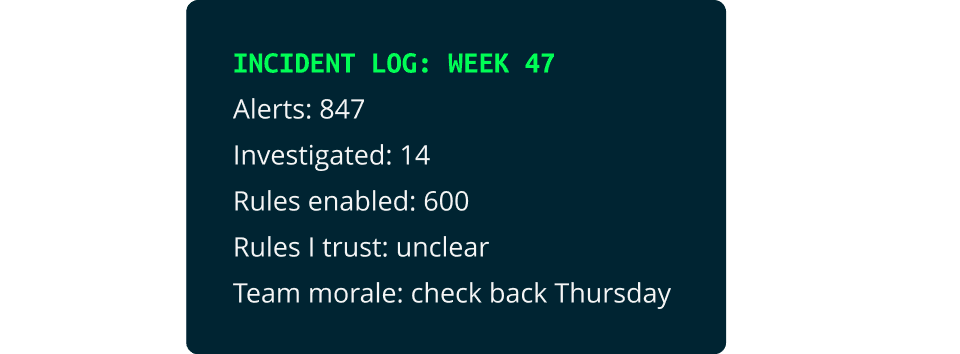
The queue is a vanity metric. 70% of SOC teams use "number of incidents handled" as their primary performance metric.4 A high queue could mean too many false positives. A low queue could mean broken rules not firing. The number tells me nothing about whether I'm actually catching threats.
Enabled is not the same as healthy. Enabled is not the same as healthy. My dashboard shows 600 rules active. What it doesn't show: how many have a stale telemetry source, a schema that drifted after the last update, or logic that's never been tested against real adversary behavior. 10% of rules in production SIEMs are probably broken, and that's the floor.1
We spend more time on tools than on threats. Count the hours. Alert tuning. Parser rebuilds after log format changes. Integration fixes after vendor updates. SIEM upgrades that break half the connectors. My analysts are skilled investigators. Most of their day is system administration. The SIEM is supposed to be the instrument, instead it became the maintenance burden.
I can't see what I'm not covering. In 75% of breaches, initial intrusion evidence was present in logs, but not accessible or operationalised at the time.5 The data was there. The detection wasn't. I can't fix a gap I can't see.
Investigation eats my analysts' time. Pivoting across five disconnected tools to build a timeline is manual, slow, and entirely dependent on who's on shift.
What I’m actually trying to do
Know what I actually cover. Not what rules are enabled, but what adversary techniques I'd catch if they ran against my environment today.
Give my analysts time back. Every hour not spent on tool maintenance is an hour spent on investigation. The balance must shift towards investigation.
Reduce noise without reducing coverage. Alert volume down, investigation rate up. Getting both right is the actual job.
Report something that matters. Not tickets closed. Coverage, trend, improvement. That's the conversation I want with the CISO.
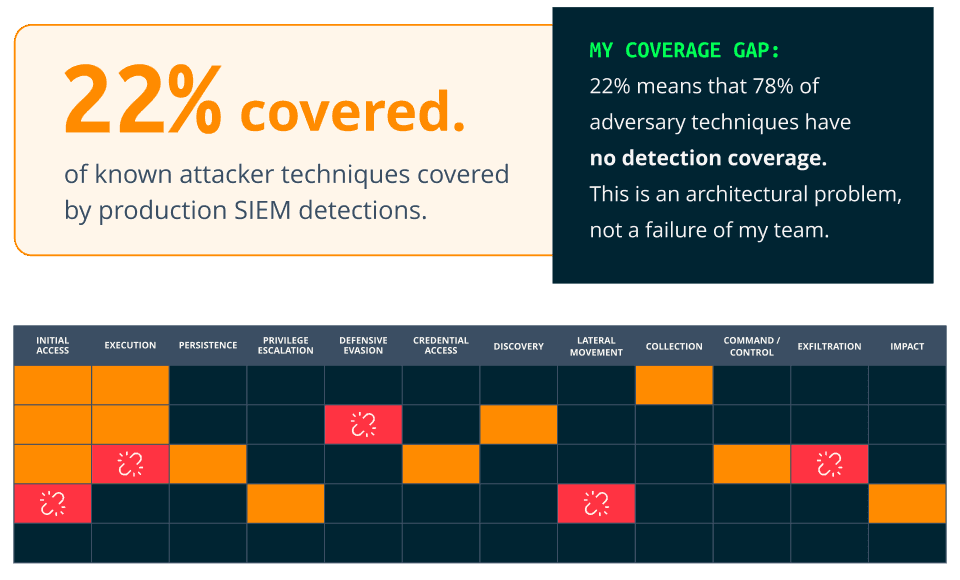
Make coverage a live metric.
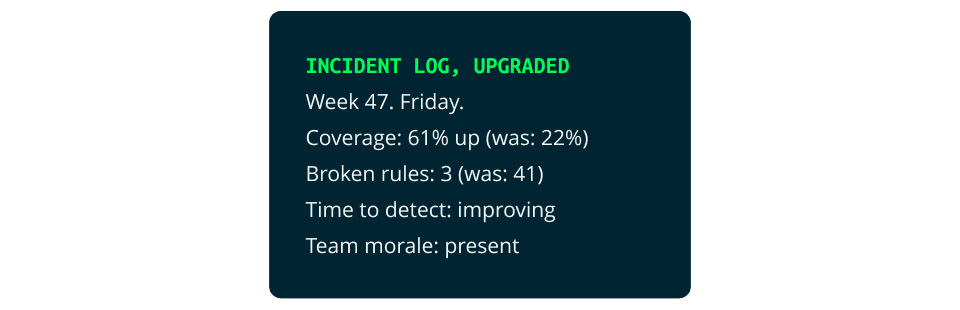
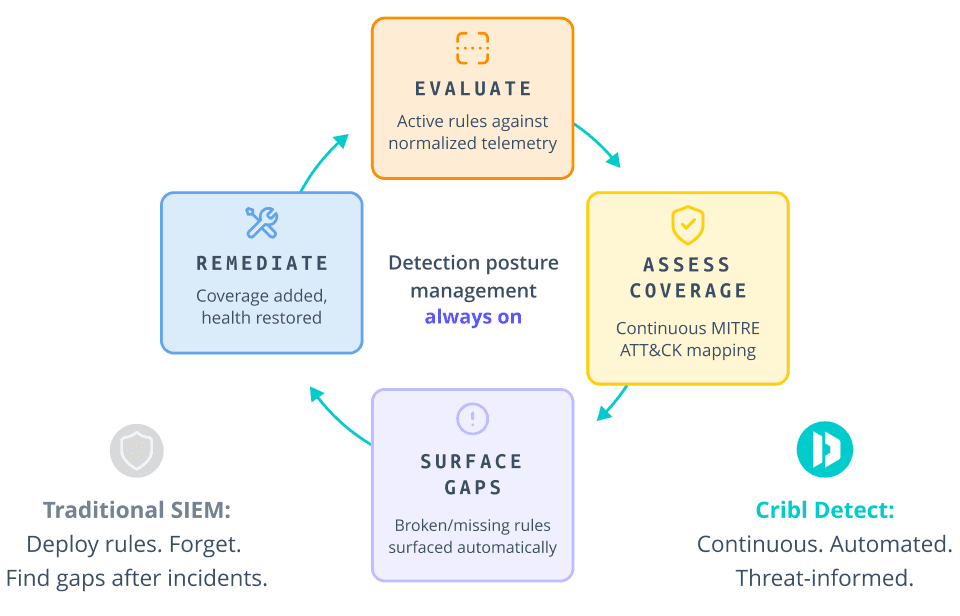
Same SOC Manager. The queue is still there. But now I can see what's in it, why it's there, and what it's not catching. Coverage is a live metric. Broken rules surface before they matter. My analysts investigate real security incidents.
What changed:
I know what I cover. In real time. Not as a one-time audit, as a live metric. When a log source goes offline, coverage drops in the dashboard. Not in the post-incident report three months later.
The flywheel replaced the triage. Evaluate, assess coverage, surface gaps, remediate. That cycle runs continuously. Broken rules surface before they matter. The gap is revealed by the platform, not by an attacker.
My analysts investigate. They don't maintain. Tool overhead is down. The hours that freed up went into actual investigation. The tradeoff moved. 90% ATT&CK coverage is achievable with the data we already collect:1 the difference is a better posture discipline, not more data.
I have metrics that mean something. ATT&CK coverage percentage. Detection health by tactic. Mean time to detect by threat category. Auto-generated. The CISO meeting changed.
AI now does the heavy lifting across telemetry, detections, historical evidence, and context. My analysts stopped constructing every query by hand and started spending that time on judgment calls.
What I can finally do:
Answer "are we covered?" at any point. Not the morning after an incident. (Right now.
Give my analysts an AI partner that surfaces context, connects the signals, and frames the picture.
Prioritize new detections by threat relevance. Not by backlog age. By which gaps actually matter to our threat profile.
Report on progress, not activity. Detection coverage by technique. Health trend over time.
03: Detection Engineer
Data gaps are detection gaps, too.
I write the rules. I've written them for three SIEM platforms across two employers, and the only thing they had in common is that none of the rules transferred. SPL doesn't become KQL. Sigma helps, but it's not native to anything. What I have after ten years in this role is deep, specific, non-transferable expertise in platforms I didn't pick. I know every quirk of the current query language. I know which integrations break after major updates. I know which detections haven't been tested against real adversary behavior since they were written. There's no dashboard that shows any of this. I am the dashboard.
What’s bothering me:
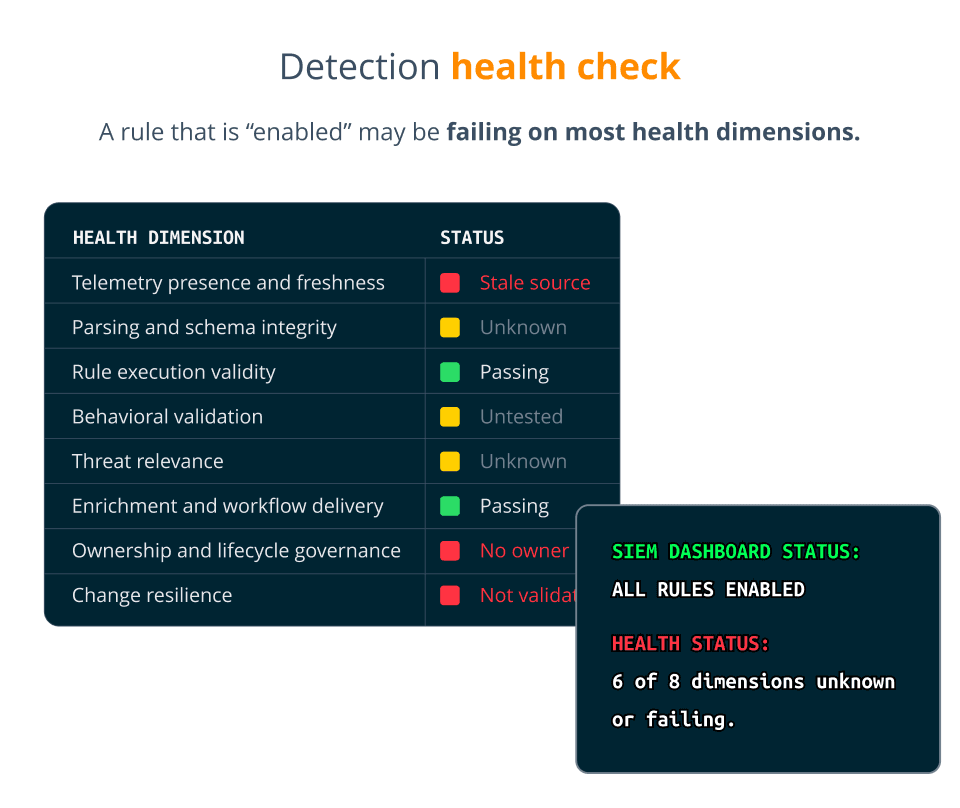
Data and detection posture guesswork. I know which detection rules are enabled. I don't know whether the telemetry those rules depend on is actually flowing, correctly parsed, and in the right place. Those are different questions. My SIEM answers the first one. It has no opinion on the second.
"Enabled" is not a health check. A rule can be simultaneously enabled and failing on telemetry freshness, schema parsing, and behavioral validation. The dashboard shows green. I find out something's broken when something gets through.
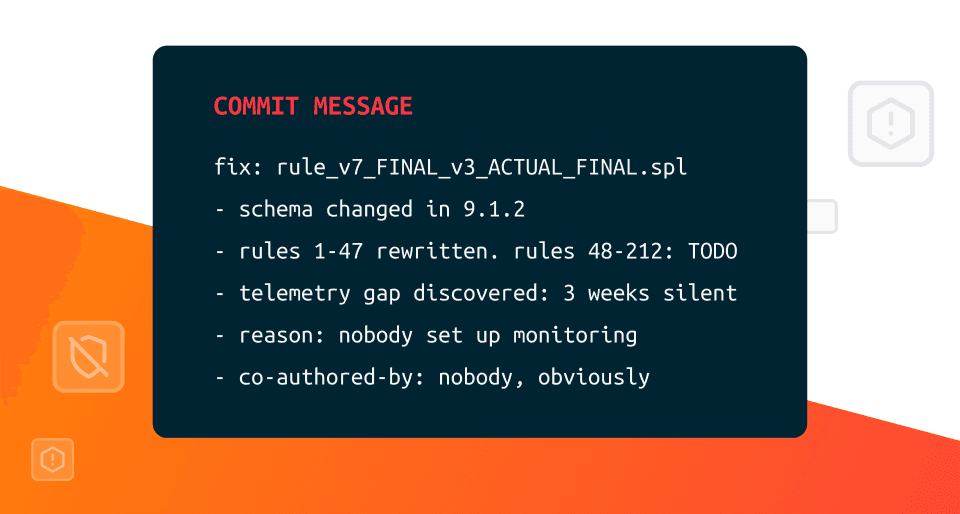
I start from scratch every time. Every SIEM has an out-of-the-box rule library. None of them deploy customized to my environment. I get a template. I configure the naming conventions, point it to the right sources, test it manually, then deploy it. Then find out three weeks later it wasn't firing correctly.
Detection waits for ingestion. It shouldn't. Data routed to cheap storage or dropped at the pipeline level takes the detection opportunity with it. By the time that decision gets made, the signal is already gone.
What I’m actually trying to do
See both sides of coverage gaps. Not just enabled rules, but whether the telemetry those rules depend on is present, correctly structured, and in the right place.
Start from working rules, not templates. Pre-configured to my environment. Tested before deployment. Not a starting point I have to rebuild from.
Know when a rule stops working. Before an attacker exploits the gap. Not after.
Detect before the data lands. Not every detection needs to wait for ingestion. Some of it should happen in the pipeline.
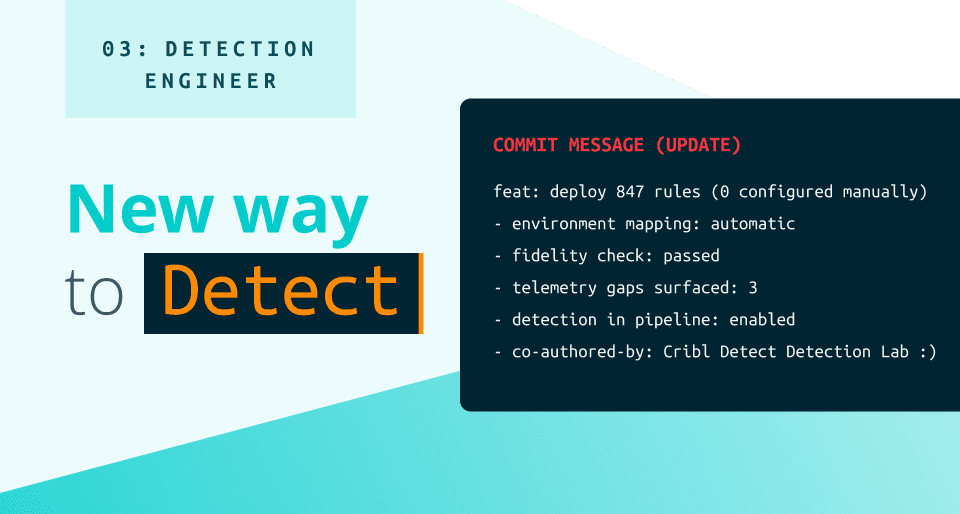
Rules that know your environment.
Same Detection Engineer. Same discipline. Different relationship with the work. What I write now is mine, not the platform's. The schema question is solved before I write a single line of logic. The health of what I deploy is monitored continuously, not discovered post-incident. I finally have time for the interesting work, like reading threat research and turning it into detections, threat hunting through historical telemetry, and focusing on AI projects.
What changed:
I can see both sides of the coverage gap now. Detection posture shows me where rules are missing. Data posture shows me whether the telemetry those rules need is actually flowing. One view, both problems. That combination is what's new.
8,000 rules. None of them need configuring. When a rule deploys, it already knows my environment: naming conventions, data sources, field mappings. It's tested for fidelity before it goes live. If a prerequisite is missing, it won't deploy silently broken. It tells me why and waits.
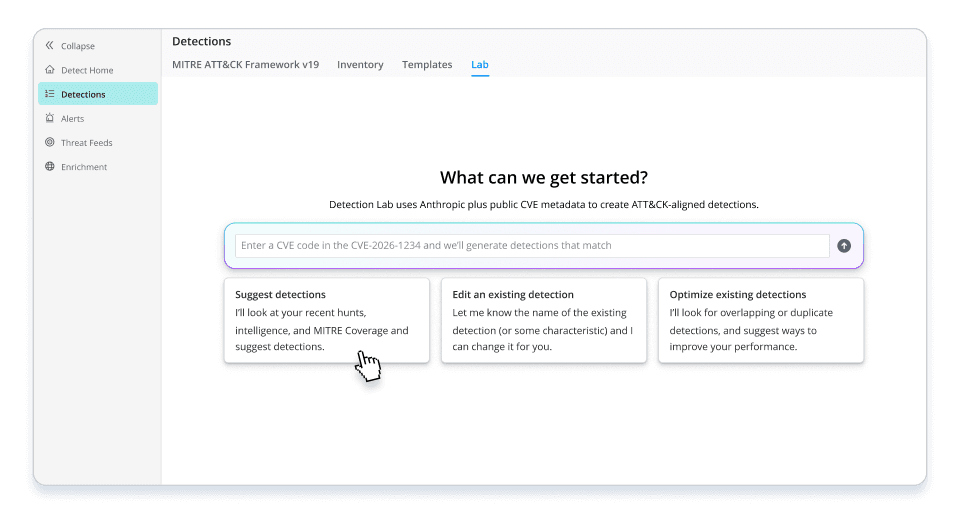
I have an AI co-pilot that knows my environment. Detection Lab generates new detections in plain English, tunes existing ones, and validates them against my actual telemetry. Not a generic suggestion. An environment-aware one.
Detection happens in the pipeline. I run detection logic on data as it moves, before it reaches any storage destination. The routing decision and the detection decision are the same conversation now. Data that goes to cold storage can still generate a signal.
What I can finally do:
Close gaps on both sides. See where detection coverage is missing and where the data that would support it is absent or misrouted. Fix both from the same place.
Generate new detections in minutes. (Human language in, working, environment-aware KQL out. Validated before deployment. Detection Lab handles the iteration I used to do manually.
Deploy rules that work on day one. Not rules I configure, test, and hope. Rules that are pre-customized, fidelity-tested, and deployment-ready before they go live.
Catch threats before they hit storage. In-stream signals before storage, even on data that gets routed elsewhere. The detection opportunity doesn't disappear because the data did.
Conclusion
The relationship between security teams and their SIEM was never supposed to be this hard.
The CISO shouldn't be explaining budget overruns caused by a software update. The SOC Manager shouldn't
be measuring success in ticket counts. The Detection Engineer shouldn't have to guess whether the telemetry their rules actually depend on is streaming in.
The frustrations are real. So is the way out: it starts with a new way to SIEM.
Cribl Detect™ keeps what every security team actually needs: visibility, detection, and investigation at scale.
And removes everything that turned a security tool into a maintenance burden.
It's time to update your relationship status.

Download the Cribl Detect datasheet and solution brief
CardinalOps 5th Annual State of SIEM Detection Risk, 2025, cribl.io/resources/rpt/cardinalops-state-of-siem-detection-risk/
ENISA NIS Investments 2025, enisa.europa.eu/publications/nis-investments-2025
Yale New Haven Health, Cribl case study, https://cribl.io/resources/cs/yale-new-haven-health/
SANS 2026 SOC Survey, https://www.sans.org/white-papers/2026-sans-soc-survey-insights-decade-evolution-cyber-defense
Unit 42 / Palo Alto Networks, https://unit42.paloaltonetworks.com/detection-beyond-the-endpoint/