
The next challenge in AI governance
Public sector organizations are rapidly developing AI governance programs.
Policies are being drafted. Governance boards are being established. Risk management frameworks are being updated. Agencies are evaluating how to adopt AI while maintaining security, privacy, and public trust.
These efforts are essential.
But as AI adoption accelerates, agencies face a more fundamental question:
How do you demonstrate that AI is being governed effectively?
In regulated environments, governance is not defined solely by the policies that exist. It is defined by an organization's ability to show that those policies are working.
As AI becomes increasingly integrated into mission systems, operational workflows, and decision-making processes, agencies will need more than governance frameworks. They will need evidence.
Governance is no longer a point-in-time activity
Historically, governance has relied on periodic assessments. Organizations conducted annual reviews, completed compliance assessments, documented controls, and performed audits to evaluate whether systems were operating as intended.
These approaches remain important, but AI introduces a different operating model. Models evolve,data sources change,prompts are modified, and agents take action.
New AI capabilities can be introduced into workflows far faster than traditional governance processes were designed to accommodate. A system reviewed six months ago may operate very differently today.
As AI adoption increases, governance can no longer depend solely on periodic checkpoints. Agencies need continuous visibility into how AI systems are being used and how risks evolve over time.
The rise of unapproved AI
Many organizations have already encountered a familiar challenge: technology adoption that occurs faster than governance processes can keep pace. AI is only accelerating this dynamic.
Employees may use public AI tools to support daily work. Developers may integrate foundation models into applications. Business units may deploy AI-enabled capabilities without centralized awareness.
The challenge is not simply whether AI is being adopted. The challenge is whether organizations have visibility into where AI is being used, what data is being shared, what decisions are being influenced, and what risks may be emerging.
Without that visibility, governance programs operate with incomplete information. And governance decisions made without complete information often create blind spots.
Accountability requires visibility
Public trust depends on accountability. Accountability depends on evidence. Evidence depends on visibility.
As AI systems become more capable and autonomous, organizations must be able to answer fundamental questions:
Which AI systems are being used?
What data do they access?
What outputs are they generating?
Which decisions are they influencing?
What actions are they taking?
Who is responsible for oversight?
How are policies being enforced?
These are governance questions. They are also observability questions.
Without operational visibility into AI activity, agencies may struggle to demonstrate compliance, support audits, investigate incidents, or validate that governance controls are functioning as intended.
From continuous monitoring to continuous assurance
Federal cybersecurity programs have long recognized that annual assessments alone cannot provide sufficient assurance in dynamic environments. Cloud adoption accelerated the shift toward continuous monitoring, ongoing assessment, and risk-based decision-making. AI introduces a similar challenge.
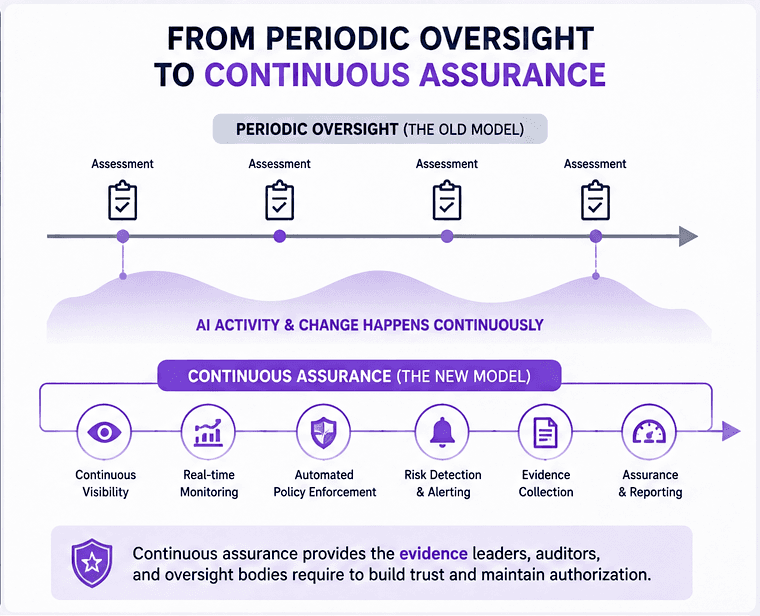
As AI systems continuously evolve, governance programs must evolve as well. Leading organizations will increasingly move toward a model of continuous assurance that includes:
Continuous monitoring of AI activity
Automated policy validation
Real-time risk detection
AI usage analytics
Agent activity monitoring
Governance dashboards
Continuous evidence collection for audits and compliance reviews
This approach enables organizations to move beyond periodic governance reviews and toward continuous confidence in how AI systems are operating.
Mission risk is more than a security problem
When discussing AI governance, security risks often receive the most attention. But, they are not the only risks that matter. AI can also introduce mission risks through:
Inaccurate recommendations
Biased outputs
Unauthorized decision-making
Incomplete or outdated data sources
Degraded model performance
Unintended operational consequences
In mission-critical environments, these risks may have consequences that extend well beyond cybersecurity. This means effective governance requires visibility into both security outcomes and mission outcomes. Organizations cannot manage risks they cannot observe.
Governance requires defensible evidence
Every governance program ultimately faces the same test: Can it produce evidence? Auditors, oversight organizations, risk executives, privacy officers, and authorizing officials increasingly require more than policy documentation. They require demonstrable proof that controls are operating effectively and that risks are being managed appropriately.
Organizations must be able to show:
How AI systems are being used
What controls are in place
Whether those controls are functioning
Where exceptions occur
How risks are identified and addressed
This level of assurance cannot be achieved through documentation alone. It requires operational evidence generated through continuous visibility.
The future of AI governance
The future of AI governance will not be defined by the number of policies an organization publishes. It will be defined by its ability to continuously demonstrate that AI systems are operating securely, responsibly, and as intended.
As AI becomes increasingly embedded in public sector missions, governance, security, compliance, and observability, systems will become more tightly connected than ever before.
Because governance is ultimately an exercise in accountability. Accountability requires evidence. Evidence requires visibility. And visibility is what transforms AI governance from a framework on paper into a capability that organizations can trust.
To learn more about how Cribl is supporting public sector organizations, reach out to your account team directly or contact us here!