
The cybersecurity environment facing European banks is changing faster than many traditional control cycles were designed to handle.
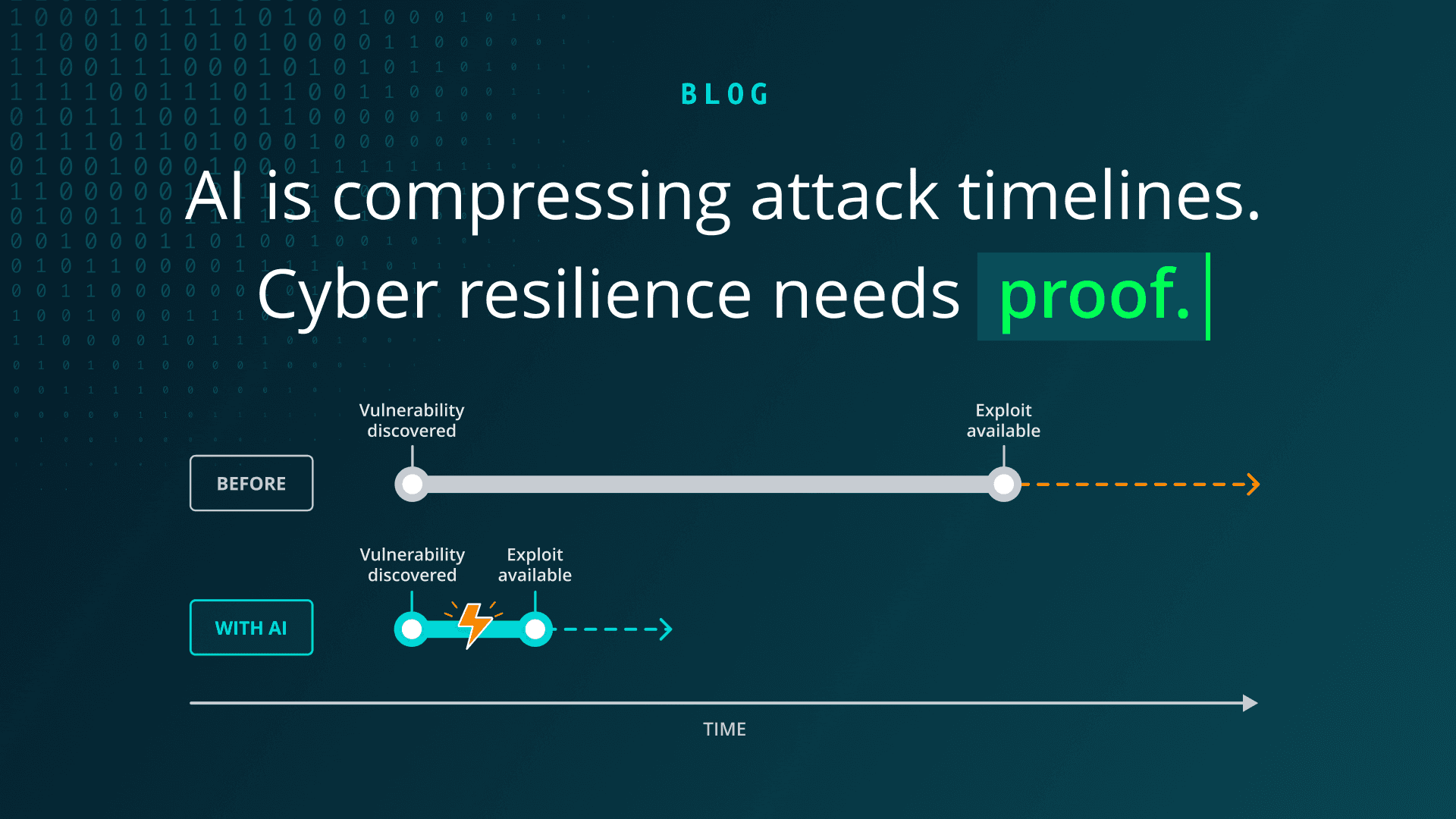
In its letter, Addressing AI-enabled cybersecurity threats, the European Central Bank warns that emerging AI models can identify software vulnerabilities and generate functioning exploits at unprecedented speed. That shortens the interval between discovering vulnerabilities and exploiting them — and puts a higher priority on visibility, response, and operational resilience.
The ECB asks significant institutions to assess this threat landscape without delay and submit an action plan to their Joint Supervisory Team by 31 October 2026. The letter does not prescribe a particular security product, asking for outcomes instead: protection of exposed assets, faster risk-based remediation, stronger monitoring, effective third-party oversight, modernised defence-in-depth, and credible response and recovery.
For banks, the question is not simply, “Do we have the right tools?” It is: “Can we see, connect, investigate, and prove that our controls are working across the entire technology estate?”
That is where Cribl can help.
The data layer beneath security and resilience controls
Banks operate a complex mix of security, IT, cloud, observability, and resilience tools. The evidence those tools need is often fragmented across legacy platforms, cloud services, endpoints, identity systems, networks, applications, and third-party providers.
Cribl provides a vendor-neutral telemetry layer across that environment. Instead of funneling every log into one rigid target, it allows financial institutions to collect, refine, and route security data to whichever tools make the most sense, preserving architectural flexibility. And it does so without tying the bank’s data strategy to one analytics vendor.
Cribl is not a patch-management platform, backup system, or crisis-management solution. It is the data-and-evidence foundation that makes those processes more observable, adaptable, and defensible.
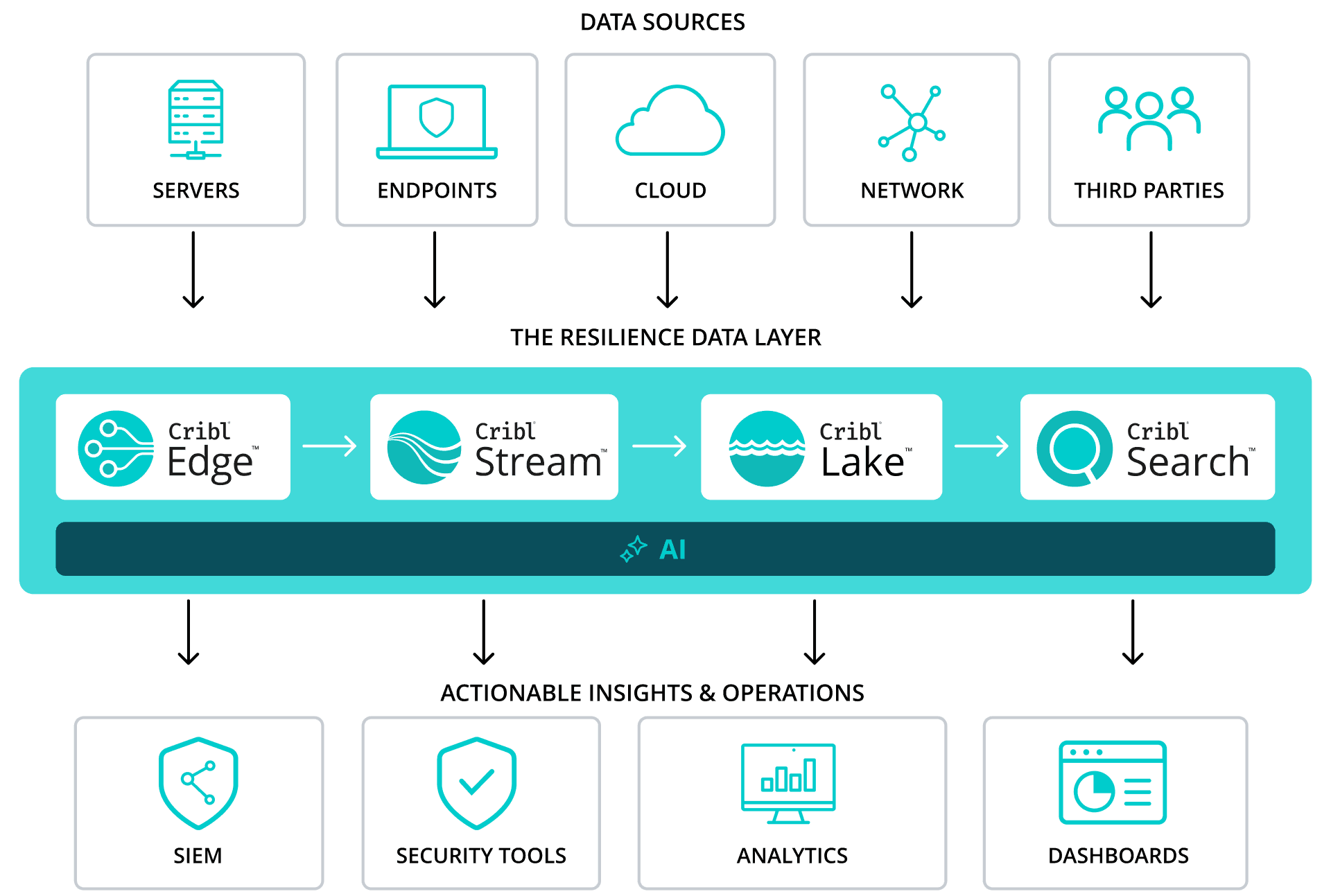
Figure 1: The resilience data layer sits across — not inside — existing tools, collecting from any source (Cribl Edge), routing and shaping in flight (Cribl Stream), retaining full-fidelity data (Cribl Lake), and enabling federated investigation (Cribl Search), with governed AI-ready data spanning the fabric.
How Cribl supports the ECB’s six focus areas
The table below summarises how each ECB focus area aligns to a telemetry outcome and the Cribl capabilities that support it.
1. Protect the attack surface
The ECB highlights the need to identify ICT assets (including third-party software and open-source components) and continuously monitor internet-facing systems, cloud environments, and third-party VPN connections.
Cribl provides a data foundation that collects telemetry from servers, endpoints, containers, cloud services, network infrastructure, and third-party platforms into a consistent control plane. This gives security and risk teams a more complete view of hybrid estates, including legacy and externally exposed systems.
Telemetry can be filtered, enriched, routed, and reduced according to its value, while full-fidelity copies are retained for investigations and evidence. Banks can expand coverage without sending every event to every downstream tool.
2. Accelerate vulnerability and patch management
The ECB expects banks to prepare for faster and higher-volume vulnerability discovery and patching, supported by risk-based prioritisation and stable change processes.
Cribl does not identify or remediate vulnerabilities itself. It connects the data required to make those activities more effective. Asset telemetry, scan results, configuration data, change records, and exposure context can be normalised and enriched before being routed to remediation tools.
When new detection requirements emerge, pipelines can be adapted quickly to add fields, sources, or routing logic. This builds a stronger evidence base to support prioritising fixes across internet-facing and critical internal systems.
3. Strengthen monitoring, detection, and AI-enabled defence
The ECB calls for stronger monitoring of application and access logs, network traffic, and other threat indicators across internet-facing applications, cloud repositories, and critical internal systems.
Cribl brings together endpoint, identity, cloud, application, and network telemetry while preserving investigative context. Cribl Search supports federated, retrospective investigations across data stored in different locations and over longer time horizons, without first re-ingesting every dataset into a central platform.
Cribl can also deliver governed, AI-ready telemetry to SIEM and security analytics tools. Data lineage, filtering, enrichment, and access policies help maintain human oversight and defensible decisions.
4. Improve governance and supply-chain assurance
The ECB makes clear that banks remain accountable for risks arising from outsourced ICT services and need assurance that third parties can respond to accelerated vulnerability disclosure and patching requirements.
Cribl helps onboard and tag third-party telemetry alongside internal data, giving teams a consistent view of provider activity, service performance, and security-relevant events. Within contractual and privacy boundaries, banks can maintain independent records of third-party behaviour and critical dependencies.
This turns fragmented exports and provider-specific feeds into a governed evidence layer for boards, risk teams, security functions, and auditors.
5. Reinforce defence-in-depth and modernise legacy environments
The ECB emphasises segmentation, zero-trust principles, strong access controls, comprehensive logging, and the modernisation of unsupported or end-of-life technology.
Replacing legacy technology is not always immediate. Where replacement must be phased, comprehensive telemetry can provide a necessary layer of oversight by making those systems visible to security and monitoring processes.
Cribl collects and routes telemetry without requiring every legacy source to be re-engineered at once. Separating data collection from downstream destinations also supports modernising the analytics infrastructure without re-plumbing every source.
6. Make operational resilience and information sharing testable
The ECB calls for regularly tested incident response, crisis management, backup, failover, restoration, and recovery arrangements, together with secure information sharing.
Cribl Lake provides open-format, lower-cost retention for queryable, full-fidelity telemetry over longer periods. This can help institutions reconstruct incident timelines and assess impact even after evidence is no longer retained in high-cost operational systems.
Historical datasets can support resilience exercises and incident simulations. Replaying representative telemetry lets teams test workflows against scenarios such as ransomware, destructive attacks, zero-day exploitation, or cloud-service disruption. Cribl can detect PII and extract, enrich, and sanitise telemetry before external sharing.
From an action plan to an evidence plan
The ECB’s letter is a call to action and a call for evidence. A bank’s plan will be stronger when it can demonstrate not only which controls exist, but how the institution knows those controls operate across its technology estate.
A practical approach is to treat telemetry as a resilience capability:
Establish visibility across internet-facing, cloud, on-premises, and third-party assets.
Connect asset, vulnerability, configuration, change, identity, application, network, and access data.
Route fit-for-purpose data to detection, remediation, and oversight tools.
Retain full-fidelity evidence in an open, cost-conscious format.
Enable federated search and replay across time horizons and data locations.
Apply governance, lineage, and sanitisation before sensitive information is shared.
Cribl supports this model as a layer across the existing stack. It does not require a bank to replace every security or resilience tool. It helps make the data behind those tools more available, usable, and easier to prove.
Resilience must be observable, testable, and provable
AI-enabled threats are compressing the time available to discover, prioritise, investigate, and respond to cyber risk. Resilience cannot depend on isolated systems, incomplete asset knowledge, or evidence available only after a lengthy manual exercise.
The banks best positioned to respond will turn distributed telemetry into a shared operational picture and turn that picture into evidence for security teams, technology leaders, management bodies, auditors, and supervisors.
The ECB has set the direction: act now, strengthen the controls that matter most, and make the action plan concrete. Cribl can help provide the data foundation beneath that plan, so cyber resilience is observable, testable, and provable.
Sources
This article is intended for general informational purposes and does not constitute legal, regulatory, or supervisory advice. Banks should assess the ECB letter and their obligations with their own legal, compliance, risk, and supervisory stakeholders.