

The last two years of AI progress have largely been a story of scale. LLMs are larger than ever and are generating more and more reasoning tokens in pursuit of the intelligence frontier. TypeSafe's newly released model, Jev, inverts that trade.
In fact, Jev isn't an LLM at all, but a System One architecture that skips sequential token generation entirely, emitting typed, calibrated decisions. This makes Jev relevant for the telemetry and observability world, where every event is a routing, enrichment, or triage decision made millions of times a day.
Take a common telemetry use case: routing events by log type. Log type is the driver for many operations in a telemetry pipeline: it selects the parser, determines the destination, and drives downstream enrichment. Getting the log type wrong means everything downstream breaks. LLMs are perfectly capable classifiers, but cost and latency make them impractical for classifying millions of log events every minute. Purpose-built classifiers solve the economics but introduce problems elsewhere: curating training datasets, retraining as formats drift, and a long tail of vendor-specific edge cases nobody has labeled. In theory, this is where System One models shine: providing a middle ground between the intelligence of an LLM and the efficiency of a bespoke classifier.
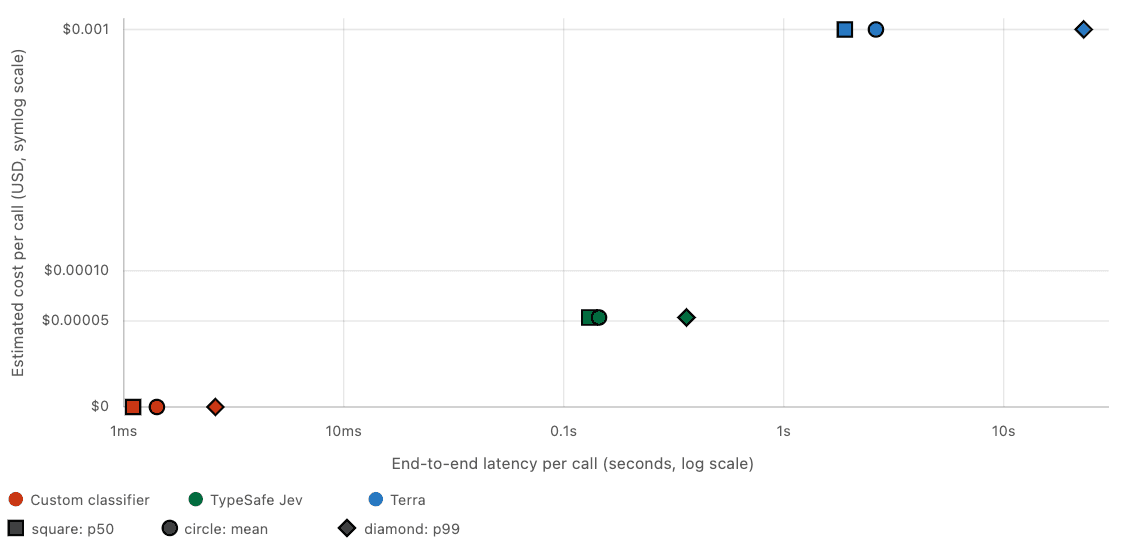
While we are excited about the unit economics and low overhead, our initial experiments have shown there is still a sizable accuracy gap on use cases involving semi-structured log data. When tasked with classifying logs into 1 of 28 common logtypes (e.g. syslog, Cisco ASA, auditd), Jev still misclassifies events 2-3x more frequently than a purpose-built classifier or GPT-5.6 Terra.
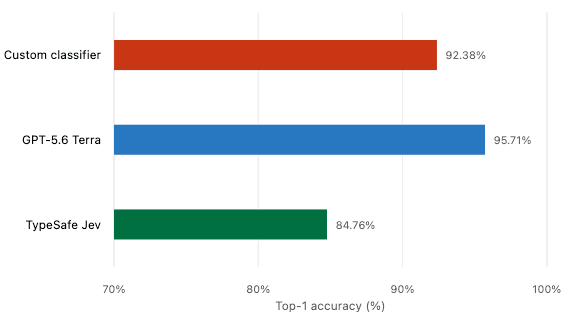
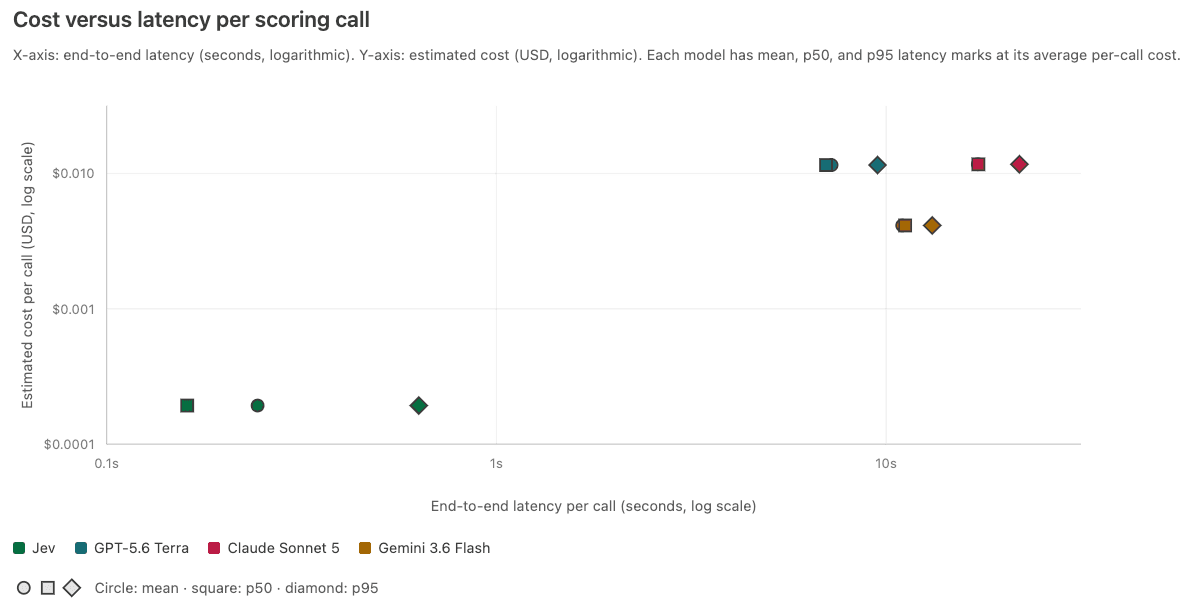
Jev’s most common failure mode is putting known logtypes into an “other” bucket, something we included in this task to simulate out-of-domain data. Jev was easily able to outshine Terra on both speed and cost, having 18x faster inference and 20x lower cost per prediction on this task. Part of the poor performance we believe can be attributed to the structure of this task in particular. Specifically, we asked these models to pick the likeliest option among 28 choices. Our classier is purpose-built for this scenario and Terra is an incredibly capable model across an innumerable number of tasks; Jev simply is not designed for this. In most cases, there will likely not be 28 possible options and Jev is more than capable of performing as well as frontier models in those cases.
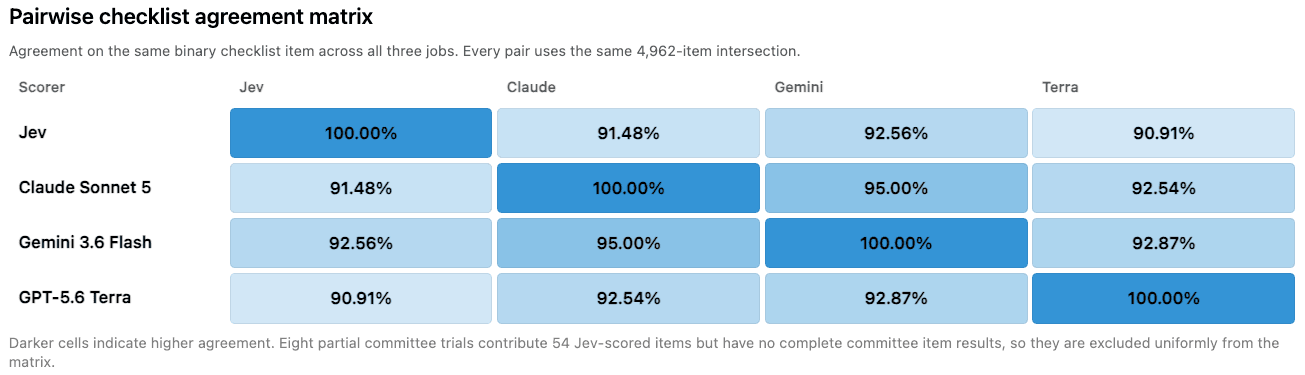
Another challenge we encounter daily on the AI Research team at Cribl is grading AI agent responses. Agent responses are long, nuanced, and rarely reducible to a deterministic scorer, so we decided on LLM-as-judge. It works, but it's a reasoning model doing a classification job. We pay frontier prices and wait on frontier latency to answer what amounts to a bounded question. Jev held >92% agreement with our committee of LLM judges at roughly 1% the cost.
While identifying logtype and scoring an agent response are small decisions in isolation, they represent a problem space that is underserved in the broader ecosystem. Specifically, in systems where you need bounded, high-volume, and accurate judgments where the right answer is one of a known set, the constraint has never been intelligence but the cost of applying it. System One models don't make those decisions smarter, they make them cheap enough to make everywhere, which turns out to be the more useful property.
Once a typed decision costs effectively nothing, the list of places to put one grows fast: parser selection, PII detection, alert triage, schema inference. We're evaluating that list now, and actively exploring methods to bring the domain expertise needed to this new class of models.
And if this is the kind of problem you like working on, we’re hiring. Come help us figure out how to build, test, and evaluate AI for real-world IT and security work.