
What is tiered storage and why do you need it?
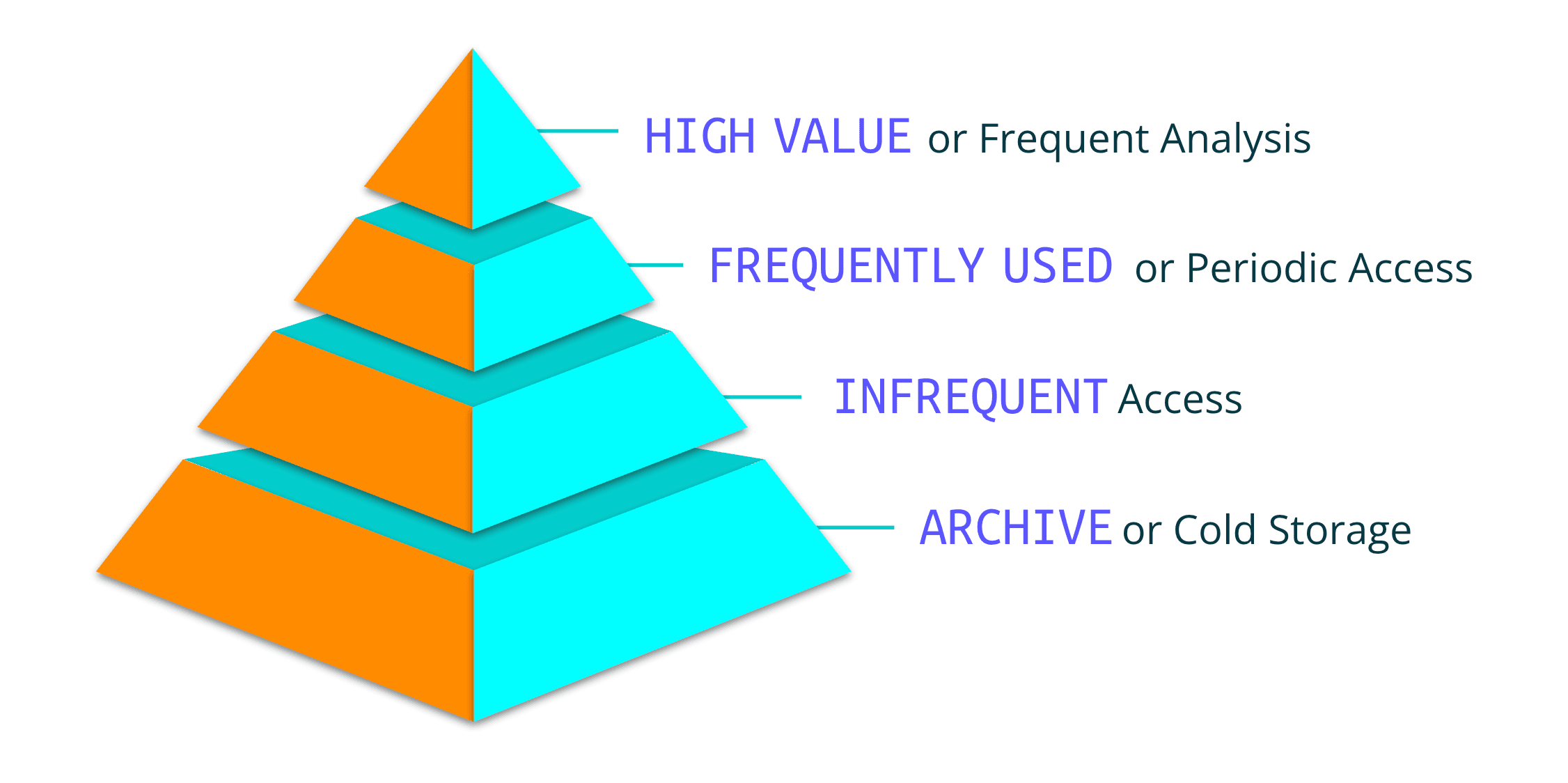
Tiered storage assigns data to different storage classes based on its value, usage, and access requirements. To see why that matters, think about the three Vs of telemetry: volume, variety, and value.
Data varies wildly in type, format, and structure, and it should be treated accordingly. That is not only a security or governance concern. It is a practical foundation for your data strategy this year and beyond.
Data also varies in value. For real-time alerting, its worth can evaporate in minutes. For compliance and incident investigation, it may only become valuable months or years from now. The key is to identify your data types and their potential value, then match each one to the right storage class for your IT and security teams.
Why do data needs vary across teams?
The value of data depends on who needs it and when. If you are on the SecOps team, you need real-time data to alert you to trouble. Data that is hours old is useless when you are responding to an active event. If you are in ITOps, hours, days, months, or years of history might be exactly what you need for trend analysis or compliance.
Data value is a function of age, accessibility, volume, and who is interacting with it. Some low-volume, real-time data that nobody looks at today can become critical evidence a month from now.
And the scale of the challenge keeps growing. Telemetry data is expanding at roughly 29% per year, which means it effectively doubles every 18 months, according to Cribl's analysis of industry data (Cribl, 2025). Budgets are not doubling every 18 months. That gap is the whole reason tiered storage exists, and it is why data tiering has become critical for security and observability teams.
And now a message from your sponsor
Cribl, built on the Data Engine for IT and Security, helps organizations change their data strategy. Cribl's suite of products is a vendor-agnostic data management solution that collects data from any source, processes billions of events per second, routes data to optimized storage, and analyzes data in place. With Cribl, IT and security teams get the choice, control, and flexibility to adapt as data needs shift. Cribl's offerings beyond Lake, including Cribl Stream for real-time pipelines, Cribl Edge for collection at the source, and Cribl Search for federated search-in-place, are available as discrete products or as a combined solution.
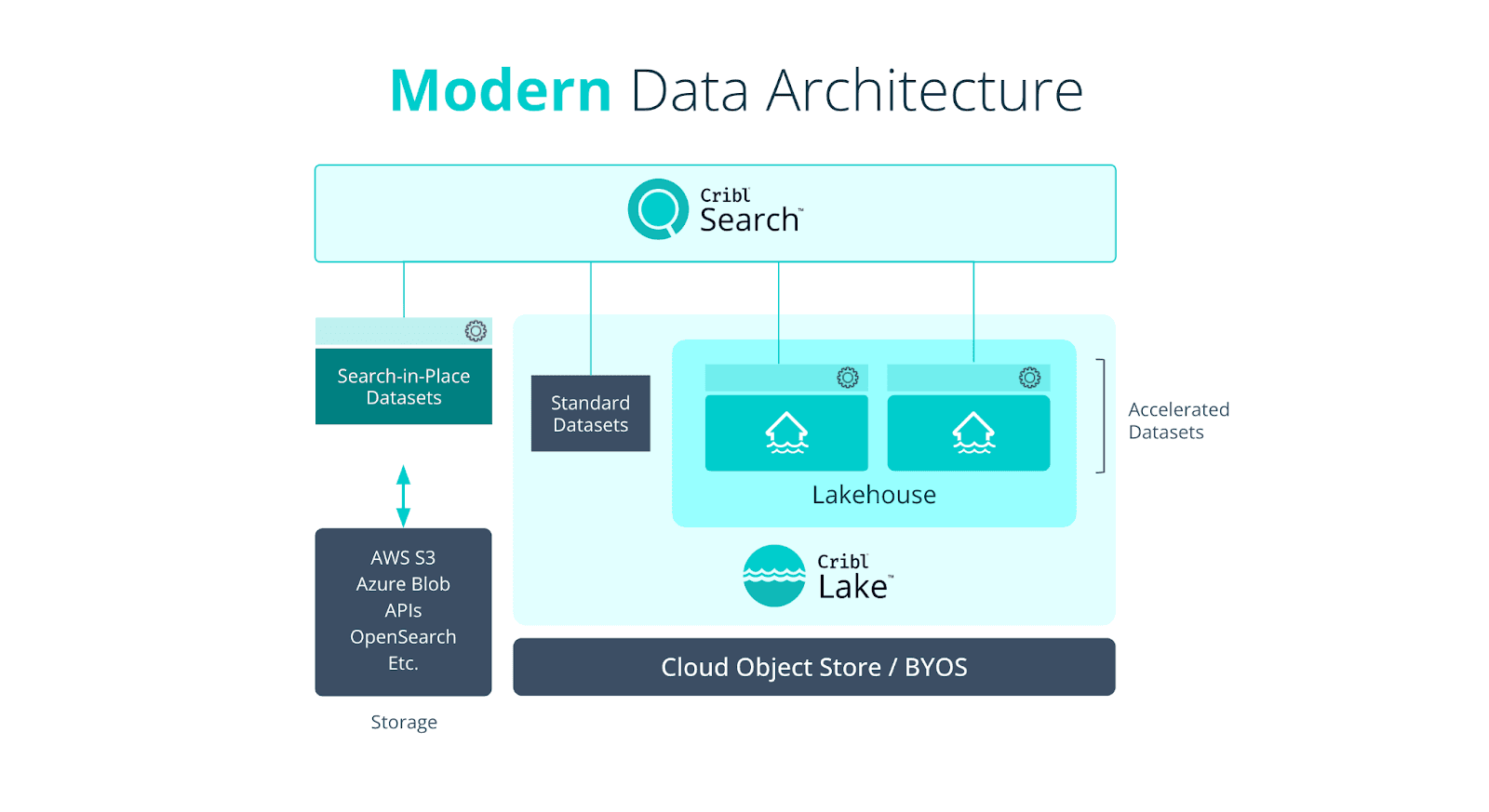
How does tiered data management work?
Tiered data management balances cost against complexity. As organizations wrestle with mounting IT and security data, many have adopted strategies that move data into storage based on timeliness: operational use cases in one place, exploratory work in another, with regulatory and compliance retention accounted for along the way. This approach blends legacy tools, cloud data warehouses, lakehouses, and data lakes to store and analyze data according to its value, usage patterns, and retention requirements. There is no single answer that fits every case.
Cribl's data engine provides automated, flexible data tiering, so where data lives lines up with how it is valued and used. Performance-optimized data flows to your analytics, monitoring, and cybersecurity tools in the form each platform expects.
Maintaining full-fidelity datasets matters as much as cost-optimized storage does. Full-fidelity data is often required for exploratory work and compliance, and tiering puts it in the right location for its intended use. Coupled with the distributed access and governance built into the data engine, every tier remains reachable no matter where the data sits.
Why consider a tiered data structure?
If you are still dumping everything into your SIEM, your budget is going to bust if it has not already. If you are filtering or sampling data to fit a license limit, you probably suspect you are missing something important. And if you are pushing SIEM overflow into cold storage to save money, you already know rehydrating that data is a real pain.
Any of those sound familiar? Then it is time for a tiered data strategy. Start with one question: where does your full-fidelity data go? Run it through a pipeline first for better management and cost control, so only critical, actionable data reaches your SIEM or system of analysis. Then structure everything else by usage and value.
Infrequently accessed data needs an archive with real-time visibility and access, minus the rehydration delays. Needle-in-the-haystack searches need high-speed, columnar storage that powers analytics, dashboards, and real-time queries. Audit and reporting data needs affordable, retrievable storage. That is what Lakehouse delivers: a storage architecture built for telemetry data management over the next decade, whether you use Cribl's products or someone else's.
Lakehouse pairs a high-speed query engine with the cost savings of object storage, so your team gets instant queries without vendor lock-in or unnecessary storage costs. By routing and storing data in the optimal format, it can reduce costs by 50% compared to traditional solutions (Cribl, 2025). Queries automatically target the fastest available source, and full-fidelity data stays in Cribl Lake for Replay whenever you need it.
What are the five reasons to implement a tiered data strategy?
Store data based on value, usage, and access needs. Route high-value, frequently accessed data to performance-optimized tiers for real-time analytics. Keep less critical or exploratory data in cost-effective storage. You cut costs and keep data available.
Use open formats to unify data. Consolidate fragmented data into a single source of truth across tiers, so analysis runs without unnecessary duplication or movement between systems.
Prioritize flexible and scalable data analysis. Combine on-demand compute with cost-effective storage to analyze large volumes without endlessly expanding infrastructure.
Use cost-effective storage to meet compliance and audit requirements. Store full-fidelity data in low-cost object storage for long-term retention, then retrieve and replay it as audits and investigations arise.
Reduce tool proliferation and complexity. Consolidate security and observability platforms to reduce reliance on specialized tools, minimize skill set fragmentation, and simplify the data lifecycle.
Stop letting your SIEM license decide what data you keep
Cribl provides tools to manage and analyze telemetry with no lock-in, no data loss, and no added agents. Half of the Fortune 100 already rely on it. Cribl is a central hub that reduces data volume and complexity, cuts costs, supports SIEM migrations, and supports compliance without disrupting the systems you already run.
Each product covers one layer of a tiered storage strategy. Stream handles real-time processing and routing, so only actionable data reaches your SIEM. Edge collects at the source. Search runs federated queries across every tier without moving or rehydrating data. Lake, with Lakehouse, provides tiered data lake storage that aligns cost with value automatically.
Because Cribl separates compute from storage and keeps data in open formats, you can onboard new tools, migrate platforms, or promote historical data into a fast tier without lock-in or data loss. Every byte stays accessible, whether it is powering a real-time dashboard today or an audit two years from now.
Pick a starting point from the list above, spin up a free Cribl.Cloud account or a sandbox, and turn your raw telemetry into actionable intelligence.
Tiered Storage: A Data Strategy FAQs
What is tiered data storage?
Tiered data storage is a strategy that places data in different storage classes based on its value, usage patterns, and access needs. High-value, frequently accessed data is stored in performance tiers for real-time analytics, while less critical or infrequently accessed data is kept in cost-effective object storage.
Why do I need a tiered data strategy for telemetry?
Telemetry data is growing approximately 29% per year, which doubles data volume about every 18 months. Sending everything to your SIEM is unsustainable, and moving aged data to cold storage makes retrieval difficult. Tiering aligns storage cost with data value, so you keep visibility without exceeding your budget.
What is Cribl Lakehouse?
Cribl Lakehouse is a feature of Cribl Lake designed for telemetry data. It has a high-speed query engine and uses object storage to reduce costs. It supports fast searches on recent data, automates tiered storage, and manages data without a fixed schema or vendor lock-in.
How is Cribl Lake different from traditional cold storage?
Traditional cold storage is cheap but slow, and rehydrating data for an investigation takes time. Cribl Lake keeps full-fidelity data accessible and searchable across tiers, so you can investigate archived data without rehydration delays. With Lakehouse acceleration, queries target the fastest available source.
How do I decide which data goes in which tier?
Start with Volume, Variety, and Value. Route critical, frequently accessed data to performance tiers for real-time alerting and dashboards. Keep exploratory, compliance, and audit data in low-cost storage where it remains retrievable and can be replayed for audits or investigations.
How can I get started with Cribl Lakehouse?
Existing Cribl.Cloud users can enable Lakehouse acceleration on a Cribl Lake dataset with a few clicks. New users can sign up for a free Cribl.Cloud account, explore the Cribl Lake Sandbox, or take free training through Cribl University.